
The Time Traveller's Dossier: The Archive of the Immortal Flame – The 1968 Zippo "7 Beautiful Ways" Advertisement
The History
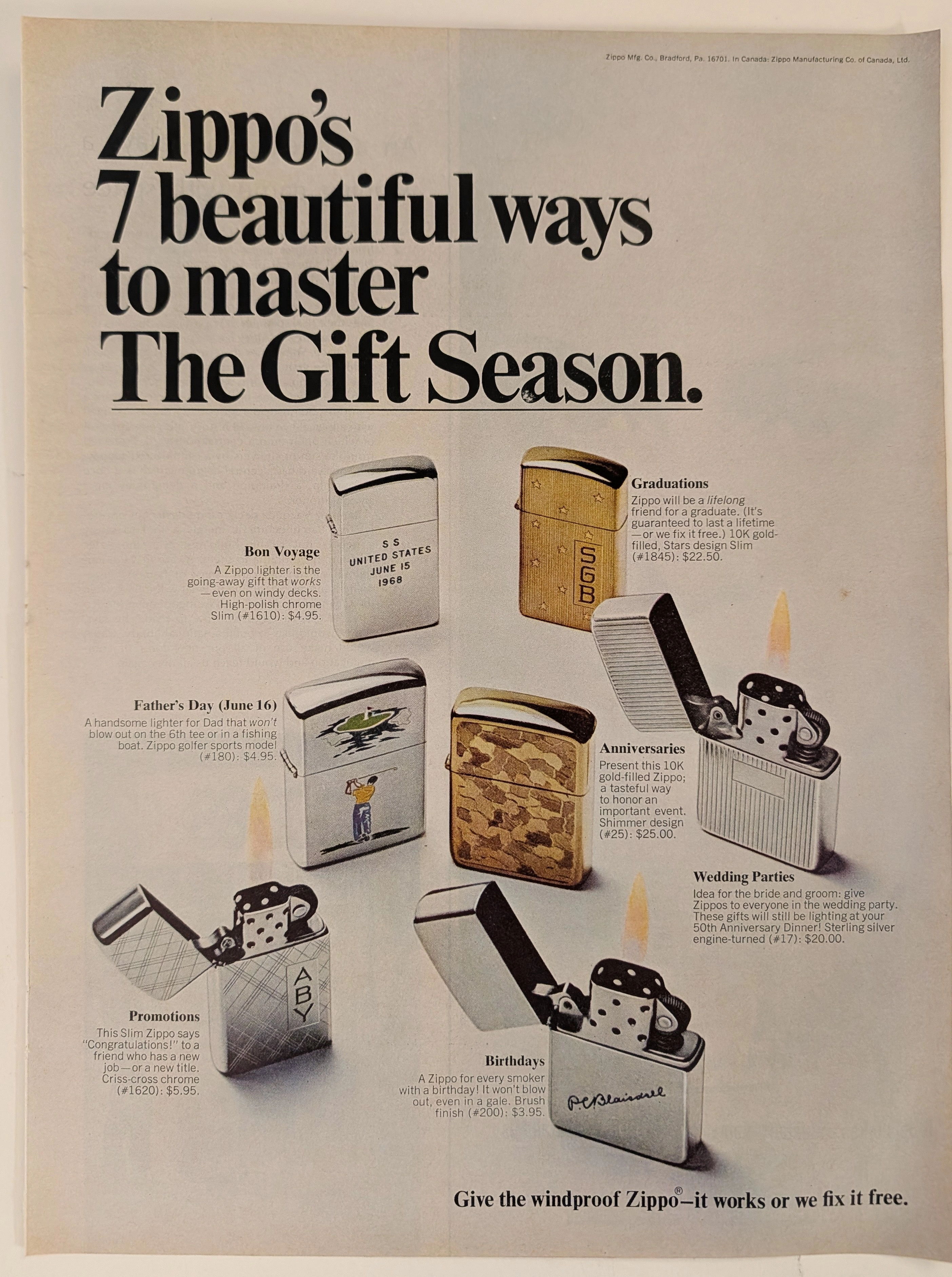
To fully appreciate the immense historical gravity of this artifact, it is essential to contextualize the year 1968. During a period when the United States was experiencing profound social unrest, protests, and the complexities of the Vietnam War, Zippo gracefully projected an image of absolute stability, success, and composed celebration. This represents a highly sophisticated psychological positioning. Zippo, universally recognized as the essential "survival tool" carried by American soldiers on the battlefield, was seamlessly elevated and recontextualized into a sophisticated "status symbol" for the middle and upper classes during times of peace.
The 7 Pillars of Gift-Giving: This advertisement masterfully segments the consumer market by presenting seven distinct models for seven specific life milestones:
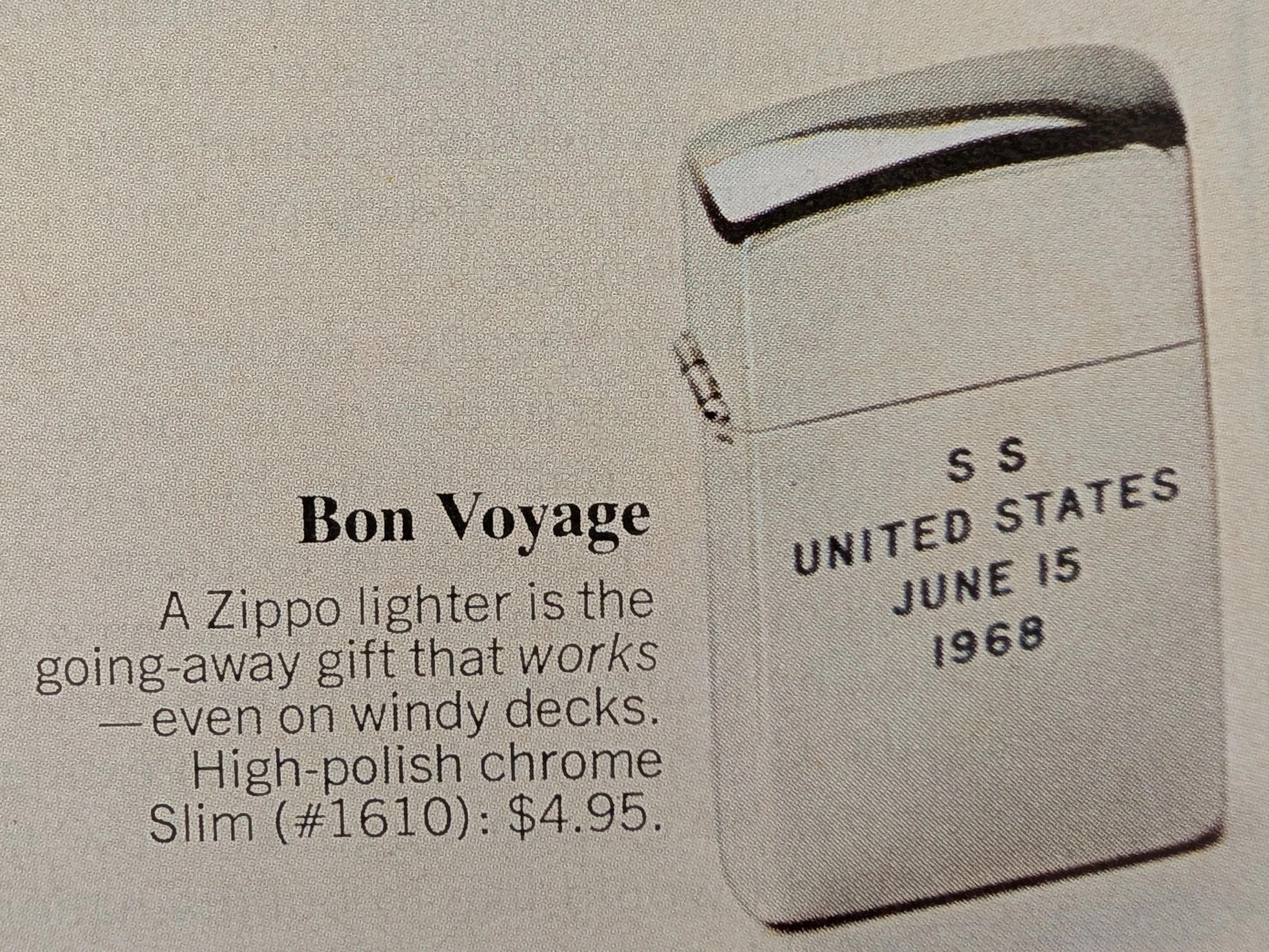
Bon Voyage: The High-polish chrome Slim model, deeply engraved with the legendary ocean liner "S S UNITED STATES JUNE 15 1968," serving as a precise historical anchor for this artifact.
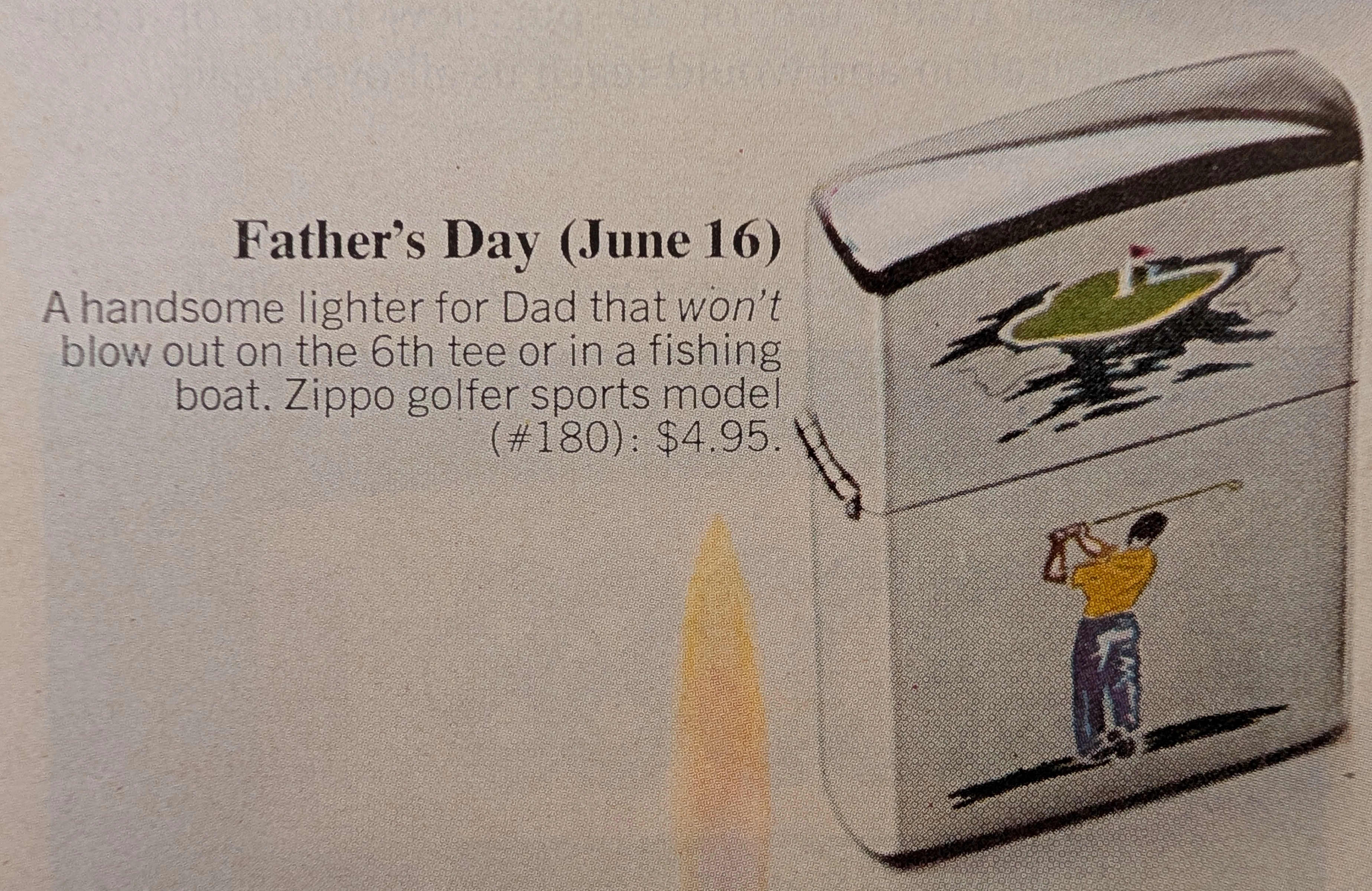
Father's Day (June 16): The golfer sports model (#180), elegantly reflecting the leisure pursuits of the affluent American middle class.
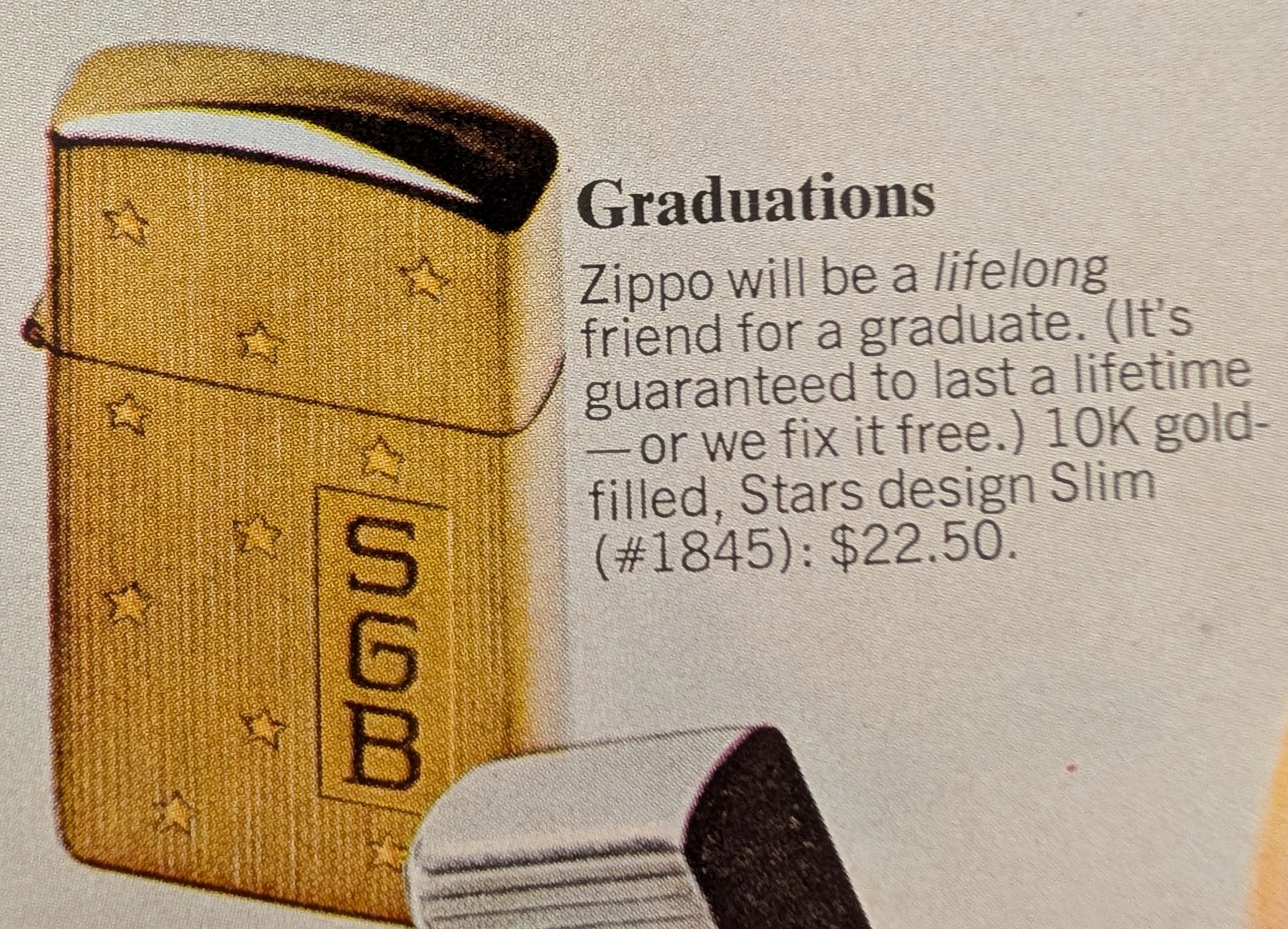
Graduations: The 10K gold-filled Stars design Slim (#1845), elevating the concept of luxury for celebrating academic milestones.
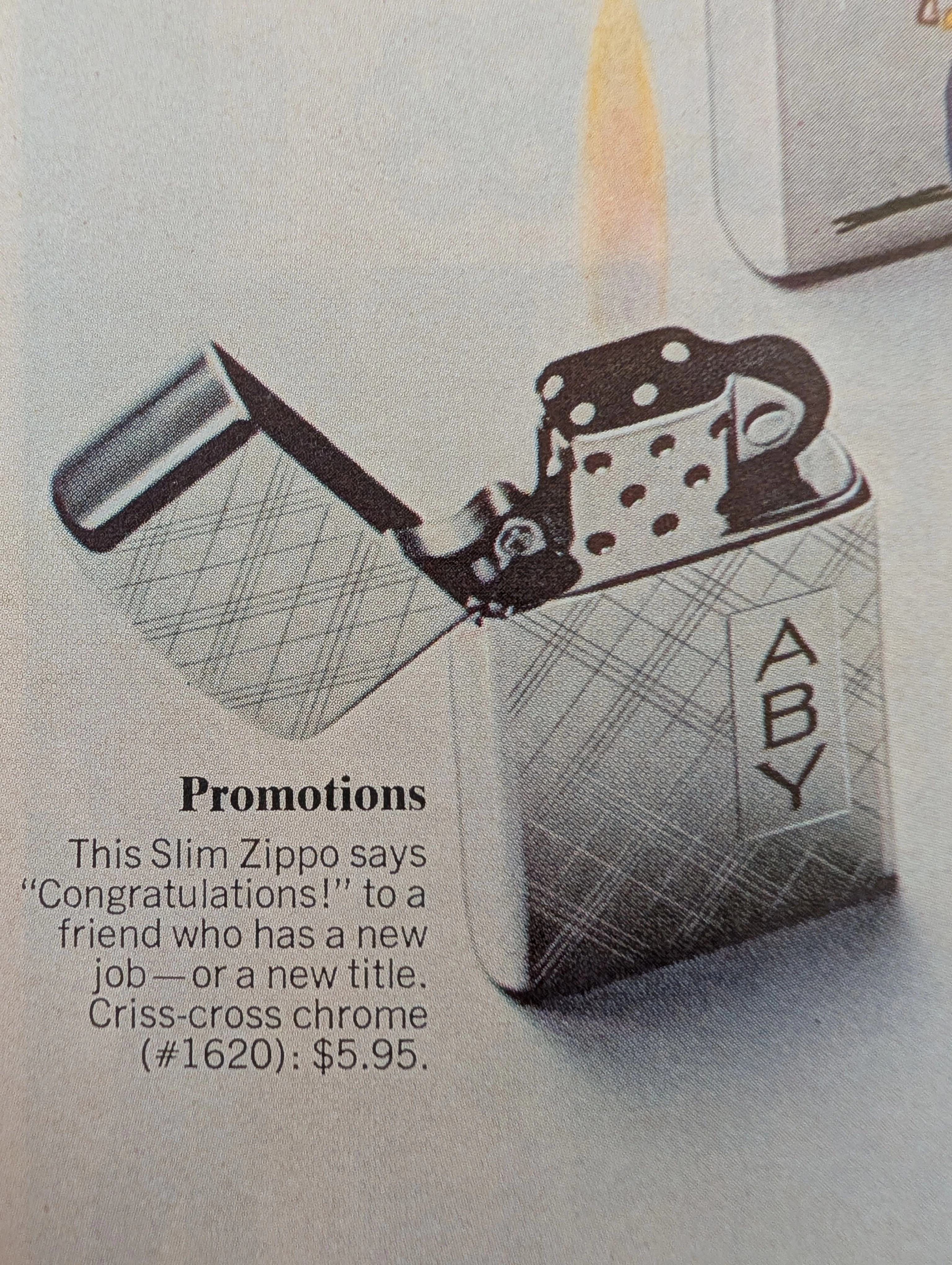
Promotions: The Criss-cross chrome Slim (#1620), positioned as the perfect acknowledgment for professional advancement.
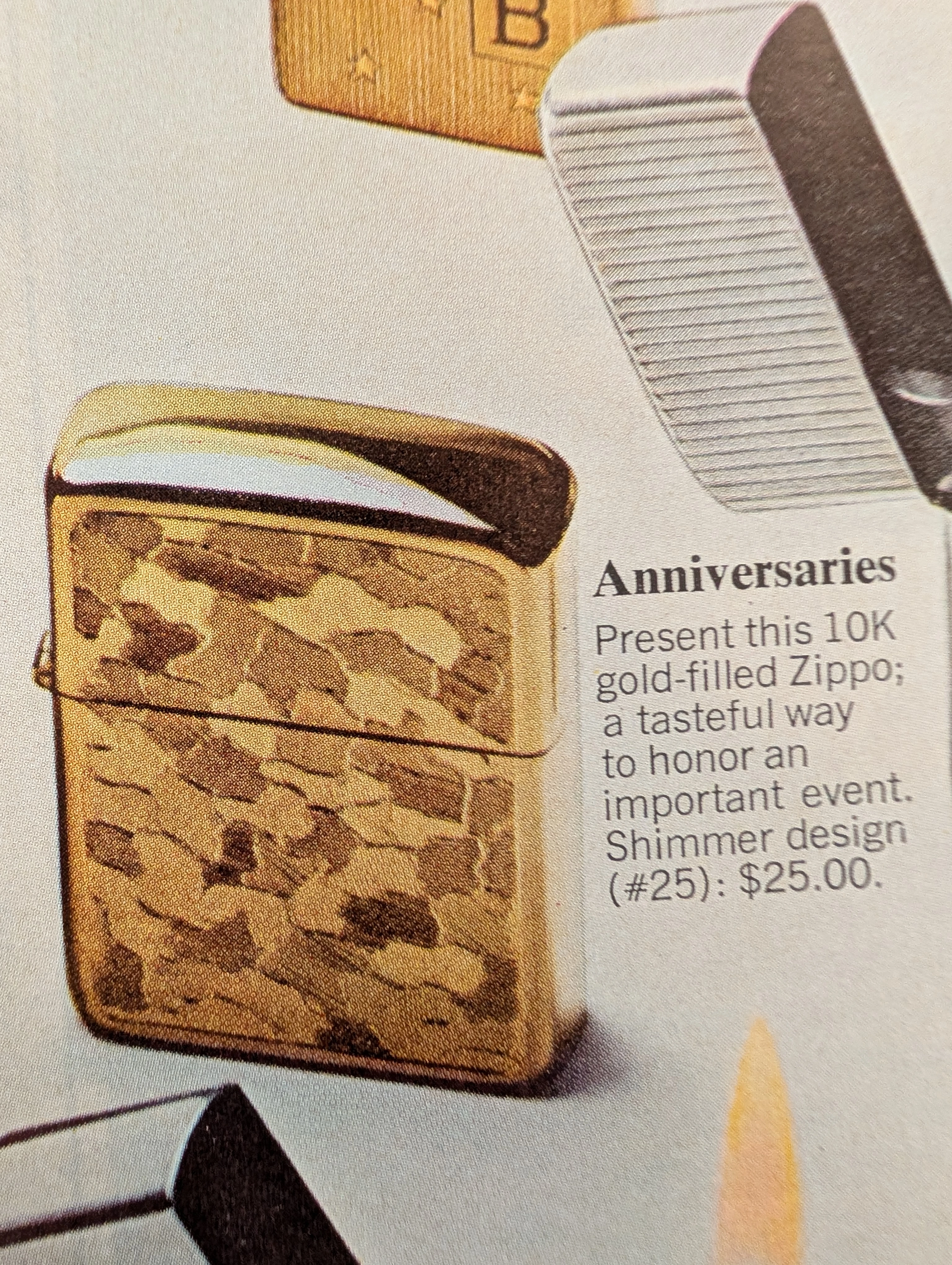
Anniversaries: The 10K gold-filled Shimmer design (#25), priced at $25.00, which represented a considerable luxury investment in that era.
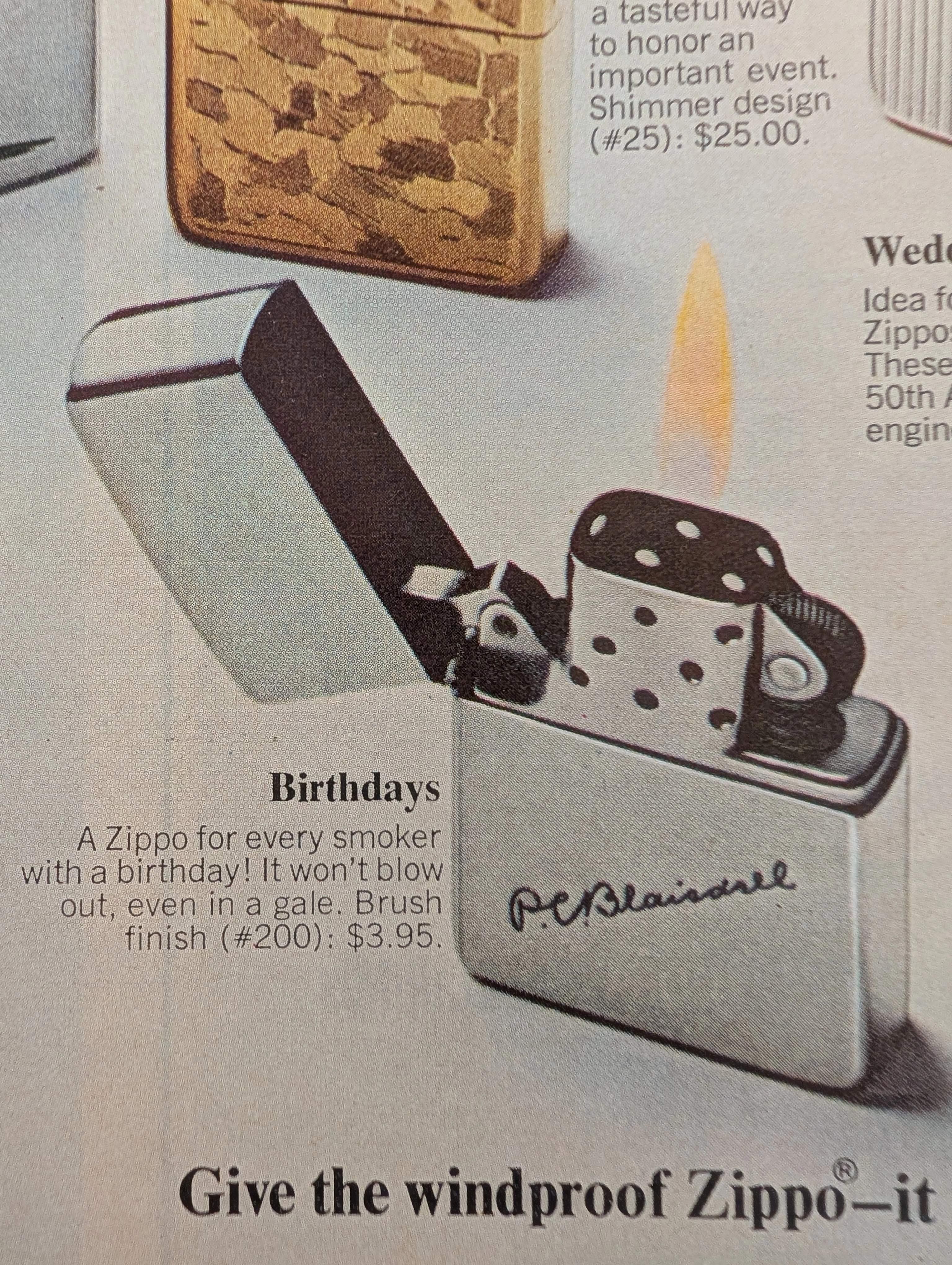
Birthdays: The standard Brush finish (#200), personalized with an engraved signature, "P.C. Blaisdell."
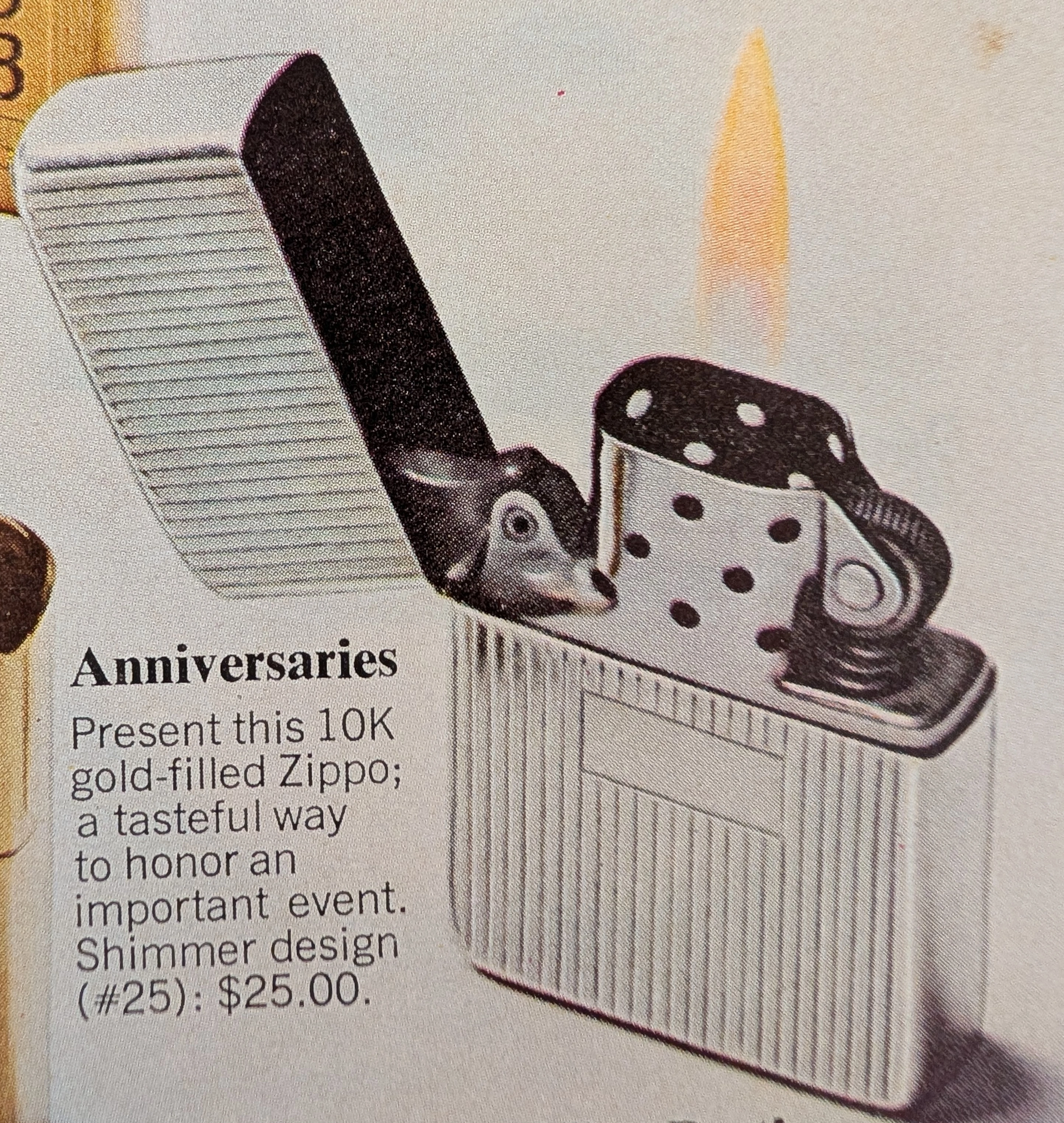
Wedding Parties: The exquisite Sterling silver engine-turned model (#17).
The Ultimate Guarantee of Immortality: The foundational text at the base of the page reads, "Give the windproof Zippo—it works or we fix it free." This is not merely a promotional slogan; it is the legendary covenant established by Zippo founder George G. Blaisdell in 1933. It stands as a profound declaration of absolute confidence in the mechanical spring-hinge engineering and the flint-wheel ignition system, outright rejecting the concept of planned obsolescence.
The Paper
As a physical entity, this printed artifact functions as a living record of mid-twentieth-century graphic reproduction and substrate chemistry. Under exceptional macro-lens forensic examination, the highly reflective metallic casings and the vibrant, lifelike flames are revealed to be constructed from a precise, mathematically rigorous galaxy of halftone rosettes. This constitutes the mechanical fingerprint of the pre-digital analog offset printing press, where varying sizes of primary color (CMYK) ink dots are layered to orchestrate the human eye's perception of dimensional depth and metallic sheen.
However, the most profound factor elevating the immense value of this artifact in the contemporary collector's market is the natural, organic process of Material Degradation. The unprinted margins and white spaces exhibit a genuine, unavoidable, and unforgeable "Toning." This gradual transition from bright white paper to a warm, antique ivory hue is caused by the chemical oxidation of Lignin—the complex organic polymer that binds cellulose fibers together within the raw wood pulp of the paper. As the substrate is exposed to ambient oxygen and ultraviolet light over more than half a century, the molecular structure of the lignin gracefully breaks down. This accumulation of time, this naturally evolving patina, represents the absolute core of the wabi-sabi aesthetic. The profound appreciation for the beauty found in natural aging is an irreversible chemical reaction, and it acts as the primary engine driving up its market value exponentially among elite collectors, providing the ultimate proof of the artifact's historical authenticity.
The Rarity
RARITY CLASS: S (Superior / Exceptional Archival Preservation)
Evaluated under the most exacting archival parameters, this artifact is definitively designated as Class S.
The remarkable paradox of mid-century magazine advertisements is that they were produced by the millions as "disposable media." They were inherently destined to be briefly read, folded, and ultimately discarded. For a full-page advertisement—one that comprehensively documents the design and pricing of seven historically significant Zippo models—to be preserved since 1968 without severe structural tearing, destructive pinholes, or catastrophic moisture staining is a profound statistical archival anomaly. The impeccable structural integrity of this paper, combined with the iconic status of the Zippo brand, elevates this document to a "Holy Grail" status among Tobacciana collectors. It is ardently sought after to ensure its historical permanence through museum-grade, acid-free conservation framing.
Visual Impact
The aesthetic brilliance of this artifact lies in its mastery of "Engineered Elegance." Despite presenting seven distinct products on a single page, the designer has masterfully utilized negative space to isolate and frame each lighter, allowing them to float independently with remarkable clarity.
The most striking visual contrast is the interplay between the "coolness" of the solid metallic casings (chrome, gold, silver) and the "warmth" of the yellow-orange flames ignited on select models. These flames serve as vital focal points that naturally draw human biological perception, transforming a static, two-dimensional print into a dynamic composition where one can almost perceive the heat. The placement of the massive, bold Serif typography at the very top functions as a structural canopy, gracefully balancing and governing all the elements beneath it, thereby creating a perfect and authoritative hierarchy of information.
Exhibition Halls
The Archive Continues
Continue the Exploration
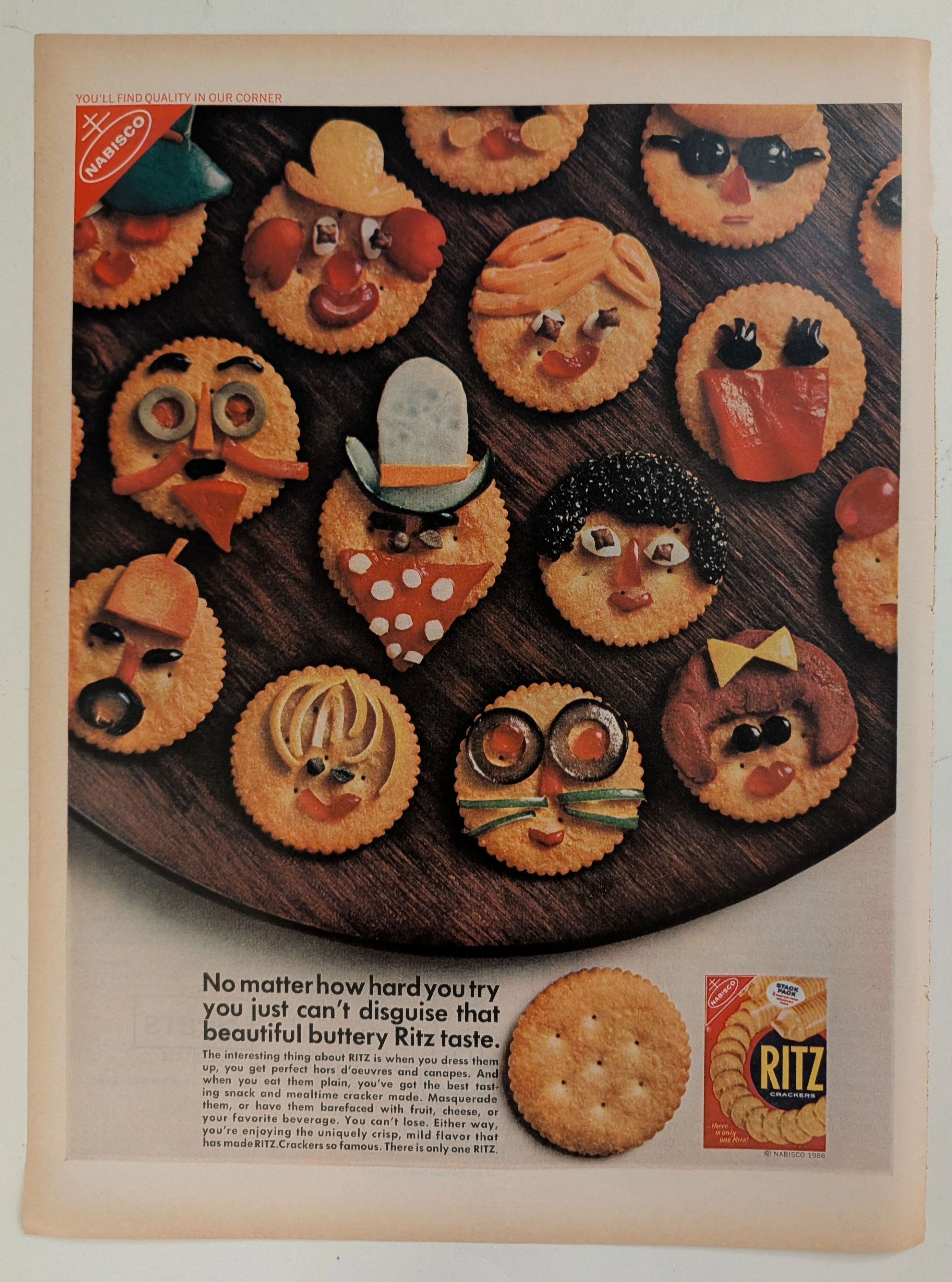
Ritz · Food
The Time Traveller's Dossier: The Masquerade of Quality – Nabisco's 1968 Ritz "Can't Disguise" Campaign and the Golden Age of Snack Branding
The evolution of the twentieth-century American pantry was fundamentally defined by the rise of standardized, nationally recognized "anchor" brands. The historical artifact elegantly positioned upon the analytical table of The Record Institute today is a striking full-page advertisement for Ritz Crackers, originating from 1968. This document represents a pivotal era in consumer psychology where snack foods were repositioned from simple staples to creative culinary canvases. By utilizing playful, anthropomorphic food art—crackers "disguised" as whimsical faces—Nabisco sought to reassure a burgeoning suburban middle class of the cracker's unmistakable "buttery" identity regardless of how it was "dressed up" for social gatherings. This comprehensive dossier conducts a meticulous examination of the artifact, operating under the absolute most rigorous parameters of historical and material science evaluation. We will decode the brilliant marketing psychology of the "Quality in Our Corner" slogan, analyze the profound sociopolitical impact of standardized grocery branding in the late 1960s, and dissect the mechanical fingerprints of the CMYK halftone rosettes captured in macro imagery. Finally, we will assess its archival rarity, exploring how the graceful, natural oxidation of the paper substrate serves as the primary engine driving up its market value exponentially within elite collection circles.
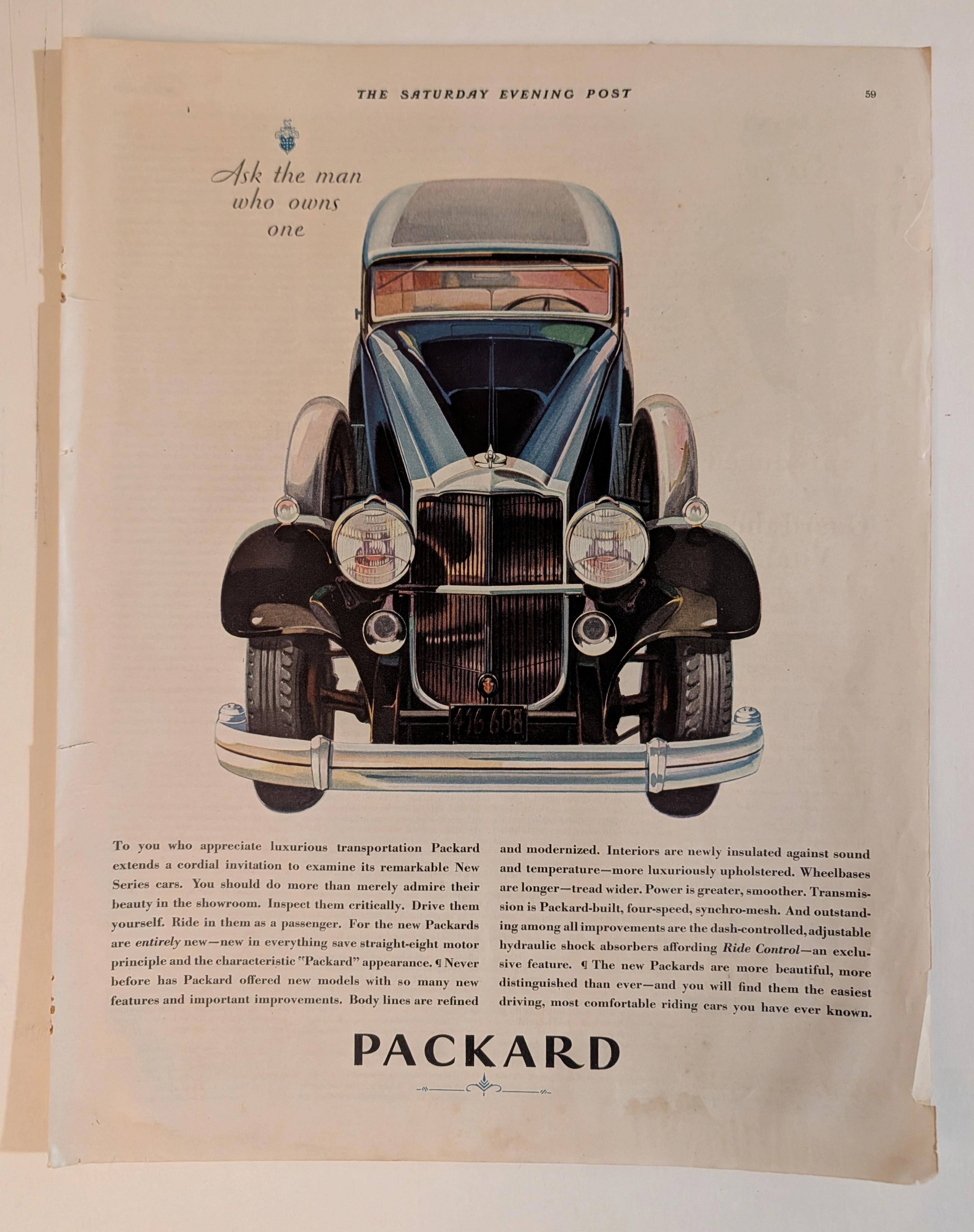
THE TIME TRAVELER'S DOSSIER: THE AUTOMOTIVE ARISTOCRACY AND THE AESTHETICS OF RUIN
The artifact under rigorous, museum-grade analysis is an exceptionally preserved Historical Relic originating from the golden age of American automotive supremacy. Sourced from a vintage issue of The Saturday Evening Post, this Primary Art Document features a commanding, full-page advertisement for Packard, one of the most prestigious luxury automobile manufacturers in world history. Visually dominated by a striking, head-on illustration of a New Series Packard, the piece explicitly highlights the legendary corporate slogan: "Ask the man who owns one". Published during the turbulent economic landscape of the early 1930s Great Depression, this advertisement is a profound sociological marker. It boldly markets uncompromising luxury—boasting features like a four-speed synchro-mesh transmission and "Ride Control" shock absorbers—to an elite aristocracy largely insulated from the era's financial collapse. Physically, this pre-2000s analog artifact is a breathtaking embodiment of wabi-sabi. It exhibits a violently torn left binding edge, significant moisture blooming along the bottom margin, and deep amber lignin oxidation. This natural chemical and environmental degradation transforms a mass-produced commercial print into an irreplaceable, ready-to-frame Primary Art Document, forever capturing the magnificent mortality of the analog age.
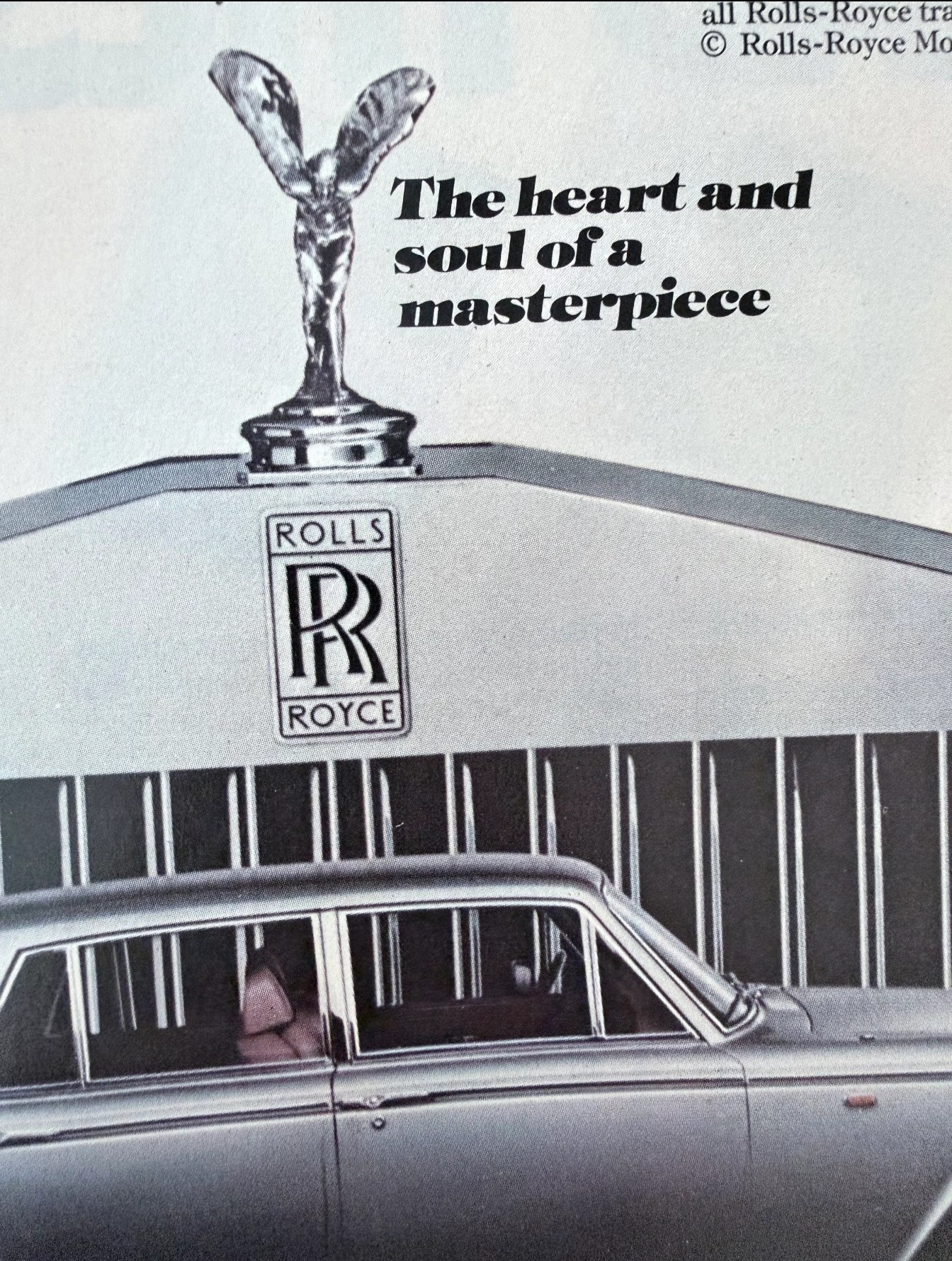
Roll Royce · Automotive
THE TIME TRAVELER'S DOSSIER: THE ENGINEERING OF IMMORTALITY AND ARISTOCRATIC AESTHETICS
The artifact under exhaustive, uncompromising, and unprecedented museum-grade analysis is an exceptionally preserved Historical Relic originating from the absolute zenith of British automotive engineering and aristocratic luxury. This Primary Art Document is a monumental, full-page theatrical advertisement for the Rolls-Royce Silver Shadow II, forensically and definitively dated to 1977 by the explicit copyright text: "© Rolls-Royce Motors Inc. 1977". This is not a mere car advertisement; it is a "Forensic Manifesto of Absolute Perfection." Published twelve years after the conception of the original 1965 edition, this document heralds the arrival of the refined Silver Shadow II. It aggressively weaponizes the brand's legacy, explicitly stating that more than half of all Rolls-Royce motor cars built since 1904 were still "humming along" in 1977. The visual architecture is dominated by the legendary "Spirit of Ecstasy" mascot, described here as "The heart and soul of a masterpiece", standing guard over the iconic Parthenon-inspired radiator grille. Rescued from the binding of a prestige 1970s periodical, this pre-2000s analog artifact exhibits a beautifully authentic warm ivory oxidation across its surface. This majestic chemical aging transforms a mass-produced piece of luxury propaganda into an irreplaceable, ready-to-frame Primary Art Document of automotive and sociological history. Quick-Reference Summary Table