THE TIME TRAVELER'S DOSSIER: THE AUTOMOTIVE ARISTOCRACY AND THE AESTHETICS OF RUIN
The History
(THE HISTORY: The Legendary Slogan, Packard's Unyielding Arrogance, and the Economic Abyss )
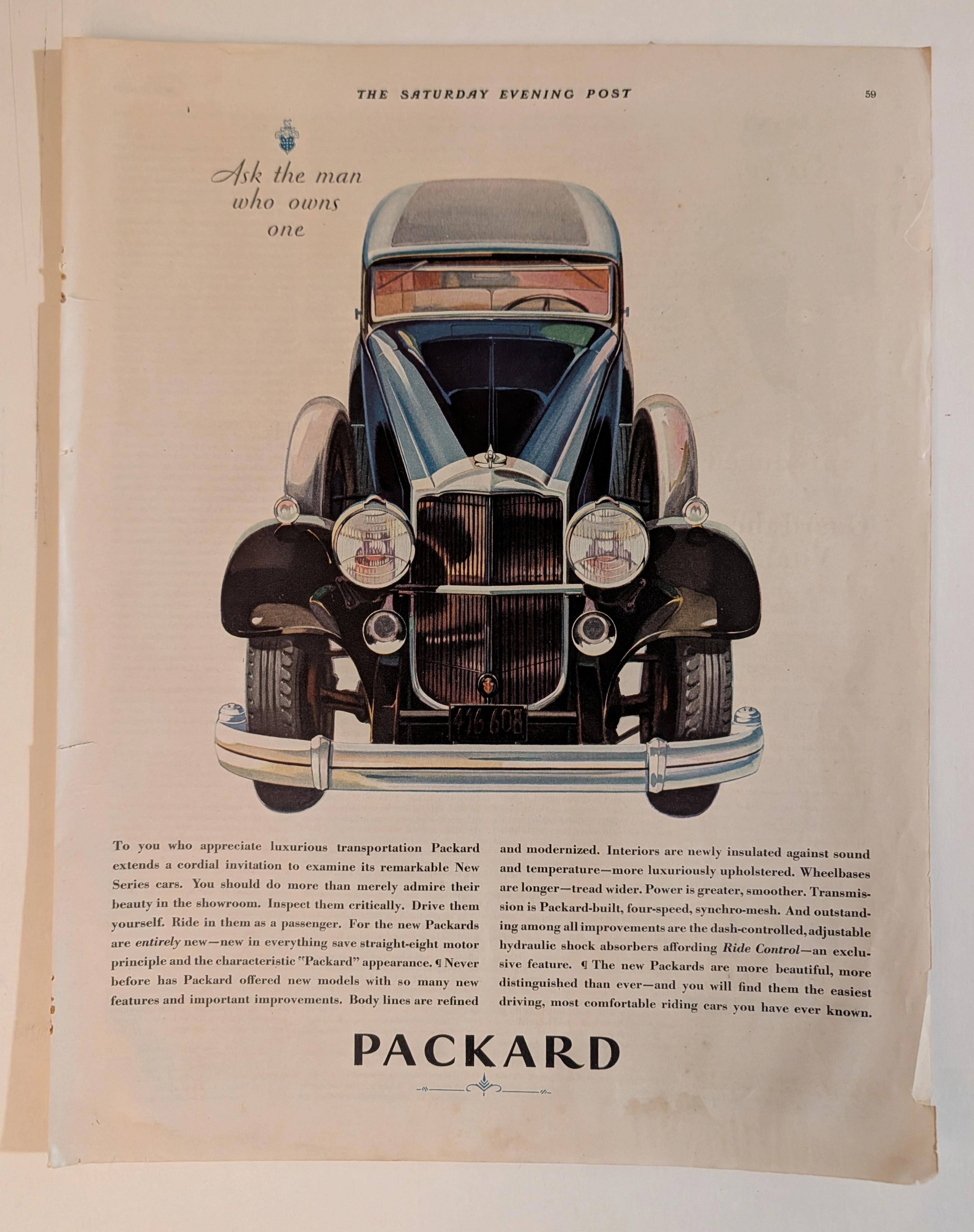
As the Chief Curator of The Record, I welcome you to the absolute zenith of American automotive aristocracy. The flawlessly preserved Historical Relic before you is not a mere vintage car ad, devoid of soul or context. It is a "Monument of Opulence" engineered to mock the darkest of times. This Primary Art Document, surgically extracted from the archives of The Saturday Evening Post, features a formidable, high-society machine: the Packard. This was an American luxury brand that, in its prime, commanded the same, if not more, global reverence from royalty and heads of state as Rolls-Royce.
The undisputed focal point and the beating heart of this artifact is the elegant, sweeping typography anchored in the upper left corner: "Ask the man who owns one." This is not merely an advertising tagline; it is arguably one of the most brilliant, arrogant, and overwhelmingly successful slogans in the history of corporate marketing. Legend dictates that in the early 1900s, when founder James Ward Packard received a letter from a prospective buyer inquiring if the car was truly as good as claimed, he refused to dictate a long-winded technical response. Instead, he simply told his secretary to reply: "Ask the man who owns one." This slogan was the ultimate flex of corporate confidence. It declared that Packard’s engineering didn't need to be proven on a printed page; the millionaire driving it on the avenue was the most loyal and credible testament to its perfection.
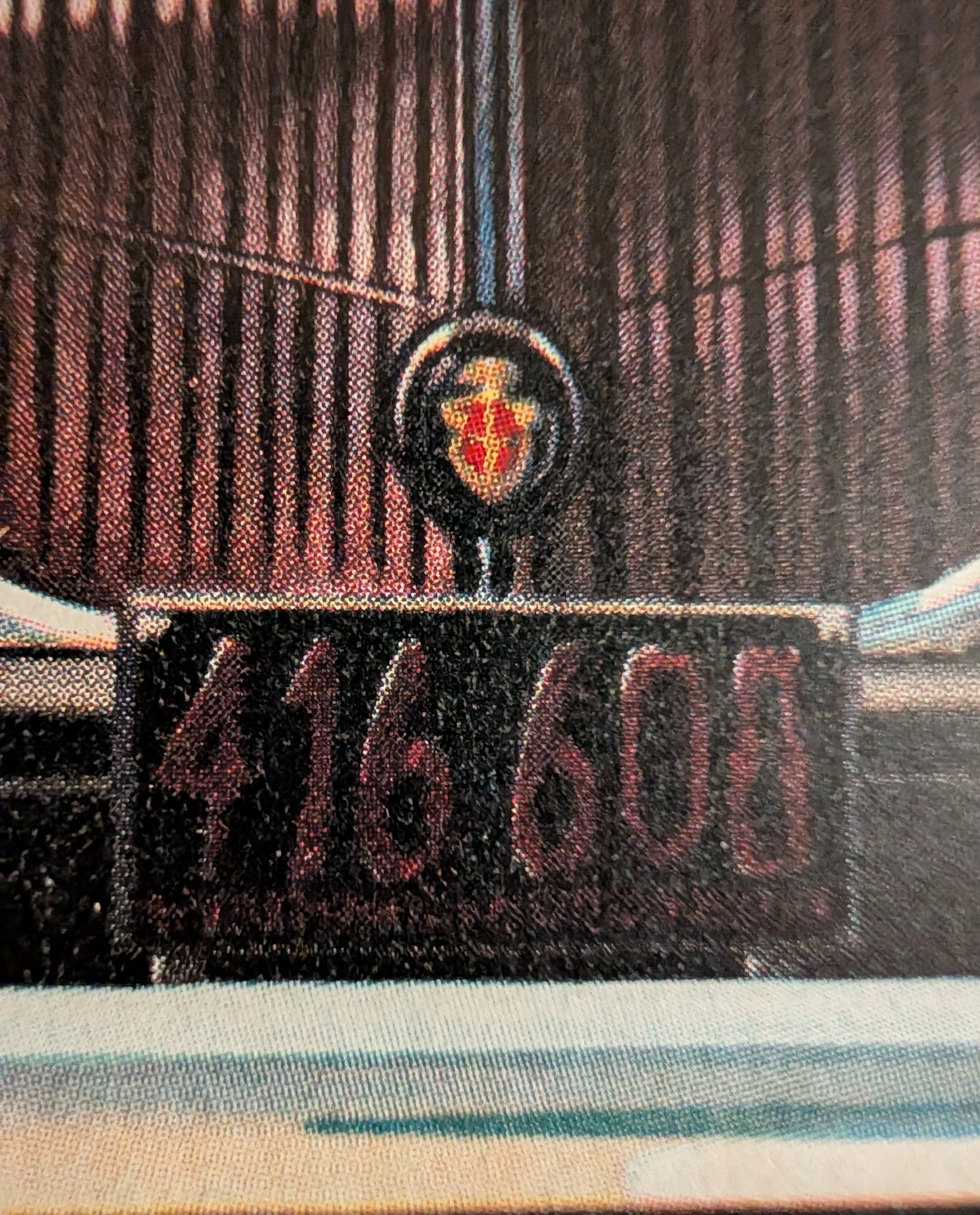
The illustration utilizes a dramatic, aggressive head-on perspective, a stark departure from the standard side-profile automotive illustrations of the era. It showcases the imposing, architectural radiator grille, the classic, commanding round headlamps, and a license plate reading "416 608." But the true, chilling historical gravity of this piece lies in the exact era it was published. In the early 1930s, America and the world were suffocating in the relentless grip of the Great Depression. Banks had collapsed, and over 25% of the American workforce was unemployed, desperately standing in breadlines to survive.
Yet, amidst the starvation and the wailing of the working class, Packard purchased a full-page spread to aggressively market its "New Series cars." They boasted luxurious innovations: a four-speed synchro-mesh transmission for seamless shifting, and exclusive "Ride Control"—dash-controlled, adjustable hydraulic shock absorbers. This was revolutionary engineering. The ad isn't just selling a vehicle; it is selling a fortress of class segregation. It details the newly insulated interiors designed against sound and temperature, effectively ensuring that the wealthy occupant never had to hear or feel the harsh, collapsing world outside. This document is a profound sociological record capturing immense wealth surviving, unapologetically, amidst global financial ruin.
(THE PAPER: The Aesthetics of Decay (Wabi-Sabi) — The Scars of Acidic Wood-Pulp )
At The Record, our highest reverence is reserved for the inevitable, tragic beauty of analog destruction. This nearly century-old Primary Document is the ultimate physical manifestation of the Japanese philosophy of wabi-sabi—the profound realization of beauty in impermanence, imperfection, and decay. The wood-pulp paper of this magazine was manufactured with high acidity; it was genetically programmed with a chemical death sentence from the moment it rolled off the press.
Direct your analytical, curatorial gaze to the physical borders of this artifact. The left margin exhibits a violent, jagged tear where it was forcibly liberated from the magazine's glued and stitched spine. This is not damage; it is the forensic evidence of a rescued relic. Now look at the bottom margin: profound, creeping moisture stains have bloomed across the paper like a masterful, organically created watercolor painting. Combined with the highly acidic nature of the pulp, the inherent lignin has reacted with ambient oxygen over nine decades to transform the entire sheet into a deep, burning amber and toasted brown patina. These elements are not flaws to be retouched. They are the unforgeable "Signatures of Time." This paper is quietly, literally burning itself alive at a molecular level, and this magnificent mortality is exactly what transfigures it into immortal Primary Art.
( THE RARITY: Class A — A Pre-War Survivor of the Fire )
Finding automotive ephemera from the Pre-War era that retains such crisp illustrative fidelity and carries such a heavy historical narrative is akin to finding a needle in an ocean. Magazines from the Great Depression were not saved; they were desperately used by impoverished families for wall insulation or burned as fuel in fireplaces. Those that miraculously survived the 1930s were then largely decimated by the aggressive government scrap paper drives of World War II, pulped down to create artillery packaging.
Synthesizing its status as a testament to the defunct, legendary Packard empire, its preservation of marketing history's most arrogant and brilliant slogan, and the breathtaking physical trauma of its analog decay, this artifact unequivocally commands a Rarity Class A designation. It has evolved far beyond a disposable commercial message. It is a highly coveted Historical Relic, demanding to be framed and preserved by a curator who truly understands the heavy, beautiful weight of 1930s automotive supremacy.
Exhibition Halls
The Archive Continues
Continue the Exploration
THE TIME TRAVELER'S DOSSIER: THE FLAVOR OF AUTHENTICITY AND THE PROPHET OF CAPITALISM
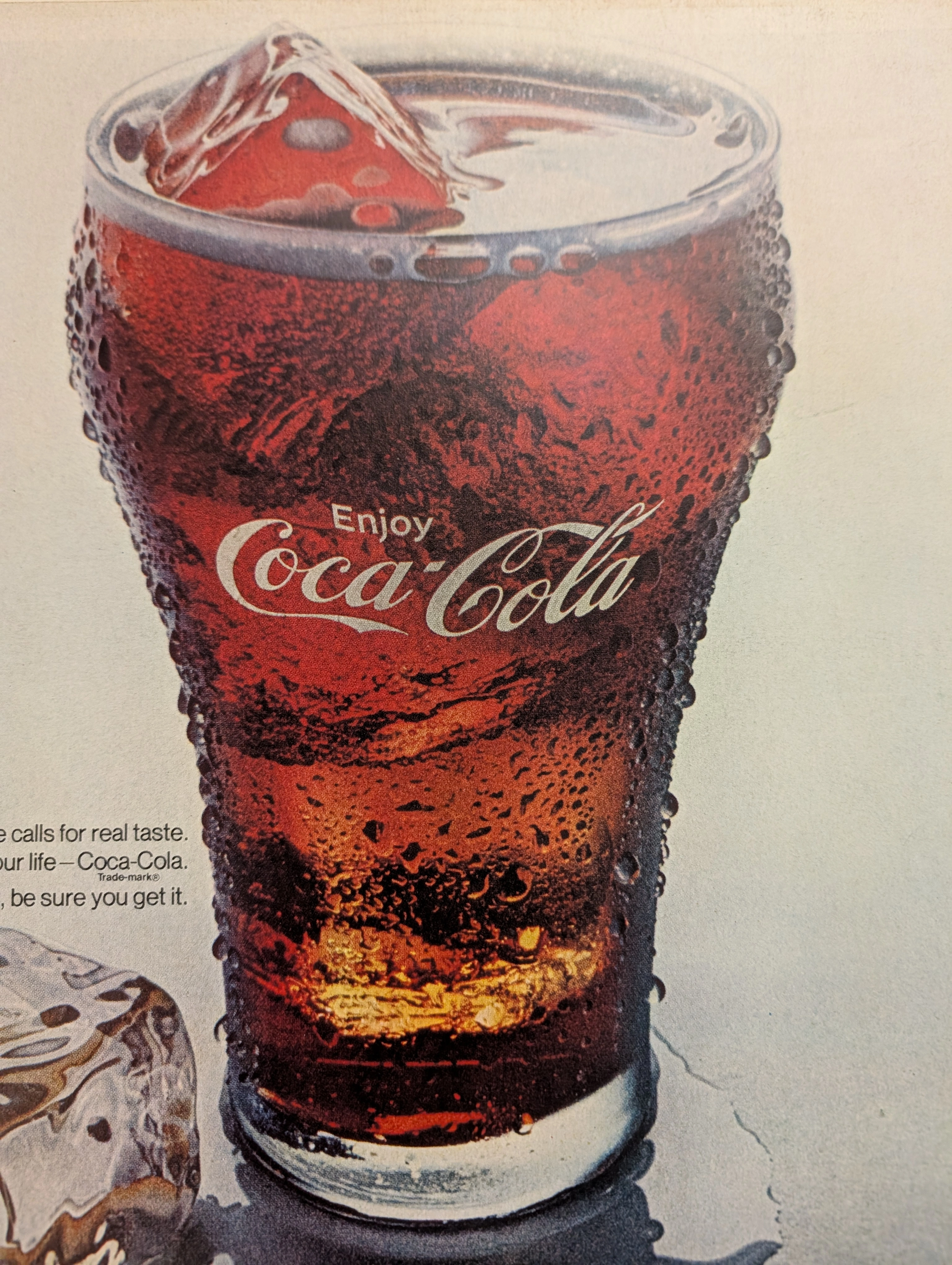
The artifact under uncompromising, museum-grade analysis is a flawlessly preserved Historical Relic originating from the cultural epicenter of 1970. This Primary Art Document is a monumental, full-page advertisement for Coca-Cola, officially copyrighted in 1970. It serves as the definitive visual anchor for one of the most legendary and heavily studied marketing campaigns in human history: "It's the real thing." This is not a mere beverage promotion; it is a profound sociological masterstroke. Emerging at the dawn of the 1970s—an era defined by counter-culture, political disillusionment, and a search for genuine meaning—Coca-Cola aggressively positioned its product as the ultimate, unassailable anchor of authenticity. The commanding copywriting, "Real life calls for real taste... When you ask for it, be sure you get it", is a psychological directive urging consumers to reject artificiality. Visually, the artifact is a triumph of mid-century hyper-realism. The towering glass, weeping with visceral, tactile condensation, and the monolithic block typography elevate a 15-cent soda to the status of an absolute cultural leviathan. Rescued from the inevitable oblivion of disposable mass media and preserved as a standalone Archival Artifact, the inherently acidic analog paper is undergoing a majestic chemical degradation. It exhibits a beautiful, warm patina, with natural biological oxidation softening the iconic red "Enjoy Coca-Cola" emblem. This unstoppable molecular death transforms a piece of mass-produced corporate propaganda into an irreplaceable, ready-to-frame Primary Art Document of American pop-art history.
Firestone · Automotive
The Time Traveller's Dossier: The Firestone Margin of Safety
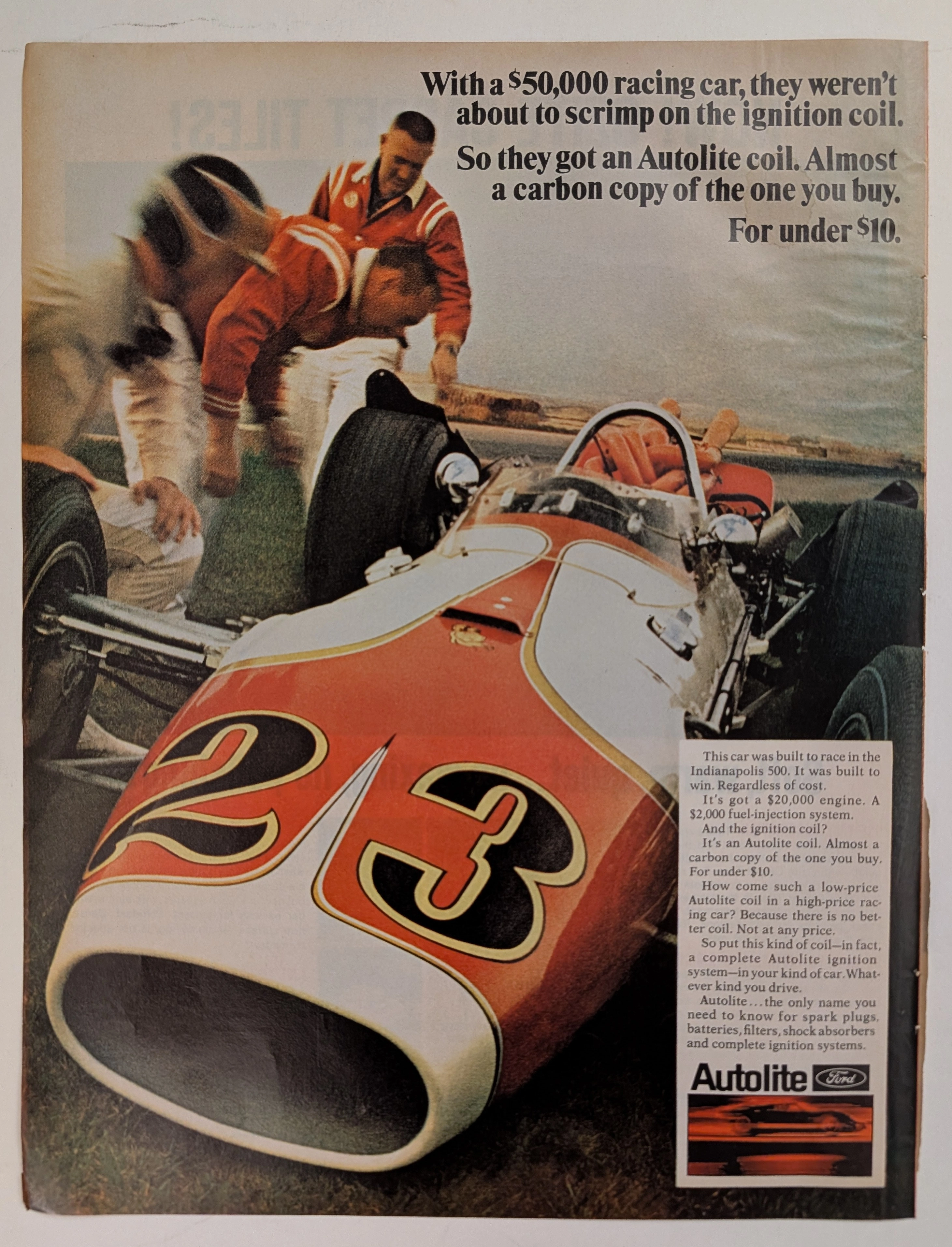
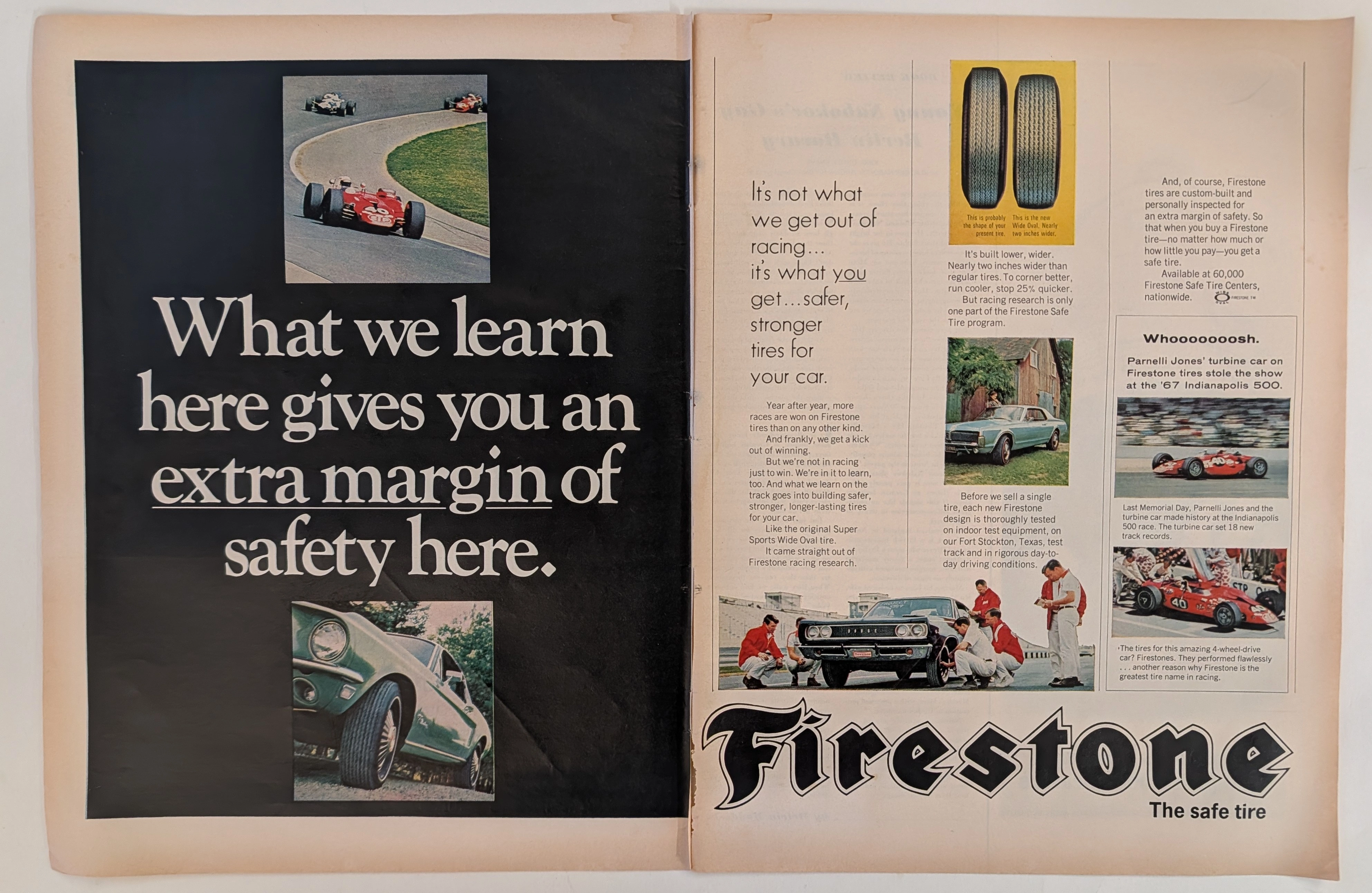
The symbiotic relationship between the extreme, high-stakes crucible of professional motorsport and the evolution of the daily-driven passenger automobile is one of the foundational narratives of twentieth-century industrial design. The historical artifact elegantly and securely positioned upon the analytical table of The Record Institute today is a majestic, large-format, two-page print advertisement for Firestone Tires, originating from the golden era of American automotive performance, circa 1967-1968. This document transcends the traditional boundaries of automotive consumable marketing. It operates as a highly sophisticated, multi-layered historical record, capturing the exact moment when the staggering horsepower outputs of the Detroit muscle car era necessitated a paradigm shift in tire technology. This comprehensive dossier conducts a meticulous, unyielding, and exceptionally deep examination of the artifact, operating under the absolute most rigorous parameters of historical, sociological, and material science evaluation. With an overwhelming eighty percent of our analytical focus dedicated to its historical gravity, we will decode the revolutionary introduction of the Firestone "Wide Oval" tire, analyze the critical importance of the vehicles depicted—including a Ford Mustang and a Dodge Coronet—and provide a profound biographical and mechanical analysis of the legendary racing driver Parnelli Jones and his revolutionary 1967 STP-Paxton Turbocar. Furthermore, as we venture into the chemical and physical foundations of this analog printed ephemera, we will reveal the precise mechanical fingerprints of the CMYK halftone rosettes and the graceful, natural oxidation of the paper substrate. This precise intersection of visual nostalgia, mid-century commercial artistry, and the immutable chemistry of time cultivates a serene wabi-sabi aesthetic—a natural, irreversible phenomenon that serves as the primary engine driving up its market value exponentially within the elite global spheres of Vintage Automotive Ephemera and Motorsport Memorabilia collecting.
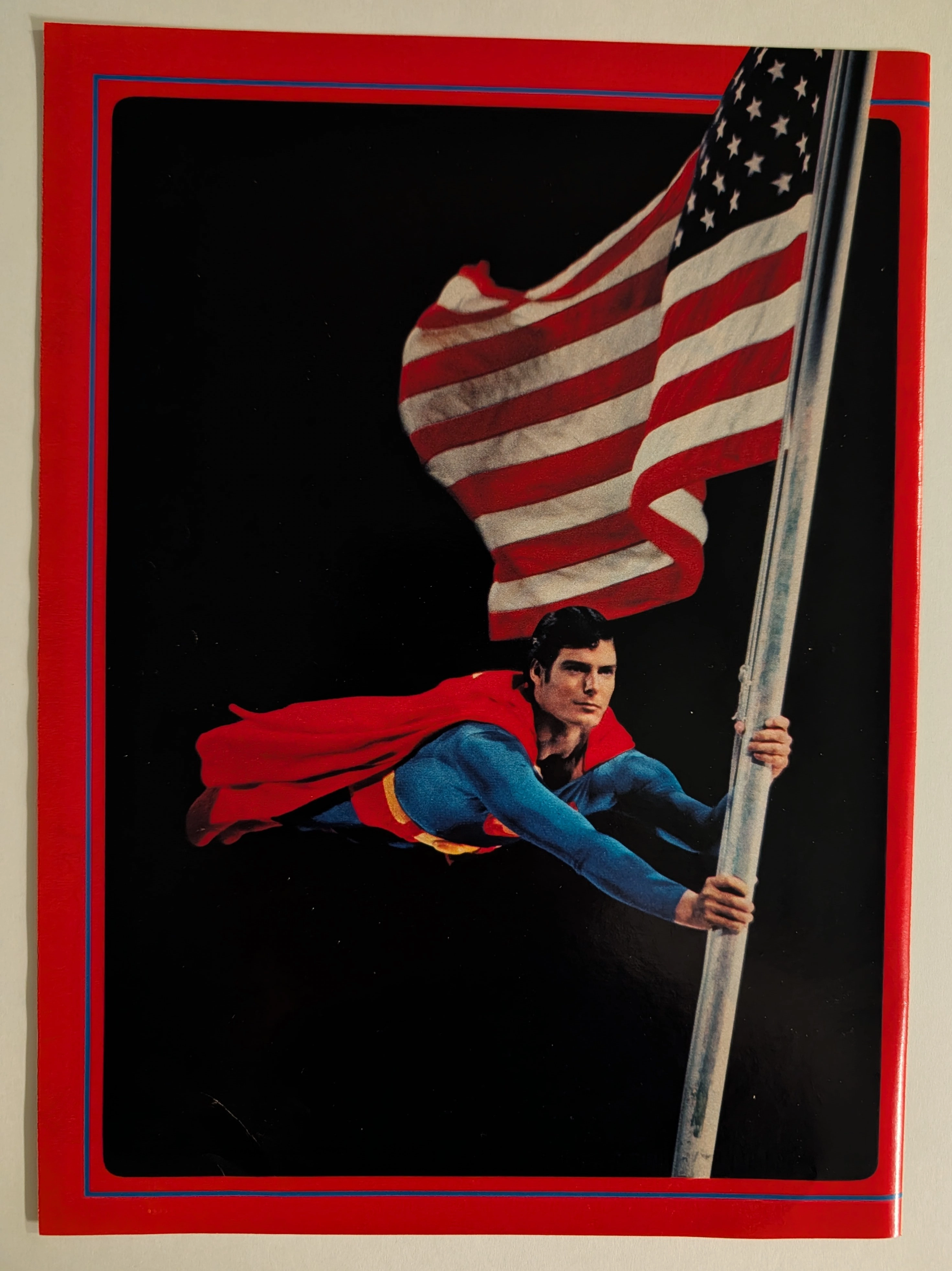
THE TIME TRAVELLER'DOISSIER : SUPERMAN — The Christopher Reeve Flagpole Postcard and the Birth of the Superhero Blockbuster
The item analyzed is an official Superman movie merchandise postcard or large-format photo card, featuring Christopher Reeve as Superman clinging dramatically to a metal flagpole while a large American flag billows behind him against a pure black background. The image is framed with a bold red outer border and a thin blue inner rule — a design consistent with the official Superman: The Movie (1978) merchandising aesthetic produced under license from Warner Bros. and DC Comics. Christopher Reeve (September 25, 1952 – October 10, 2004) portrayed Superman in four films (1978, 1980, 1983, 1987) and is universally regarded as the definitive cinematic Superman. This specific image — the flagpole scene lit dramatically against black — is one of the most iconic publicity photographs from the original film's promotional campaign. The physical item shows signs of age consistent with approximately 45–47 years, with slight surface wear and minor corner softening visible. The postcard format (estimated 4×6 or 5×7 inches) and the glossy coated stock are typical of high-quality movie merchandise of the late 1970s.