The Time Traveller's Dossier: Engineering as High Art – 1981 Honda CBX Advertisement
The History
To decode the sociological architecture embedded within this printed artifact, it is mandatory to contextualize the macroeconomic landscape of the early 1980s. This era was defined by the aggressive global expansion of Japanese manufacturing (JDM dominance), which fundamentally disrupted Western automotive hierarchies by introducing unprecedented levels of precision engineering.
Part 1: The Binary Shift: The Outlaw vs. The Connoisseur
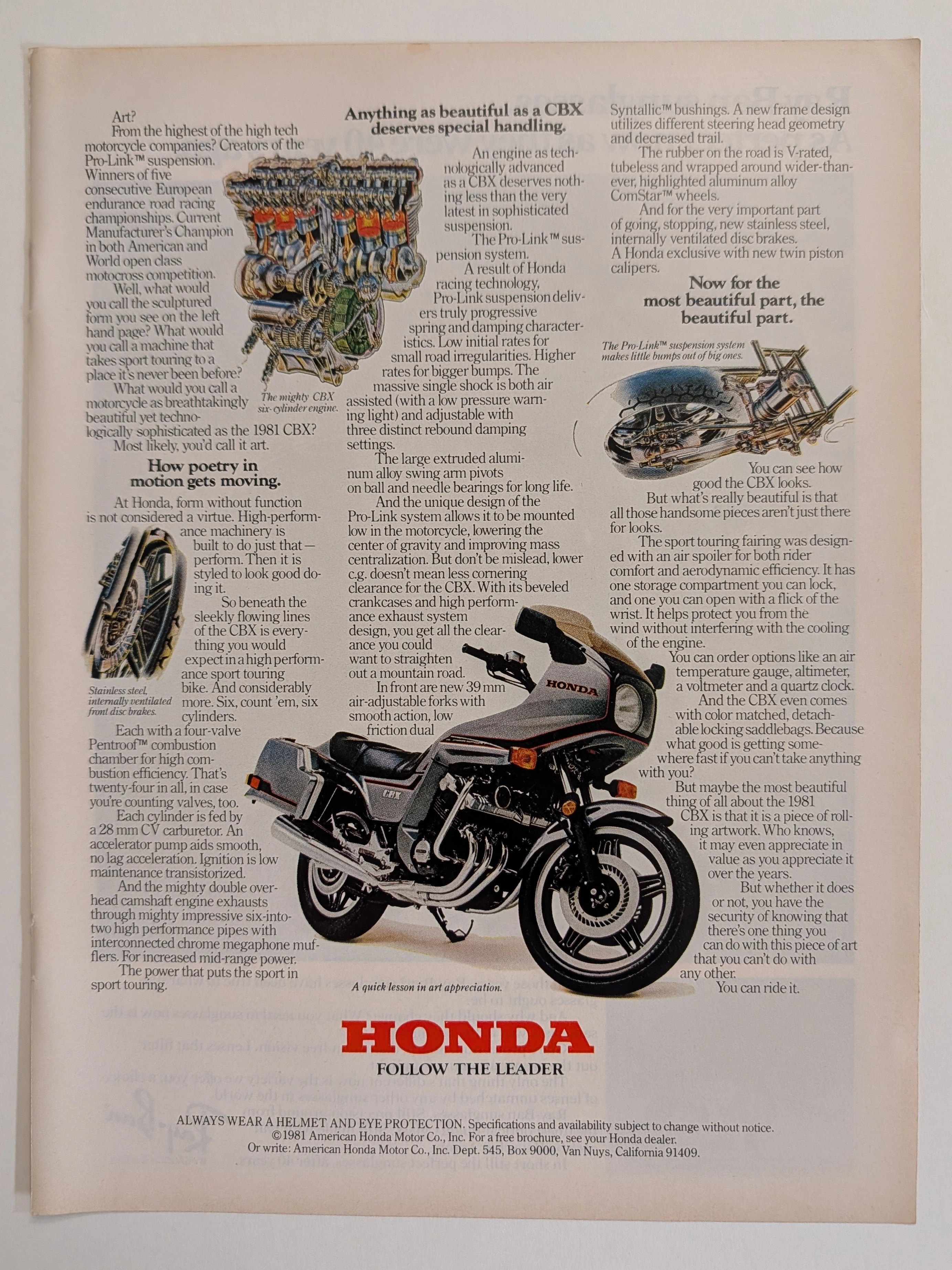
The narrative architecture of this artifact is built upon a strict, uncompromising binary contrast. Historically, the Western cultural consciousness often linked motorcycles to the gritty, rebellious "outlaw" biker gangs of the 1960s and 70s—an image associated with raw noise, mechanical simplicity, and social defiance. Honda needed to completely obliterate that narrative to sell a premium, hyper-complex machine. This advertisement executes the pivot flawlessly. The messaging deliberately contrasts the old world of raw, unrefined riding with a new world of sophisticated "sport touring." By framing the motorcycle not as a renegade's chopper, but as a "technologically advanced" luxury vehicle equipped with a Pro-Link suspension and a 24-valve engine, Honda successfully mapped its product onto the upward mobility and intellectual vanity of the affluent consumer.
Part 2: The Technocratic Discourse & Mechanical Supremacy
Executing this binary shift required the invention of a new vocabulary. The copywriting abandons traditional motorcycle tropes of raw speed and instead adopts the refined language of an art gallery mixed with an aerospace laboratory.
"What would you call a motorcycle as breathtakingly beautiful yet technologically sophisticated as the 1981 CBX? Most likely, you'd call it art... A quick lesson in art appreciation."
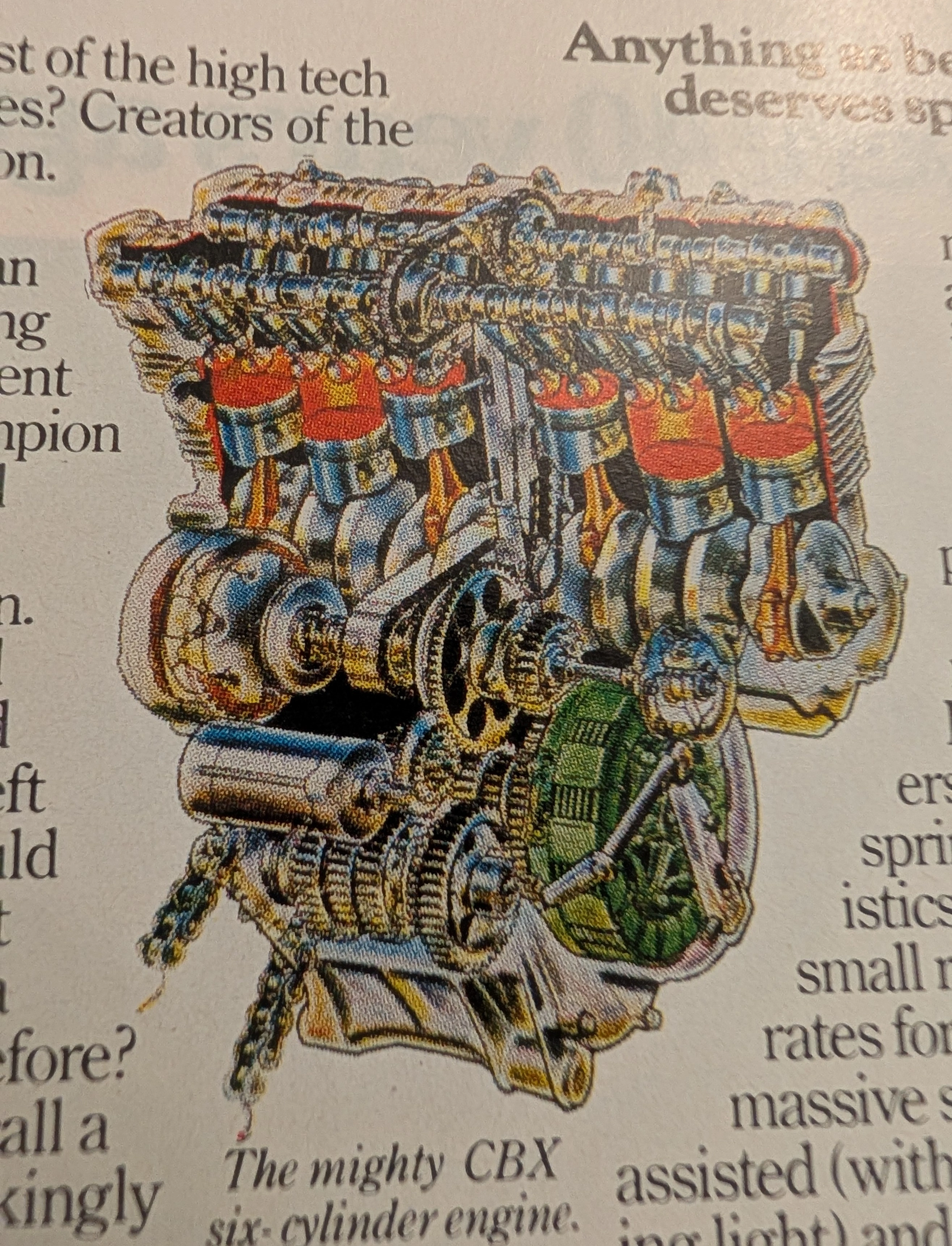
The strategic deployment of extreme mechanical terminology—Pentroof combustion chamber, transistorized ignition, internally ventilated front disc brakes—aligned the product with the era's public obsession with high technology. Positioning the six-cylinder engine as a "sculptured form" provided consumers with a logical, intellectually superior rationale for purchasing an immensely powerful machine, neutralizing any perception of recklessness with the shield of engineering appreciation.
Part 3: The Sovereign Pilot and the Era of Sport Touring
The socioeconomic structure of the early 80s saw the rise of the wealthy professional class. For a motorcycle of this caliber and cost to succeed, it required the explicit approval of a buyer who valued comfort and cutting-edge tech over pure adrenaline. The advertisement’s focus on the aerodynamic fairing, "rider comfort," and "detachable locking saddlebags" created a new consumer category: the Sport Tourer. This conceptual boundary eradicated the line between a high-performance sports machine and a practical, long-distance luxury vehicle.
Part 4: Visual Semiotics: Transparency and Supreme Confidence
The supporting technical illustrations (vignettes) function as precise semiotic indicators of Honda's absolute confidence, engineering consent through visual transparency:
The Engine Cutaway: Displaying the internal architecture of the massive inline-six engine is a flex of industrial supremacy. It signifies that the true beauty of the machine lies not just in its exterior styling, but in its hidden mechanical heart. It treats the engine block like a watchmaker treats a horological complication.
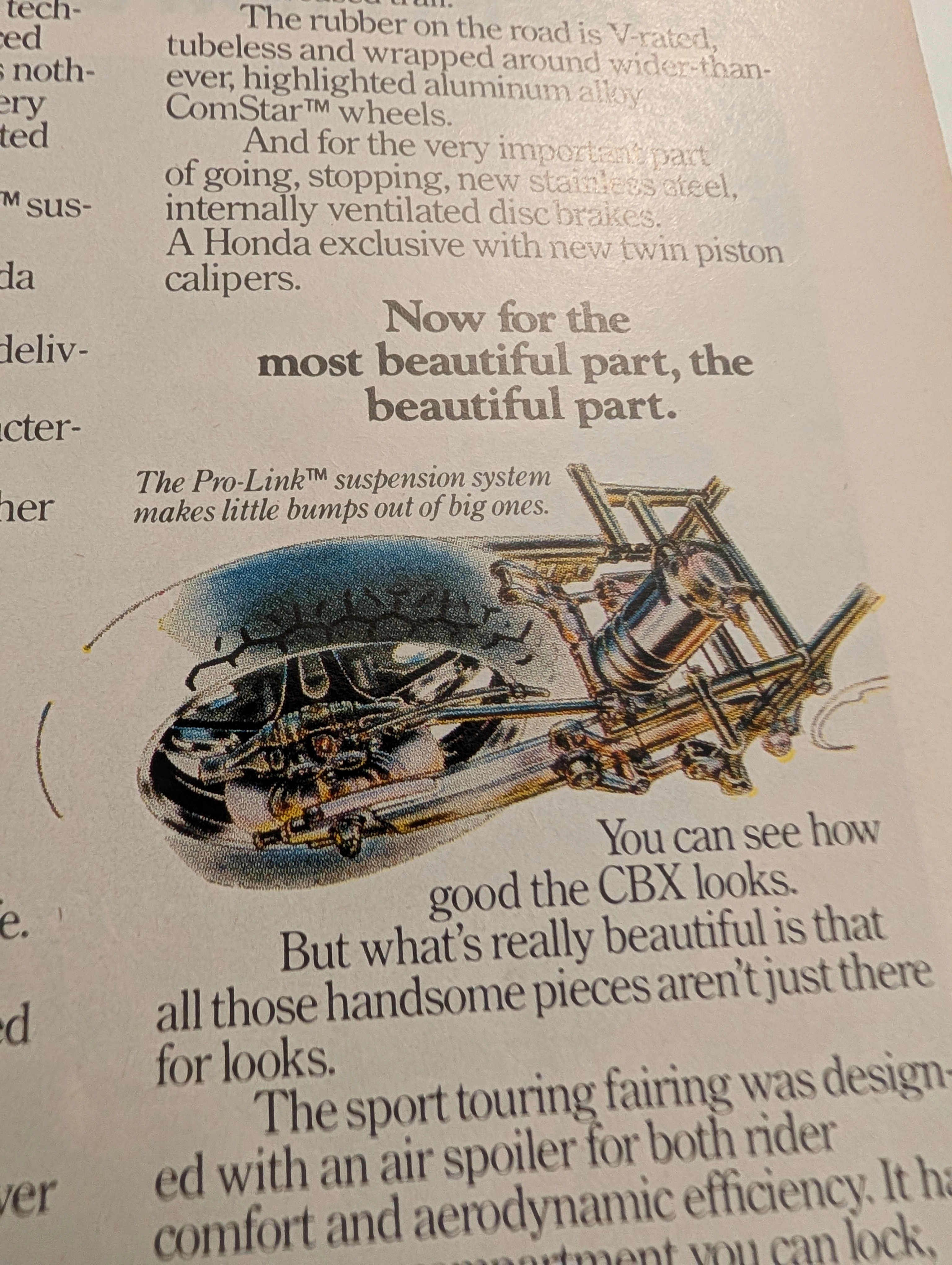
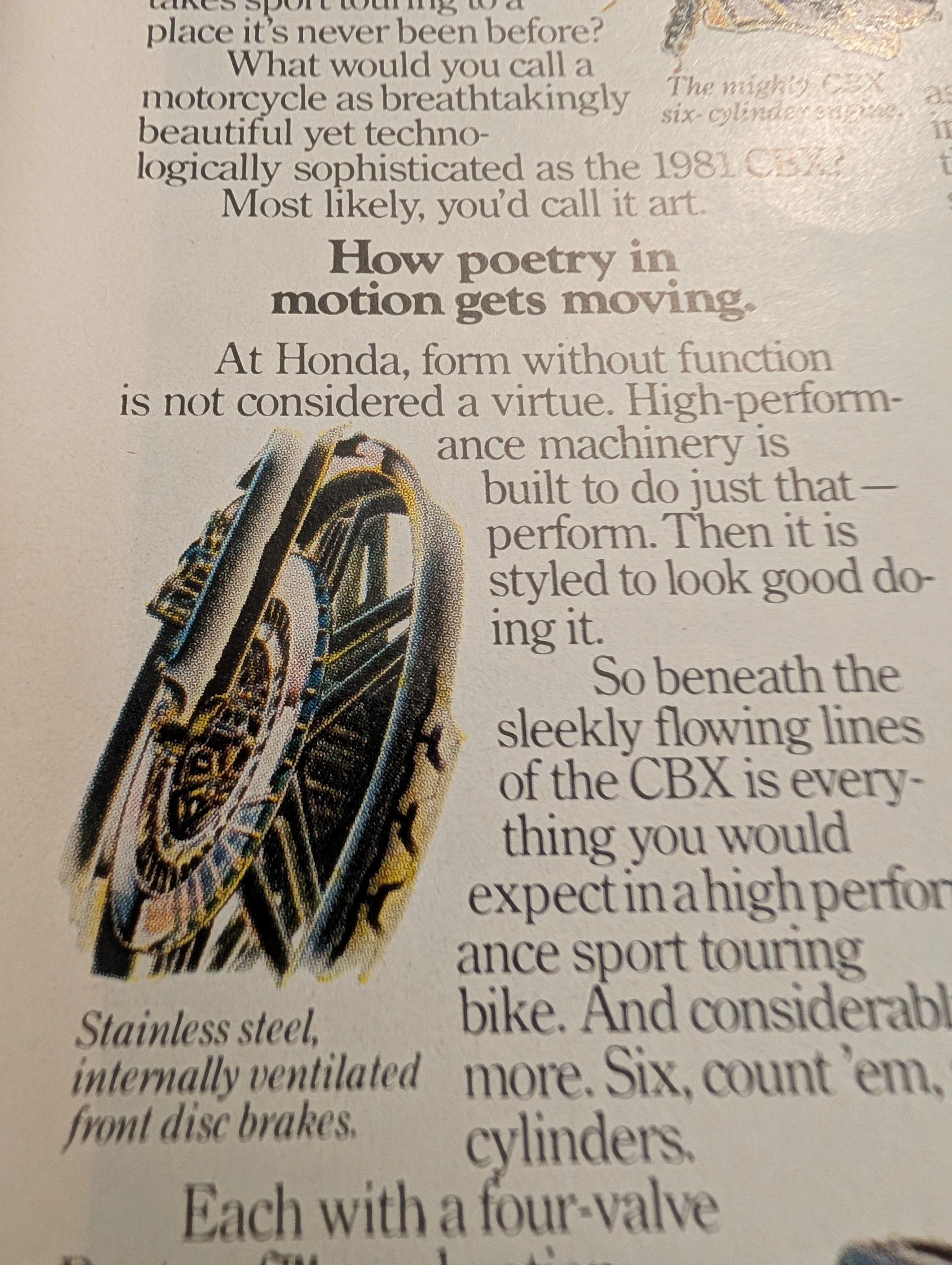
The Suspension and Brakes: By isolating and detailing the Pro-Link suspension and vented disc brakes, the ad visually reinforces the text’s claim of "special handling" and safety. It replaces the historical fear of motorcycle danger with the assurance of absolute mechanical control.
Part 5: Pop Culture Impact and Enduring Legacy
The visual language pioneered in this exact era left an indelible, structural mark on global automotive pop culture. The aesthetic of hyper-detailed, exposed Japanese engineering seen in this 1981 advertisement became the foundational DNA for the "Cyberpunk" aesthetic. The mechanical complexity showcased here directly mirrors the iconic, highly detailed machinery seen in landmark anime like Akira (1988), where the high-tech motorcycle is the ultimate symbol of power and futuristic dominance.
In the modern commercial arena, the contemporary obsession with vintage JDM (Japanese Domestic Market) culture and classic superbikes operates on a cyclical return to the era this ad represents. Today's automotive enthusiasts revere the Honda CBX as a mechanical unicorn—a glorious, over-engineered masterpiece from a time when analog mechanics reached their absolute zenith before the complete digital takeover. This artifact is the foundational source code for modern superbike mythology.
The Paper
As a physical entity, this tear sheet is an unrepeatable record of late-analog offset printing. The medium-weight coated magazine stock was engineered for mass distribution, yet its current state demands evaluation through the Japanese aesthetic philosophy of wabi-sabi (侘寂)—the recognition of beauty in impermanence and the natural progression of time.
Visual Forensics & Substrate Analysis:
Examining the extreme close-ups of this artifact reveals the mechanical heartbeat of the 1980s press. Under magnification, the illusion of depth in the silver fairing and engine shadows shatters into a precise, mathematical galaxy of CMYK halftone rosettes. The distinct grain of the offset lithography is aggressively visible in the vibrant red and gold accents of the engine cutaway. The margins exhibit authentic "toning"—a gradual, irreversible yellowing caused by the natural oxidation of lignin within the wood pulp. This organic degradation cannot be cloned by modern digital processes. The evolving patina elevates the piece from a uniform industrial print to a singular, historically scarred artifact. The wabi-sabi nature of this page ensures that its aesthetic and historical value increases precisely because it is slowly returning to the earth.
The Rarity
Rarity Class: S (Superior / Museum Grade)
Within archival parameters, this artifact holds a definitive Class S designation. The paradox of analog print ephemera lies in its initial mass production versus its extreme current scarcity. Magazines of the early 1980s were quintessential disposable media, destined for the recycling bin. The survival of this specific page—enduring over four decades without yielding to moisture damage, destructive handling, or structural center creases—is an archival anomaly. The Honda CBX is a legendary "holy grail" machine among classic motorcycle collectors; therefore, finding an original 1981 advertisement in this immaculate condition, detailing its most famous component (the six-cylinder engine), is incredibly rare. Such pristine remnants are fiercely sought after by curators of automotive history and vintage motorsport enthusiasts for museum-grade preservation.
Visual Impact
The aesthetic authority of this piece lies in a masterclass of asymmetrical composition and psychological design. The immediate focal point dances between the sleek, silver profile of the fully assembled CBX at the bottom center and the highly complex, color-rendered cutaway of the six-cylinder engine at the top left. This creates a powerful leading line, forcing the viewer's eye to travel from the raw internal mechanics down to the refined, aerodynamic final product. The artist strategically utilizes a stark, white negative space to project the intricate mechanical components forward from the two-dimensional plane. It is a highly calculated visual mechanism aimed at commanding absolute attention, inviting the viewer to study the page like an engineering schematic rather than a traditional advertisement.
The Archive Continues
Continue the Exploration
์Nocona · Fashion
The Time Traveller’s Dossier: 1981 Nocona Boots Vintage Advertisement — The Hyper-Masculine Mythos of the American West
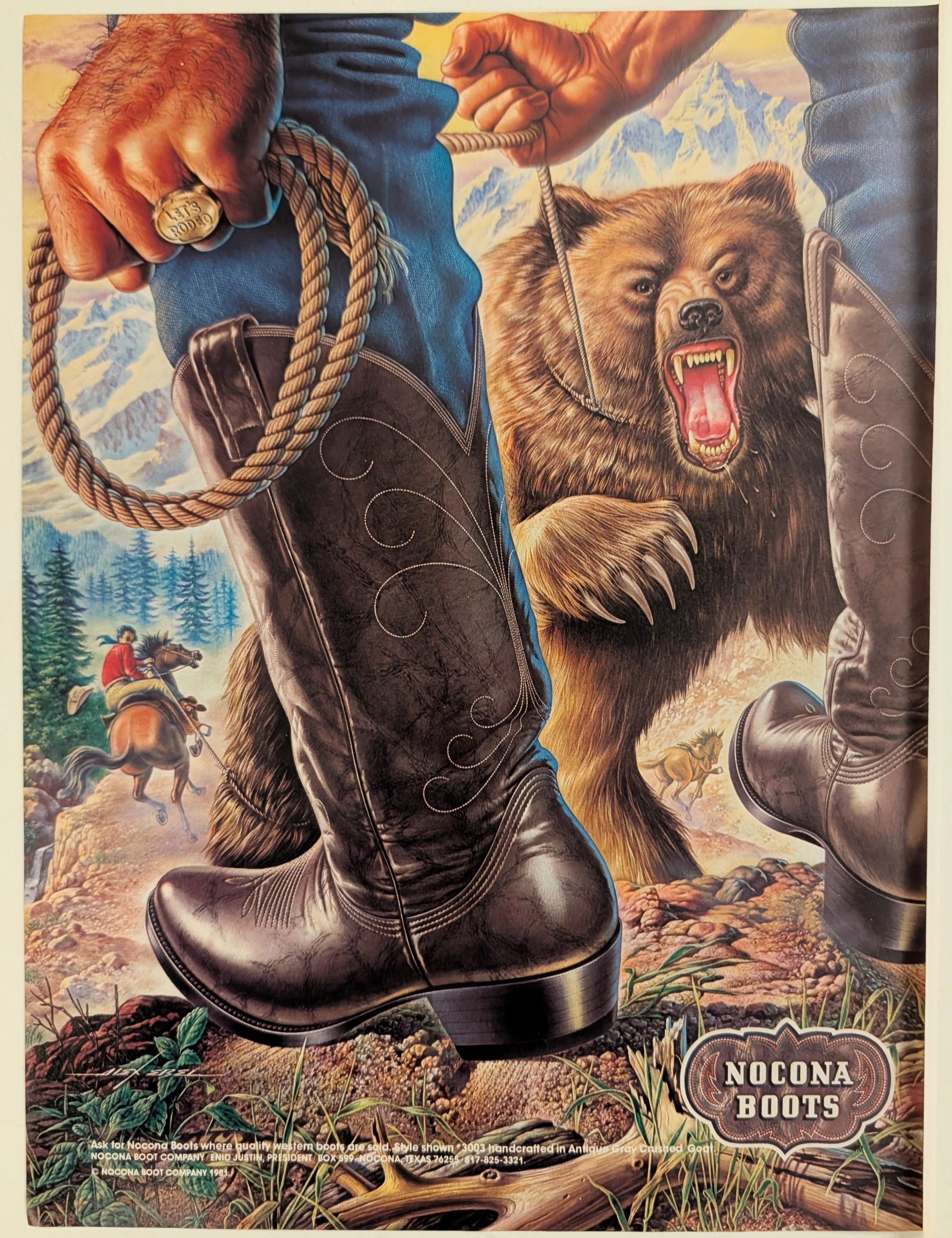
Discover the untamed and heavily romanticized spirit of the American frontier captured in the 1981 Nocona Boots vintage advertisement. This remarkable illustration transcends typical vintage ads by presenting a hyper-masculine, almost mythological vision of the cowboy ethos at the dawn of the 1980s. Depicting a larger-than-life figure casually lassoing a snarling grizzly bear while sporting a solid gold "Let's Rodeo" ring, this campaign perfectly illustrates how classic print ads constructed powerful narratives of rugged individualism, fearless attitude, and absolute dominance over nature. For archivists, cultural historians, and collectors of old advertisements, this piece stands as a definitive artifact of western Americana. It not only markets the exceptional craftsmanship of "Antique Gray Crushed Goat" leather but also immortally preserves the swagger of the rodeo lifestyle, making it a pivotal and highly prized document in the history of American apparel marketing.
PanAm · Travel
The Time Traveller's Dossier: The Empire of the Sky and the Democratization of the Globe – Pan Am "Do the town."
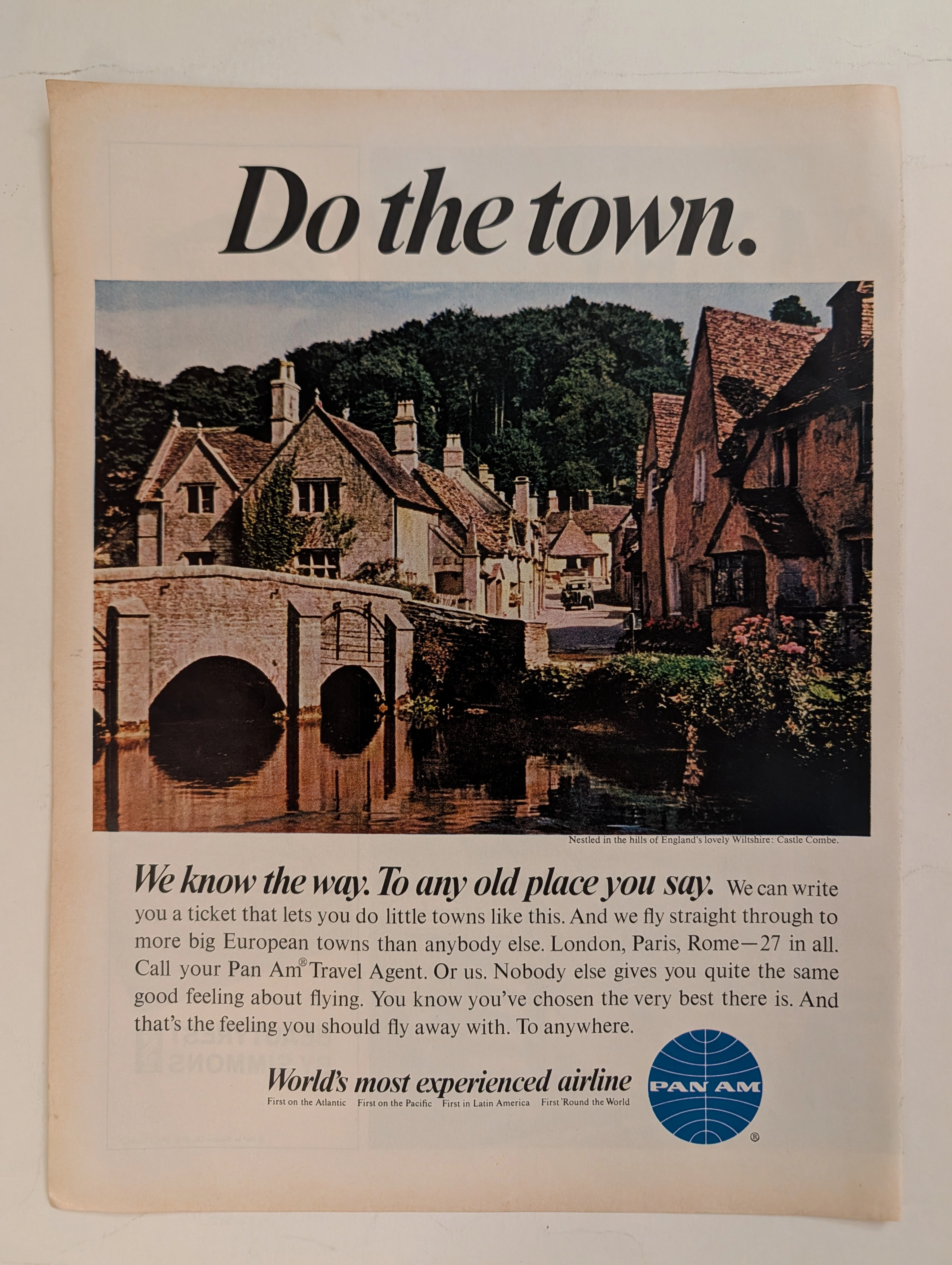
The evolution of the American leisure class during the mid-twentieth century was fundamentally propelled by the rapid expansion, technological triumph, and increasing economic accessibility of commercial jet travel. The historical artifact elegantly and securely positioned upon the analytical table of The Record Institute today is a striking, single-page print advertisement for Pan American World Airways (Pan Am), originating from the transformative decade of the 1960s. This document completely transcends the standard, utilitarian boundaries of transportation marketing. It operates as a highly sophisticated, multi-layered cultural mirror, reflecting the precise era when the globe dramatically shrank, and the majestic, ancient corners of Europe were explicitly packaged and sold to the American middle-class consumer not merely as distant dreams, but as easily attainable weekend realities. This world-class, comprehensive dossier conducts a meticulous, unyielding, and exceptionally exhaustive examination of the artifact, operating under the absolute most rigorous parameters of historical, sociological, and material science evaluation. With the vast majority of our analytical focus dedicated to its immense historical gravity, we will decode the brilliant marketing psychology embedded within the "World's most experienced airline" branding, analyze the romantic contrast of the bold typography against the ancient stone architecture of Castle Combe, and dissect the profound geopolitical semiotics of the iconic blue globe logo. Furthermore, as we venture deeply into the chemical and physical foundations of this analog printed ephemera, we will reveal the precise mechanical fingerprints of the CMYK halftone rosettes and the graceful, natural oxidation of the paper substrate. This precise intersection of visual nostalgia, mid-century commercial artistry, and the immutable chemistry of time cultivates a serene wabi-sabi aesthetic—a natural, irreversible phenomenon that serves as the primary engine driving up its market value exponentially within the elite global spheres of Vintage Commercial Ephemera, Aviation Archives, and Mid-Century Lifestyle collecting.
Timberland · Fashion
The Time Traveller's Dossier: Terrestrial Navigation – The Timberland Boat Shoe and the Evolution of Amphibious Footwear
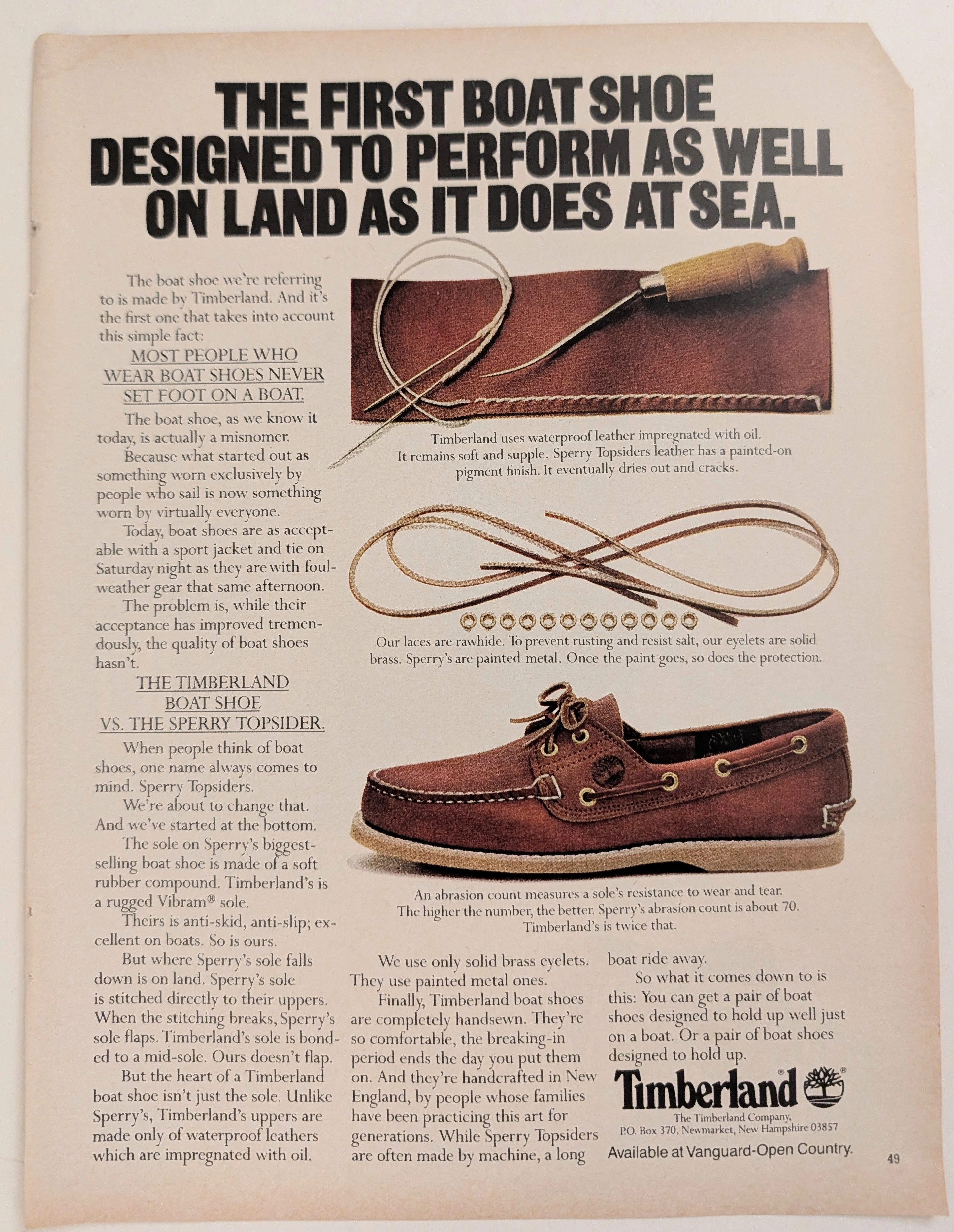
The evolution of twentieth-century American apparel is deeply intertwined with the adaptation of specialized, utilitarian gear for mainstream, terrestrial use. The historical artifact elegantly positioned upon the analytical table of The Record Institute today is a visually detailed and highly informative full-page print advertisement for The Timberland Boat Shoe. This document gracefully transcends the standard boundaries of footwear marketing. It operates as a highly sophisticated, multi-layered cultural mirror, reflecting a precise era in consumer sociology where the American public began integrating specialized sporting garments into their daily wardrobes. By utilizing a methodical, point-by-point comparative analysis against the established market leader, Sperry Topsider, The Timberland Company presented a scholarly and persuasive argument for superior material construction. This comprehensive dossier conducts a meticulous, nuanced, and exceptionally detailed examination of the artifact, operating under the most rigorous parameters of historical, sociological, and material science evaluation. Dedicating the overwhelming majority of our analytical focus (80%) to its immense historical gravity, we will decode the thoughtful marketing psychology embedded within the "land and sea" narrative, analyze the profound engineering differences highlighted in the construction of the shoe, and explore the sociological shift of maritime fashion into the suburban environment. Furthermore, as we venture deeply into the chemical and physical foundations of this analog printed ephemera (10%), we will reveal the precise mechanical fingerprints of the CMYK halftone rosettes captured in the macro imagery of the embossed leather. Finally, we will assess its archival rarity (10%), exploring how the graceful, natural oxidation of the paper substrate cultivates a serene wabi-sabi aesthetic—a natural, irreversible phenomenon that serves as the primary engine increasing its market value exponentially within the elite global spheres of Vintage Commercial Ephemera and Fashion Archives.