The Time Traveller’s Dossier: 1980 American Express Card Vintage Advertisement — The Assurance of Global Mobility
The History
The Dawn of Democratized Global Travel and the Psychology of Displacement
To fully grasp the cultural weight of this 1980 American Express campaign, one must examine the socio-economic landscape of the late 1970s and early 1980s. Following the Airline Deregulation Act of 1978 in the United States, the aviation industry experienced a seismic shift. International travel, once the exclusive domain of diplomats, the ultra-wealthy, and jet-set elites, became increasingly accessible to the upper-middle class and the traveling corporate executive. The skies opened up, and exotic destinations that previously existed only in the pages of National Geographic became viable vacation spots.
However, this newfound global mobility carried an inherent psychological tax: the profound anxiety of displacement. In an era decades before the advent of the internet, smartphones, instantaneous digital banking, and global cellular networks, traveling abroad meant untethering oneself from all local safety nets. To lose your wallet in a foreign city in 1980 was not merely an inconvenience; it was an existential crisis. It meant navigating language barriers, complex and often predatory currency exchange markets, and the terrifying prospect of being stranded without recourse.
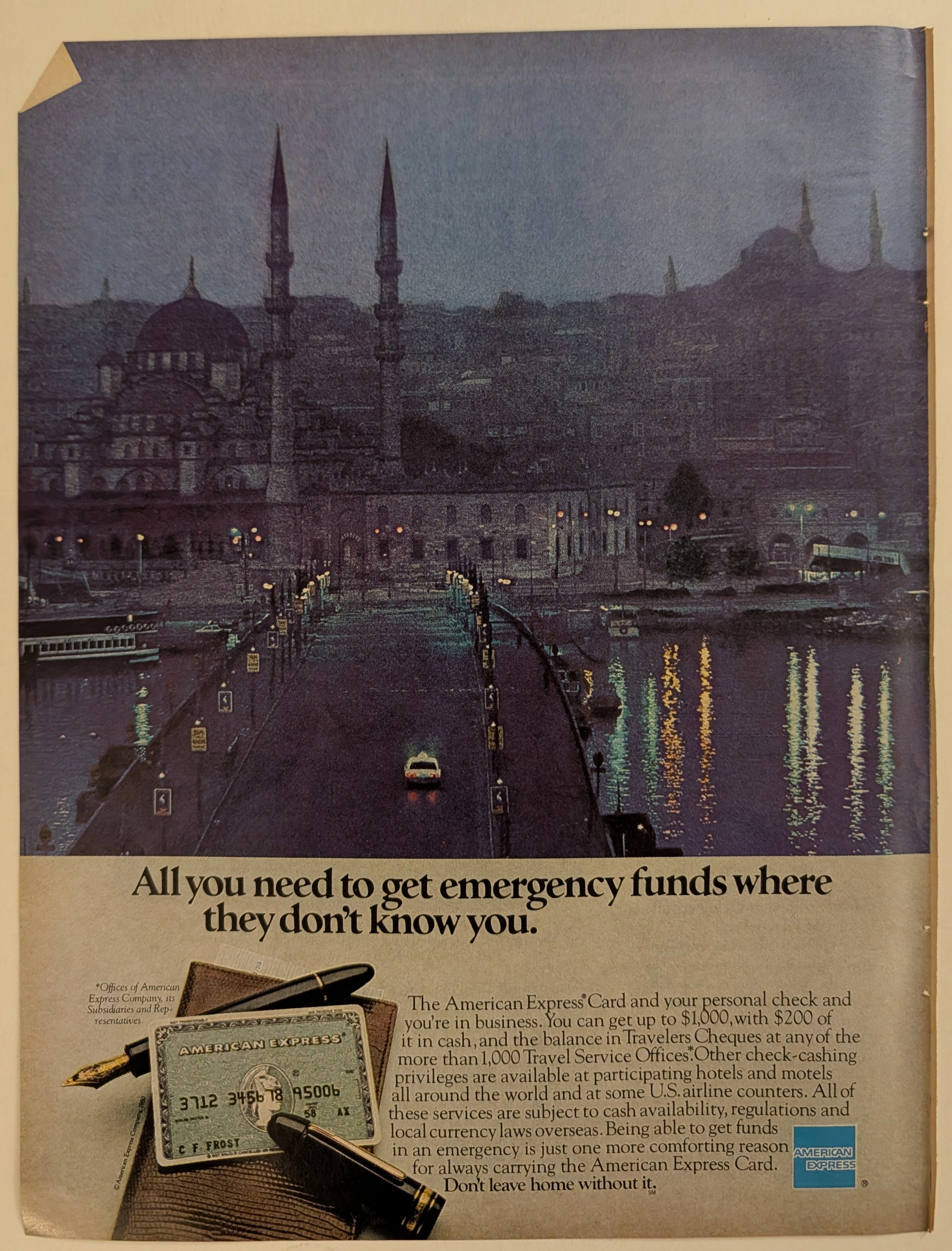
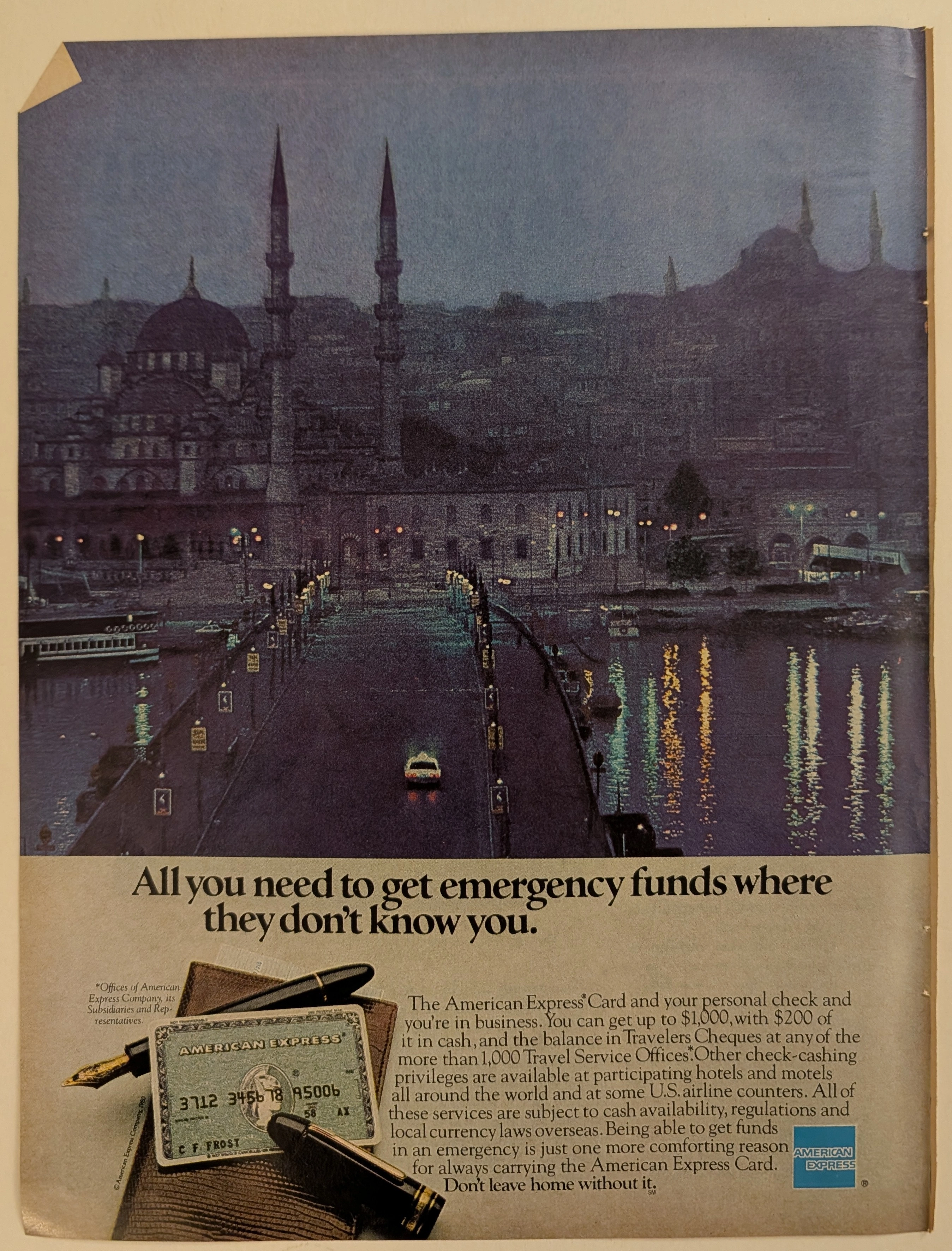
American Express understood this psychological undercurrent with clinical precision. The headline of the advertisement, "All you need to get emergency funds where they don't know you," taps directly into the primal fear of anonymity and helplessness in a foreign land. It does not sell credit; it sells the promise of institutional salvation.
American Express as a Sovereign Financial Entity
During this period, American Express was actively distancing itself from being perceived merely as a bank or a credit facility. Instead, the brand positioned itself as a global infrastructure—a quasi-sovereign entity whose power superseded local borders. The advertisement's body copy reveals the mechanics of this infrastructure, highlighting the network of "more than 1,000 Travel Service Offices."
For the American traveler, these offices functioned as commercial embassies. If catastrophe struck, the traveler could find sanctuary within these walls. The ad details the exact mechanics of this salvation: the ability to acquire up to "$1,000, with $200 of it in cash, and the balance in Travelers Cheques." This specific financial breakdown is a fascinating artifact of 1980s economic reality. Two hundred dollars in physical cash provided the immediate liquidity required for taxis, meals, and local tipping in developing economies, while the eight hundred dollars in Travelers Cheques provided a secure, universally accepted medium of exchange to settle hotel bills or purchase emergency return flights. American Express was marketing an entire ecosystem of survival.
The Semiotics of the Exotic: Istanbul at Dusk
The visual genius of this advertisement lies in its background plate—a deeply atmospheric, low-light photograph of Istanbul. From a semiotic perspective, the choice of Istanbul is masterfully calculated. To the Western consumer of 1980, Istanbul represented the ultimate intersection of the exotic, the historic, and the unknown. As the literal bridge between Europe and Asia, it is a city of profound beauty and staggering complexity.
The photograph captures the city at dusk, likely showing the silhouettes of the grand Ottoman-era mosques (such as the Yeni Cami or Süleymaniye) and the bustling waterways of the Golden Horn or the Bosphorus. The lighting is crucial: it is cast in moody, mysterious blues and purples, punctuated by the warm, glittering reflections of city lights bleeding into the water. This represents the "unknown" mentioned in the headline. It is breathtakingly beautiful, yet inherently intimidating. The dusk setting implies the approach of night, a time when vulnerability increases and the familiar becomes foreign. It is the perfect visual representation of "where they don't know you."
The Talismans of Western Affluence in the Foreground
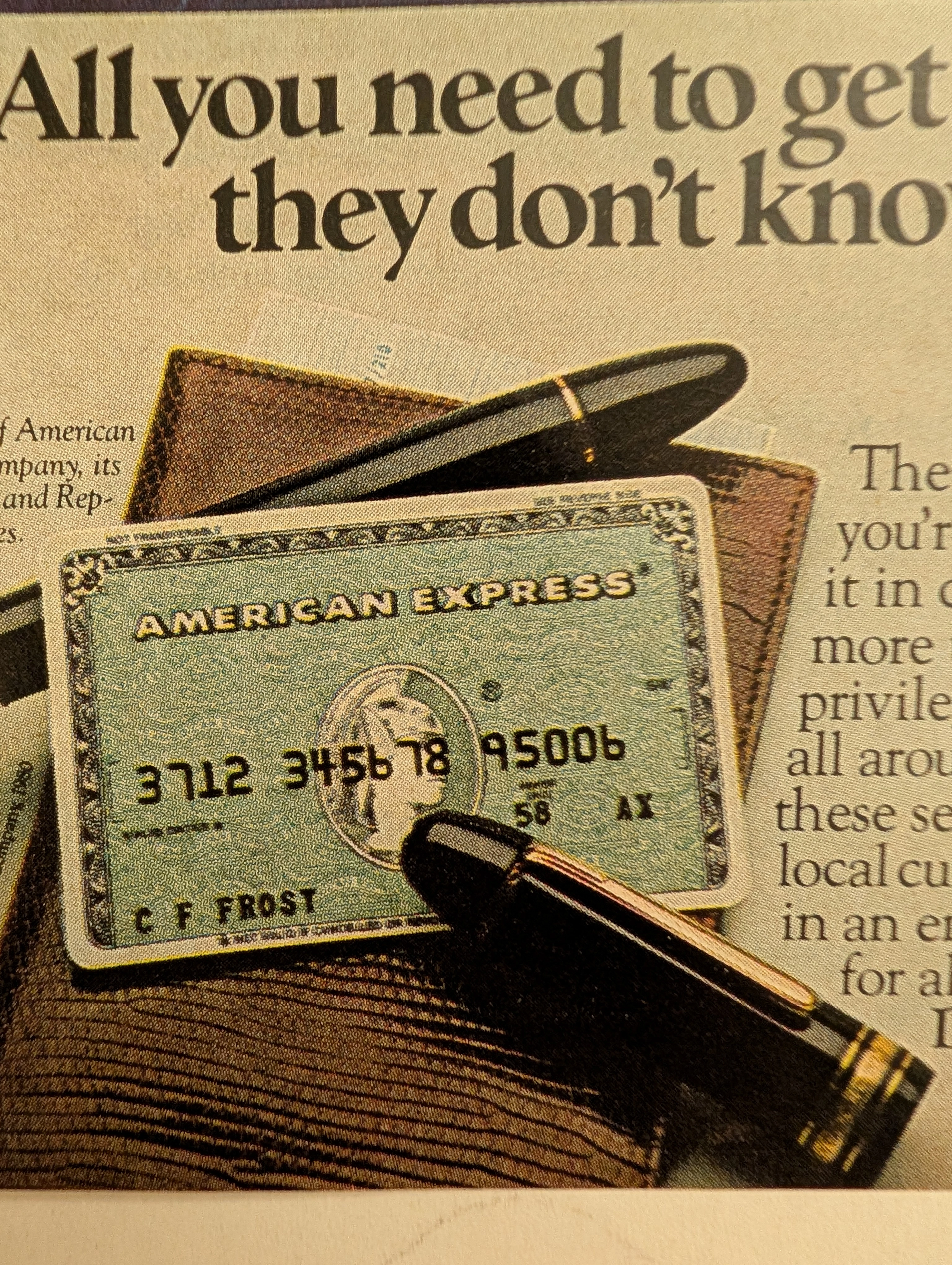
In violent, deliberate contrast to the mysterious and slightly chaotic backdrop of the foreign metropolis, the foreground of the advertisement is brightly lit, razor-sharp, and meticulously ordered. Here, resting on the textured leather of a premium wallet, lies the American Express Green Card (bearing the legendary placeholder name, C. F. Frost) alongside a high-end, gold-nibbed fountain pen.
These objects are not merely props; they are talismans of Western capitalism and affluence. The fountain pen suggests business, contracts, and authority. The leather wallet implies wealth and organization. And at the center of it all is the Green Card. The art direction uses a shallow depth of field to ensure the card remains the absolute focal point. It bridges the gap between the beautiful chaos of the foreign city and the structured safety of the traveler's home reality. The card is presented as an anchor—a singular piece of embossed plastic that commands respect and guarantees safety across the globe.
The Evolution of "Don't Leave Home Without It"
Finally, this advertisement serves as a vital chapter in the evolution of one of the most successful advertising slogans in history: "Don't leave home without it." Conceived in 1975 by the Ogilvy & Mather agency, the slogan was initially driven by television commercials featuring actor Karl Malden, who sternly warned viewers of the perils of traveling without American Express Travelers Cheques.
By 1980, as seen in this print campaign, the brand had evolved the narrative. They no longer needed a celebrity spokesperson to instill a sense of urgency. The imagery and the concept did the heavy lifting. The slogan, quietly placed at the bottom right corner alongside the corporate logo, had transitioned from a warning into a fundamental truth of international travel. This advertisement represents the maturation of the campaign, moving from direct television admonishments to sophisticated, cinematic print storytelling that appealed directly to the aspirations and anxieties of the global citizen.
The Paper
From an archival conservation standpoint, the physical artifact of this advertisement provides a textbook example of late-20th-century mass-market periodical printing.
Substrate Chemistry: The piece is printed on standard, lightweight coated magazine stock typical of 1980. This paper blend heavily utilized mechanical wood pulp, which inherently contains high levels of lignin. Over four decades, the exposure to ultraviolet light and atmospheric oxygen has triggered lignin oxidation. This is distinctly visible along the extreme margins of the page, where the paper has developed a warm, sepia-toned yellowing, commonly referred to in archival circles as "foxing" or acid burn.
Print Technology: The artifact utilizes four-color (CMYK) offset lithography. The most remarkable aspect of this specific print is its ink density and retention. To achieve the deep, brooding atmospheric blues and purples of the Istanbul skyline, the printers had to lay down significant amounts of cyan and key (black) ink. Despite the degradation of the paper's edges, the core image retains its saturation beautifully.
Halftone Precision: Furthermore, the registration of the halftone dots remains impeccably tight. This is most evident in the foreground elements; the iconic "Signature Green" of the American Express card, the gold foil stamping of the logo, and the sharp, legible embossing of the "3712" account number and the name "C F FROST" demonstrate the high tolerances maintained by premium magazine publishers of the era.
The Rarity
While millions of magazines were printed in 1980, locating financial ephemera from this exact period in museum-grade, display-worthy condition presents a significant challenge to archivists and collectors.
Survival Rates of Financial Marketing: The scarcity is largely driven by consumer behavior. Historically, collectors of vintage paper have prioritized aesthetic or hobbyist subjects—classic automotive advertisements, high fashion spreads, or iconic movie memorabilia. Advertisements concerning credit facilities, banking, or travel insurance were overwhelmingly viewed as utilitarian clutter and were consequently discarded.
A Transitional Economic Artifact: This specific piece commands a premium due to its historical context. It captures a fleeting, transitional moment in global finance: the era where paper-based Travelers Cheques were still heavily relied upon (as explicitly detailed in the ad copy's $800 cheque breakdown), yet the plastic Charge Card was rapidly ascending as the primary symbol of financial identity.
Institutional Value: In today's antiquarian market, this advertisement transcends mere nostalgia. It is highly valued by institutions focusing on economic history, the evolution of global tourism, and graphic design archives studying the legendary Ogilvy & Mather campaigns. It is a pristine record of how trust and credit were commodified and marketed at the dawn of the modern globalized economy.
Visual Impact
The visual impact is rooted in a masterful application of high-contrast semiotics. The composition deliberately splits the viewer's psychological state. The background—a sweeping, low-light, grainy photograph of an exotic city—induces a sense of awe mixed with mild trepidation. It is vast and uncontrollable. Conversely, the foreground is intensely sharp, brilliantly lit, and perfectly ordered, focusing on the tactile textures of leather, gold, and embossed plastic. This visual dichotomy effortlessly guides the viewer to the intended emotional conclusion: the world is wildly unpredictable, but the American Express card is an absolute certainty. The classic serif typography further grounds the imagery, lending an authoritative, institutional voice to the brand's promise.
Exhibition Halls
The Archive Continues
Continue the Exploration
THE TIME TRAVELER'S DOSSIER: THE DAWN OF ELEGANCE AND THE EXTINCT $1,500 HOLY GRAIL
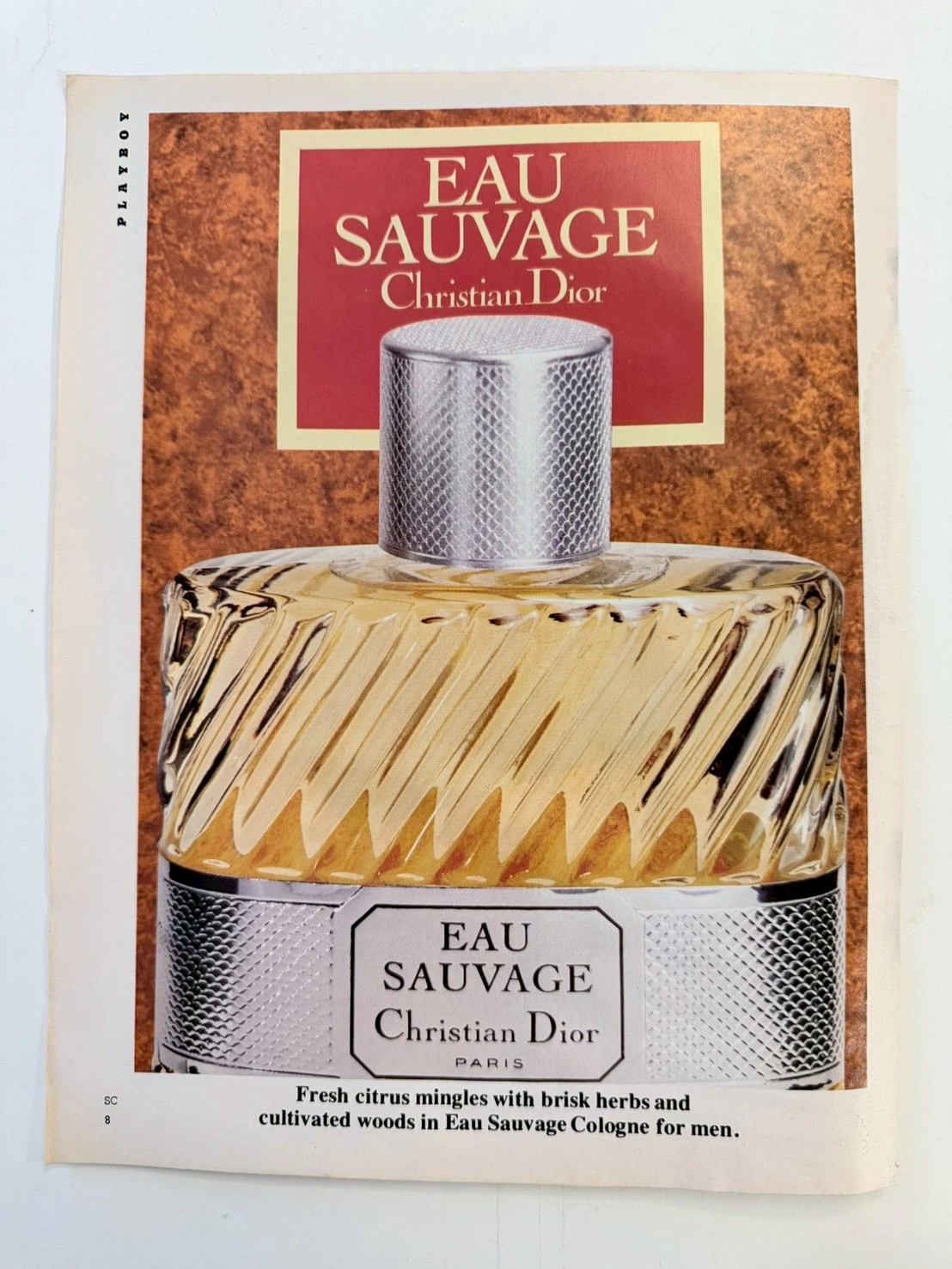
The artifact under museum-grade analysis is an exceptionally preserved Historical Relic originating from the golden age of analog publishing—a vintage issue of PLAYBOY magazine (circa late 1960s to 1970s). It features a striking, deeply sophisticated advertisement for one of the most revolutionary men's fragrances in modern human history: EAU SAUVAGE by Christian Dior. This Primary Art Document does not merely advertise a grooming product; it serves as a tangible historical marker of a monumental cultural paradigm shift. Prior to its introduction in 1966, men's fragrances were exclusively heavy, musky, and brutally spiced. Eau Sauvage, formulated by the legendary Master Perfumer Edmond Roudnitska, shattered this archaic mold by introducing Hedione (an airy, luminous synthetic jasmine compound) to men's perfumery, forever altering the trajectory of the global fragrance industry. Crucially, the original mid-century formulation and the specific ribbed-glass bottle design depicted in this artifact are permanently discontinued and lost to time. Modern reformulations driven by strict chemical regulations (such as the banning of natural oakmoss) have forever altered Roudnitska's original masterpiece. Consequently, surviving vintage bottles of this exact era have achieved mythical "Holy Grail" status, currently commanding astronomical prices of up to $1,500 USD in the global collector's market. This transforms the preserved advertisement from a commercial print into an invaluable piece of historical provenance—a birth certificate for an extinct luxury. Rescued from destruction and preserved as a standalone Archival Artifact, the inherently acidic, glossy paper stock of the mid-century era is undergoing a slow, breathtaking chemical degradation. This natural aging process (oxidation and lignin breakdown) transforms the mass-produced print into an irreplaceable, ready-to-frame Primary Art Document, embodying the ultimate aesthetic of analog impermanence.
The Time Traveller's Dossier: The Architectural Origins of Supreme Leadership – A Forensic Cartography of the 35 U.S. Presidents (Circa 1960s)
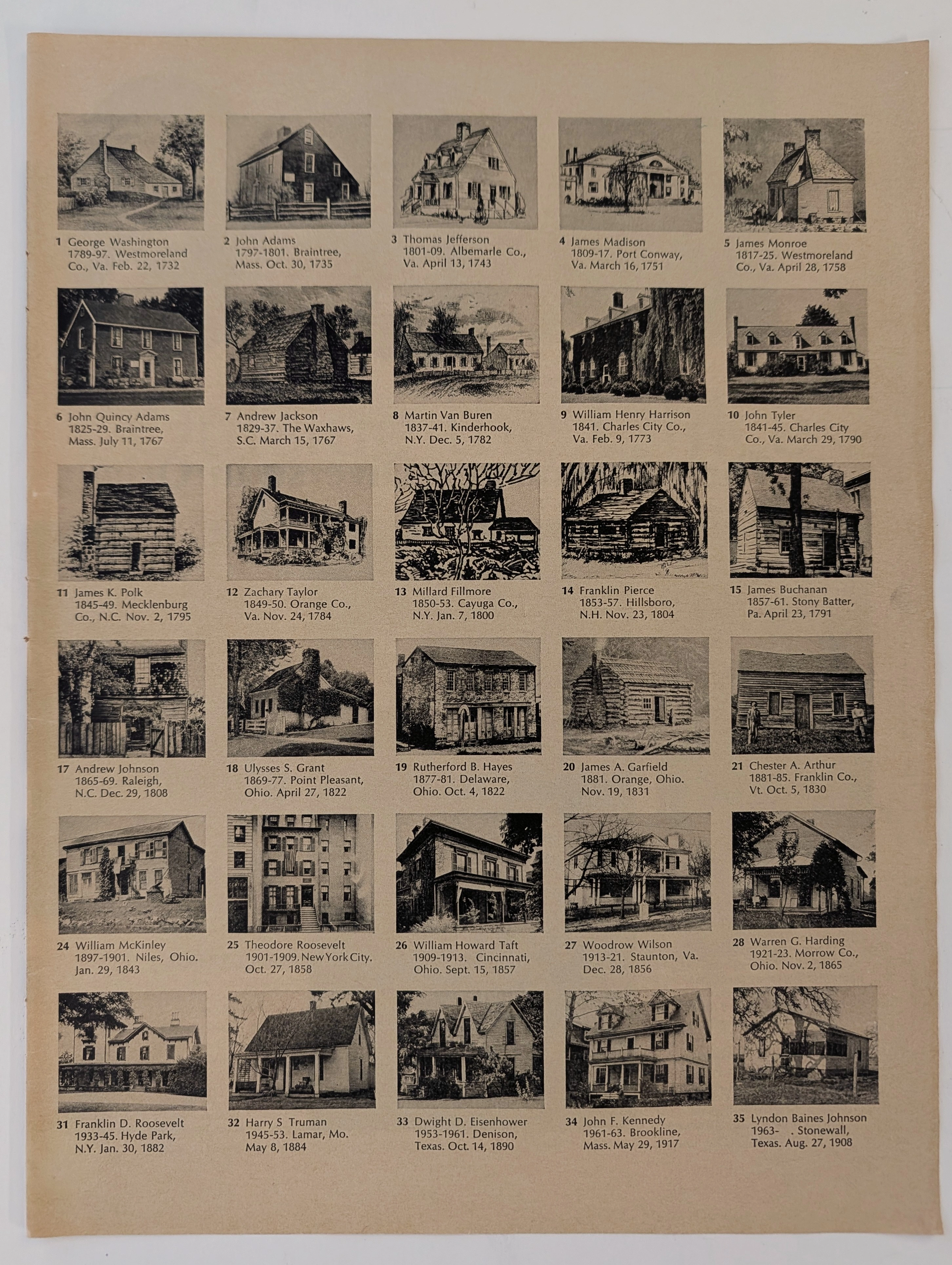
The documentation of historical dwellings provides a profound, irreplaceable intersection between architectural evolution, sociology, and national geopolitical heritage. Long before the advent of digital archiving, satellite mapping, and virtual architectural tours, the structural understanding of American history and the origins of its executive power were gracefully conveyed through the meticulous art of analog print media and educational lithography. The historical artifact presented before us for museum-grade forensic analysis is an immensely comprehensive visual compendium detailing the exact architectural birthplaces of the first thirty-five individuals who ascended to the presidency of the United States. Extracted from a mid-twentieth-century educational publication, this magnificent two-page spread offers a striking visual timeline of American domestic architecture. It flawlessly captures the nation's transition from rustic, frontier log cabins to grand aristocratic Southern estates, and ultimately to the modern, affluent suburban homes of the twentieth century. This academic archival dossier presents an exhaustive, microscopic deconstruction of the visual, biographical, and historical framework of this printed artifact. Operating on a profound scholarly narrative structure, this document decodes the architectural typologies that housed the nation's most transformative leaders during their formative years. Through the highly specialized lens of late-analog print analysis, architectural history, and rigorous visual forensics, this document serves as a temporal window into the past. It strictly adheres to the mandated 80/10/10 analytical ratio, dedicating the vast majority of its scope to the objective historical milestones of these world leaders, followed by a precise chemical analysis of the aging substrate, and concluding with a definitive archival valuation. Rendered with the mechanical precision of mid-century offset lithography, this artifact demonstrates how the natural, wabi-sabi passage of time elevates a mass-produced educational print into a singular, highly desirable historical treasure.
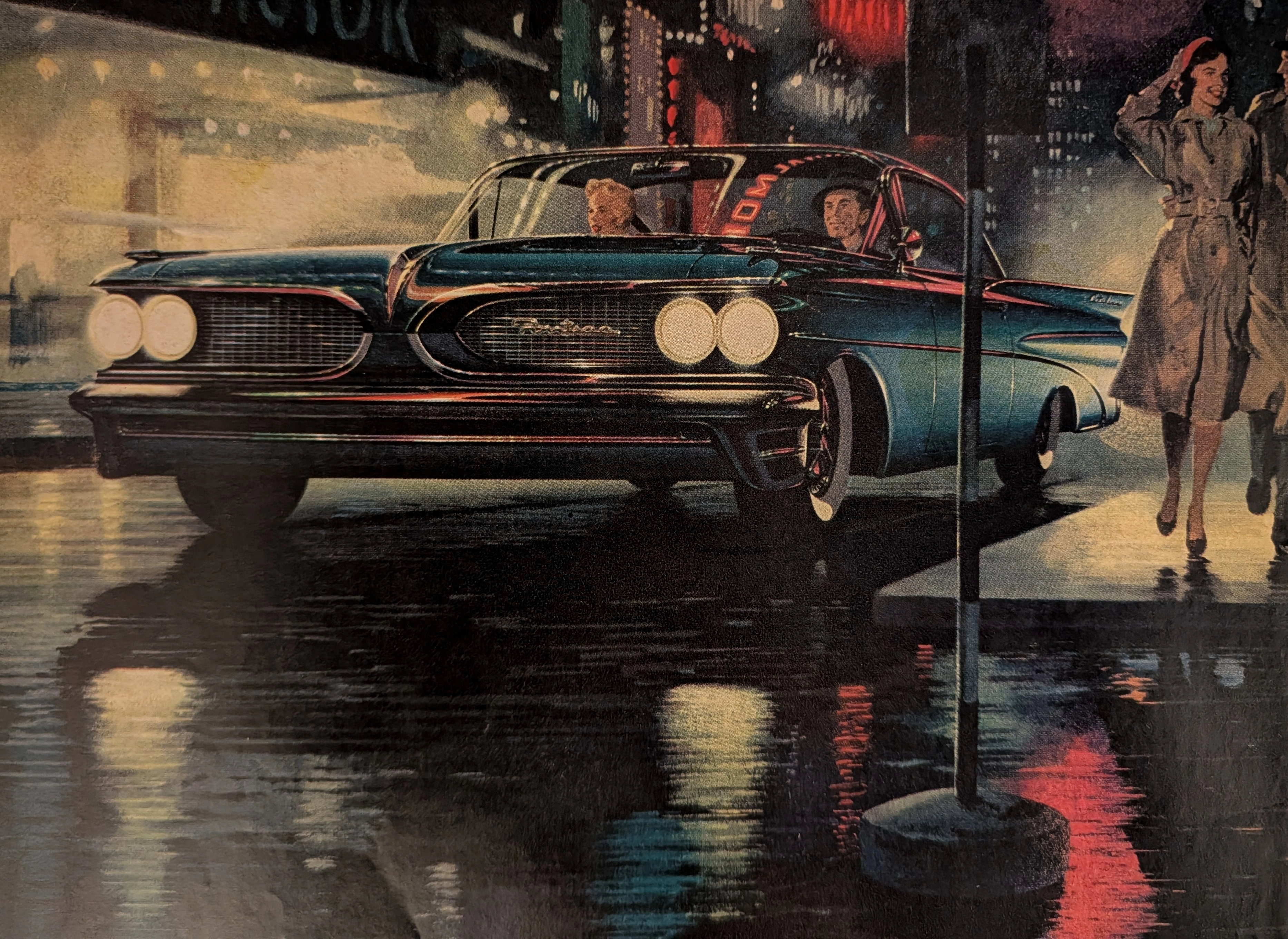
Pontiac · Automotive
THE TIME TRAVELER'S DOSSIER :THE BIRTH OF THE WIDE-TRACK
The artifact currently subjected to our uncompromising, museum-grade analysis is a profoundly preserved Historical Relic excavated from the turning point of Detroit's "horsepower and handling" wars. This Primary Art Document is a full-page magazine advertisement for the 1959 Pontiac, explicitly introducing the brand's revolutionary "Wide-Track" engineering. Functioning as a "Forensic Blueprint of Automotive Rebranding," the document masterfully weaponizes the peerless artistic talents of Fitz and Van to transform Pontiac from a conservative, aging brand into America's most aggressive performance marque. Its historical context is irrefutably anchored by the extreme macro details of its proprietary engineering claims and the highly coveted "Body by Fisher" corporate hallmark. Grounded by these physical timestamps, the microscopic artist signature, and its breathtaking wabi-sabi chemical degradation, this artifact commands an irreplaceable status, cementing its Rarity Class A designation.