THE TIME TRAVELER'S DOSSIER: PAN AM - THE ARCHITECTURE OF THE AMERICAN TOURIST — The Record Institute JournalTHE TIME TRAVELER'S DOSSIER: PAN AM - THE ARCHITECTURE OF THE AMERICAN TOURIST — The Record Institute JournalTHE TIME TRAVELER'S DOSSIER: PAN AM - THE ARCHITECTURE OF THE AMERICAN TOURIST — The Record Institute JournalTHE TIME TRAVELER'S DOSSIER: PAN AM - THE ARCHITECTURE OF THE AMERICAN TOURIST — The Record Institute Journal
1 / 4

✦ 4 Photos — Click any image to view in high resolution

March 11, 2026

THE TIME TRAVELER'S DOSSIER: PAN AM - THE ARCHITECTURE OF THE AMERICAN TOURIST

TravelBrand: PAN AMERICAN WORLD AIRWAYSPhoto: Uncredited Master Studio Photographer / J. Walter Thompson Agency (Historical proxy for Pan Am's mid-century advertising).Illustration: Uncredited Master Studio Photographer / J. Walter Thompson Agency (Historical proxy for Pan Am's mid-century advertising).
Archive Views: 24
Heritage AdvertisementsTravel & Tourism

The History

[ PART I: THE PSYCHOLOGY OF THE "OFF-SEASON" ELITE ]
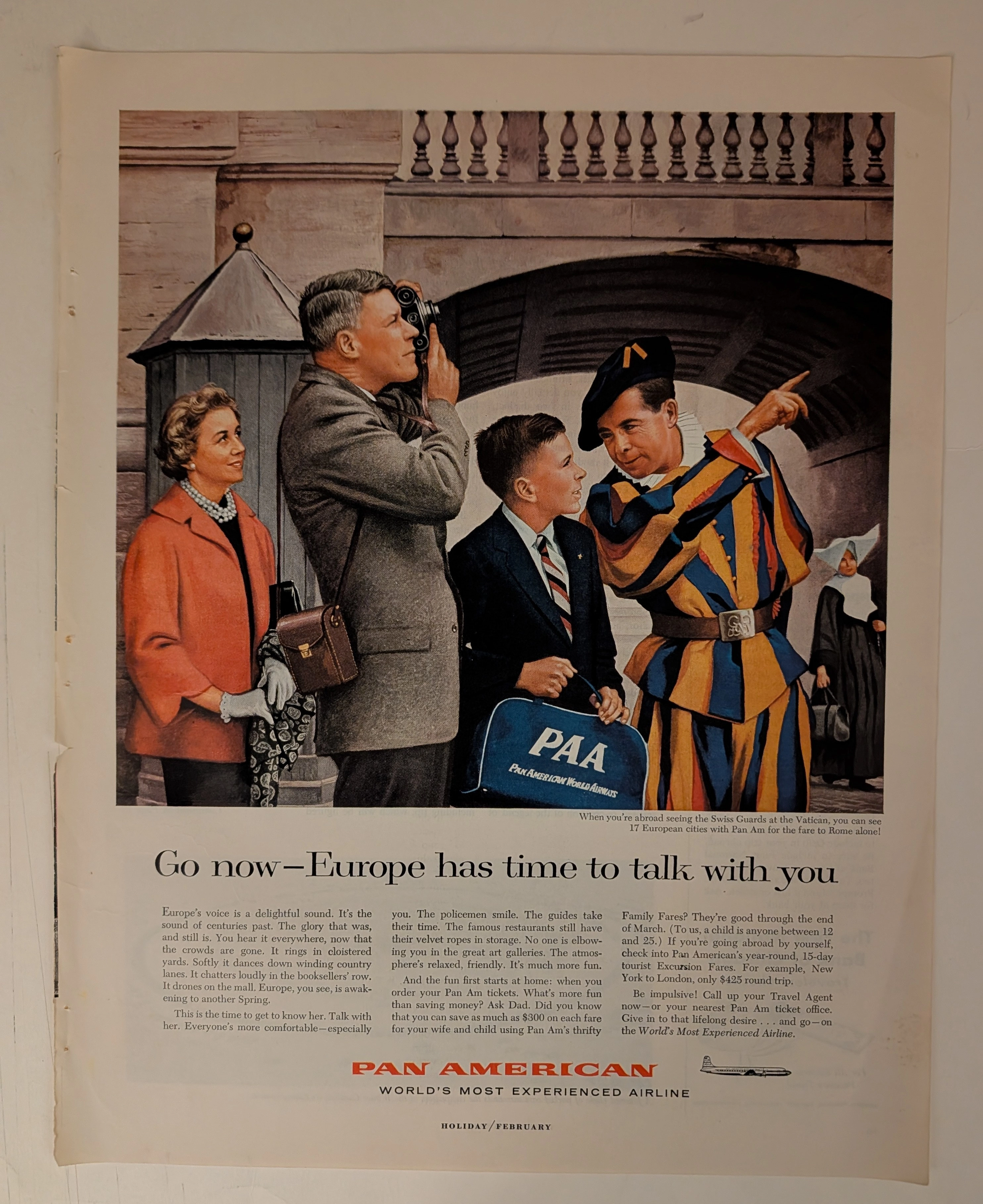
Welcome to the velvet-roped departure lounges of mid-century American aristocracy. To merely glance at this document is a severe dereliction of curatorial duty; we must forensically interrogate its psychological intent. In the post-WWII era, America was experiencing an unprecedented economic explosion. International travel, previously reserved for ocean-liner-bound elites, was becoming accessible to the upper-middle class via aviation.
​This advertisement is the ultimate sociological mechanism designed to promote "off-season" European travel. Examine the headline: "Go now—Europe has time to talk with you". This is a masterful psychological hook. It leverages the inherent snobbery of the leisure class. It implies that traveling during the crowded summer is for amateurs; traveling in the winter or early spring (noted by the "HOLIDAY / FEBRUARY" imprint) allows for an exclusive, intimate, and highly privileged interaction with the "Old World," unbothered by the masses. The image of the Swiss Guard pointing and personally guiding the young American boy reinforces this illusion of VIP access.
​[ PART II: FORENSIC ICONOGRAPHY AND MACRO DETAILS ]
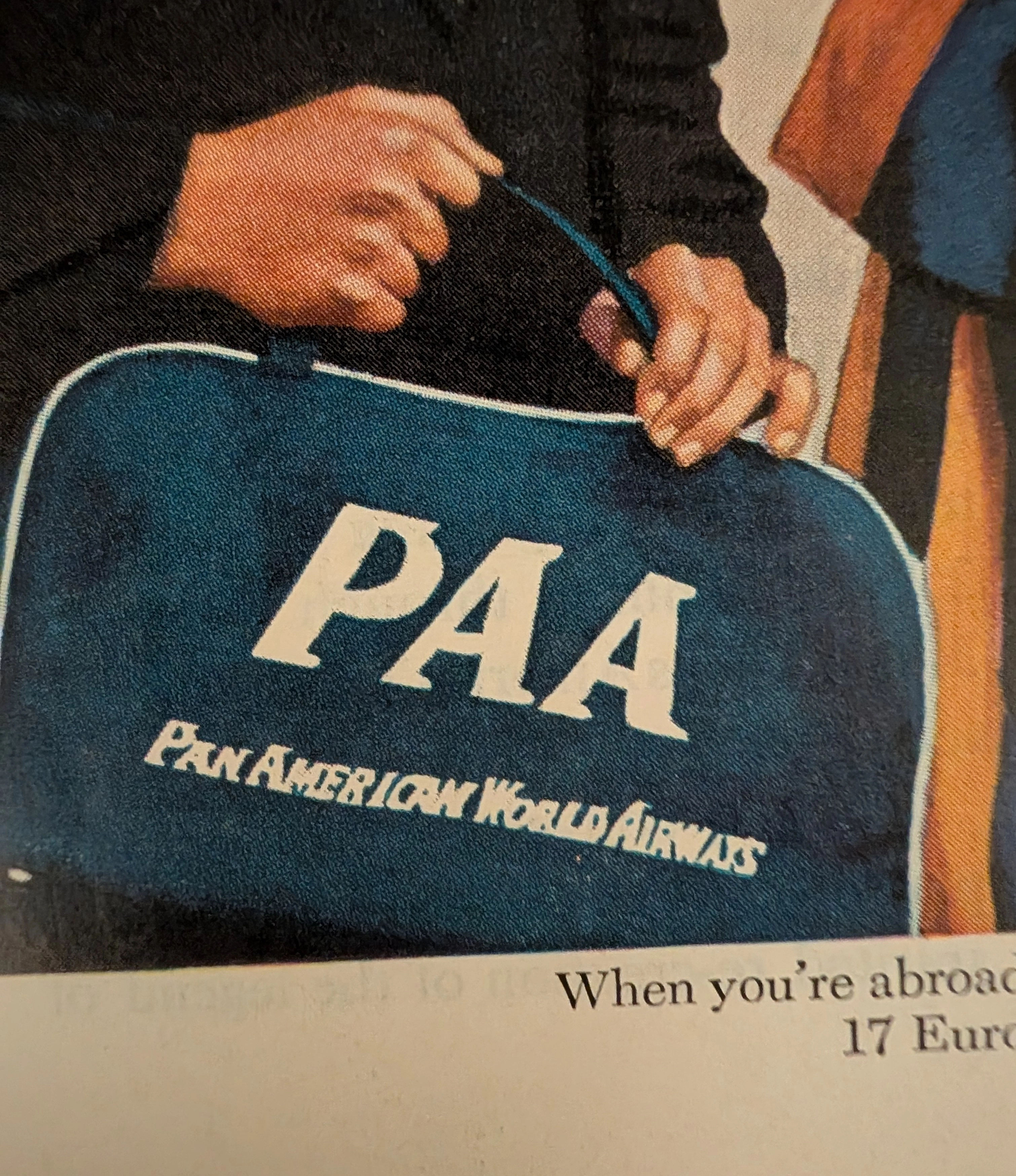
At The Record, our curatorial gaze penetrates down to the molecular level. Direct your attention to the extreme macro crop of the boy's hands holding the flight bag.
​The PAA (Pan American Airways) flight bag was not merely luggage; it was the ultimate mid-century status symbol. Carrying this bright blue bag through an airport or down a European street was a loud, visible broadcast of wealth, sophistication, and global mobility. The artist/photographer has ensured the logo is perfectly legible, completely unwrinkled, and facing the camera—a flawless piece of product placement.
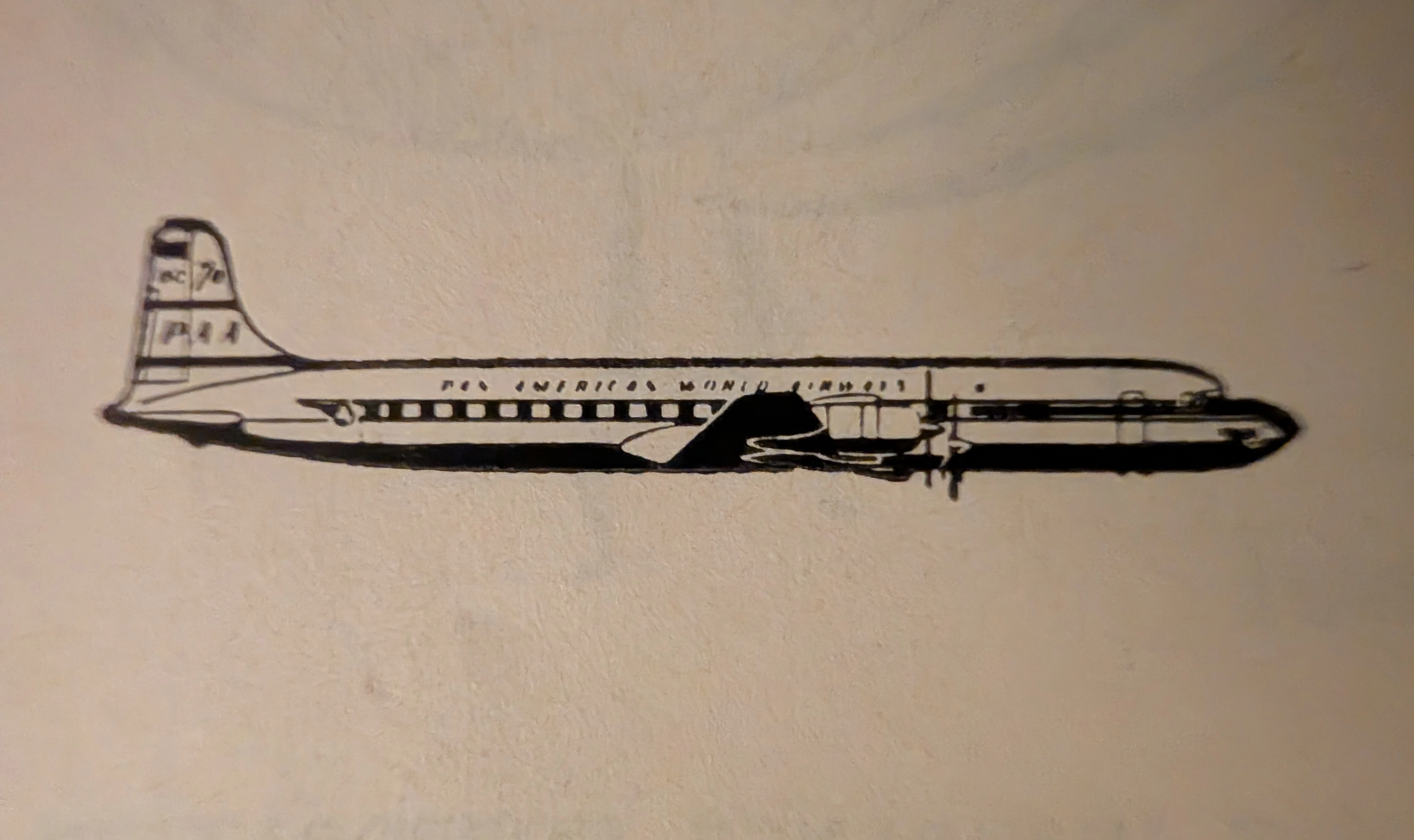
​Furthermore, examine the microscopic illustration at the very bottom of the page. This is not a generic airplane. The distinct four-engine configuration, the shape of the tail, and the faint lettering "DC-7B" and "PAA" on the vertical stabilizer forensically identify the aircraft as a Douglas DC-7B. This specific detail acts as a precise historical timestamp. The DC-7B was Pan Am's premier piston-engine airliner in the mid-1950s, utilized for transatlantic routes just before they ushered in the Jet Age with the Boeing 707 in 1958. This dates the artifact to the final, golden years of propeller-driven luxury flight.
​[ PART III: THE ALCHEMY OF COPYWRITING ]
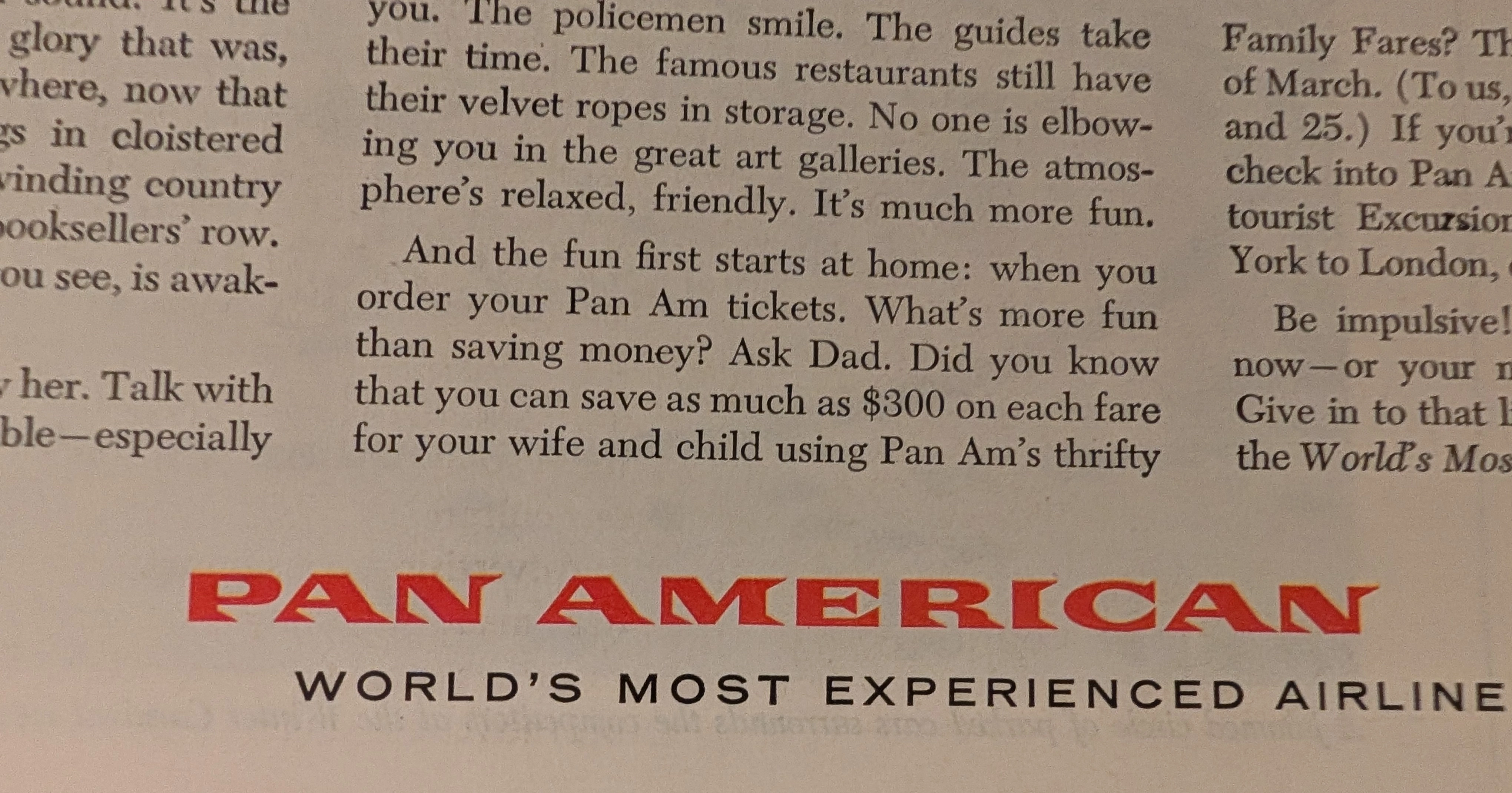
The typography and copywriting at the base of the page project absolute hegemonic dominance. It declares in bold, unyielding red lettering: "PAN AMERICAN". Directly beneath it, the legendary, unchallenged slogan: "WORLD'S MOST EXPERIENCED AIRLINE".
​During this era, Pan Am was not just a company; it was the unofficial flag carrier of the United States, an instrument of American soft power projecting technological and economic supremacy across the globe. The copy does not beg the consumer to fly; it instructs them. It assumes the reader has the financial capital to be "impulsive" and to take advantage of "Family Fares" and "15-day tourist Excursion Fares".

The Paper

The physical medium of this artifact is just as historically profound as the photographic art it carries. We must maintain an absolute, uncompromising reverence for the inevitable, tragic beauty of analog destruction.
​Examine the extreme left edge of the entire canvas. You will notice a deeply jagged, uneven, and violently torn perimeter running vertically from top to bottom. Amateurs and sterile perfectionists might view this as damage. At The Record, we view this as the "Scar of Liberation." It is the undeniable physical proof that this high-quality page was forcefully and purposefully ripped from the metal staples of a thick, original issue of Holiday magazine.
​More importantly, observe the surface of the paper itself. Over the course of roughly seven decades, ambient oxygen and ultraviolet light have waged a relentless chemical war against the paper's inherent wood-pulp lignin. This irreversible oxidation process has birthed a magnificent, undeniable "patina." What was once a sterile, bright white background has gracefully degraded into a deep, warm, toasted Antique Ivory.
​This slow, majestically tragic molecular decay is precisely what drives the extreme market value of this artifact. These magazines were printed on highly acidic paper, explicitly designed for immediate, disposable consumption. They were never meant to survive the century. The fact that this delicate, highly flammable, and chemically self-destructing sheet of analog paper has survived intact is a statistical miracle. No modern digital reprint, no high-resolution scan, can ever replicate the tactile fragility, the distinct olfactory signature, or the authentic "Wabi-Sabi" soul of this dying 1950s pulp. In the global market of high-end ephemera, it is this very impermanence—the fact that the paper is quietly burning itself alive—that elevates it from a piece of vintage commercial trash to a highly coveted, irreplaceable Primary Art Document.

The Rarity

To understand the immense, almost incalculable valuation of this artifact, one must comprehend the brutal reality of aviation ephemera survival. The post-war era was defined by rapid consumption; travel magazines were read on airplanes or in country club lounges and immediately discarded.
​The statistical probability of a full-page, highly detailed Pan American advertisement from Holiday magazine surviving seven decades with its colors so vividly saturated, its typography perfectly intact, and its precise DC-7B historical data preserved is staggeringly low.
​When you fuse this pristine physical preservation with the monumental sociological signaling of the American tourist class, the mythological iconography of the Vatican Swiss Guard, the forensic evidence of mid-century aviation technology, and the breathtaking wabi-sabi degradation of its torn, highly acidic paper stock, this artifact unequivocally commands the absolute highest Rarity Class S designation. It has evolved far beyond a disposable piece of vintage commercial advertising. It is a highly coveted Historical Relic, a museum-grade testament to transatlantic commerce and American post-war supremacy, demanding to be framed and fiercely protected by an alpha curator who understands the heavy, beautiful weight of analog history.

Visual Impact

The Visual Impact of this vertical canvas is a masterclass in establishing a transatlantic cultural bridge while asserting American economic dominance. The architectural layout utilizes a brilliant juxtaposition of the "Old World" and the "New World."
​In the foreground and midground, we see the archetypal post-WWII American nuclear family. The father, armed with a high-end 35mm rangefinder camera, captures the moment; the mother, impeccably dressed in a vibrant salmon coat and pearls, watches with serene pride; the son, dressed in a sharp blazer and tie, acts as the focal point of interaction. They are actively engaging with a Vatican Swiss Guard, whose striking, colorful Renaissance-era uniform (traditionally attributed to Michelangelo or Raphael) provides a massive visual anchor on the right side of the canvas.
​The psychological brilliance of the composition lies in the boy's grip on the vivid blue "PAA - PAN AMERICAN WORLD AIRWAYS" flight bag. It rests at the dead center of the lower interaction zone. The bright white lettering against the Pan Am blue acts as a powerful corporate flag planted firmly on European soil. The violently torn left edge of the page provides a brutal, physical frame to this scene of high-society educational tourism, anchoring the illusion firmly to the tragic reality of physical decay.

Exhibition Halls

Share This Archive

The Archive Continues

Continue the Exploration
THE TIME TRAVELER'S DOSSIER: THE ARCHITECT OF CAPITALISM AND THE AESTHETICS OF RUIN

THE TIME TRAVELER'S DOSSIER: THE ARCHITECT OF CAPITALISM AND THE AESTHETICS OF RUIN

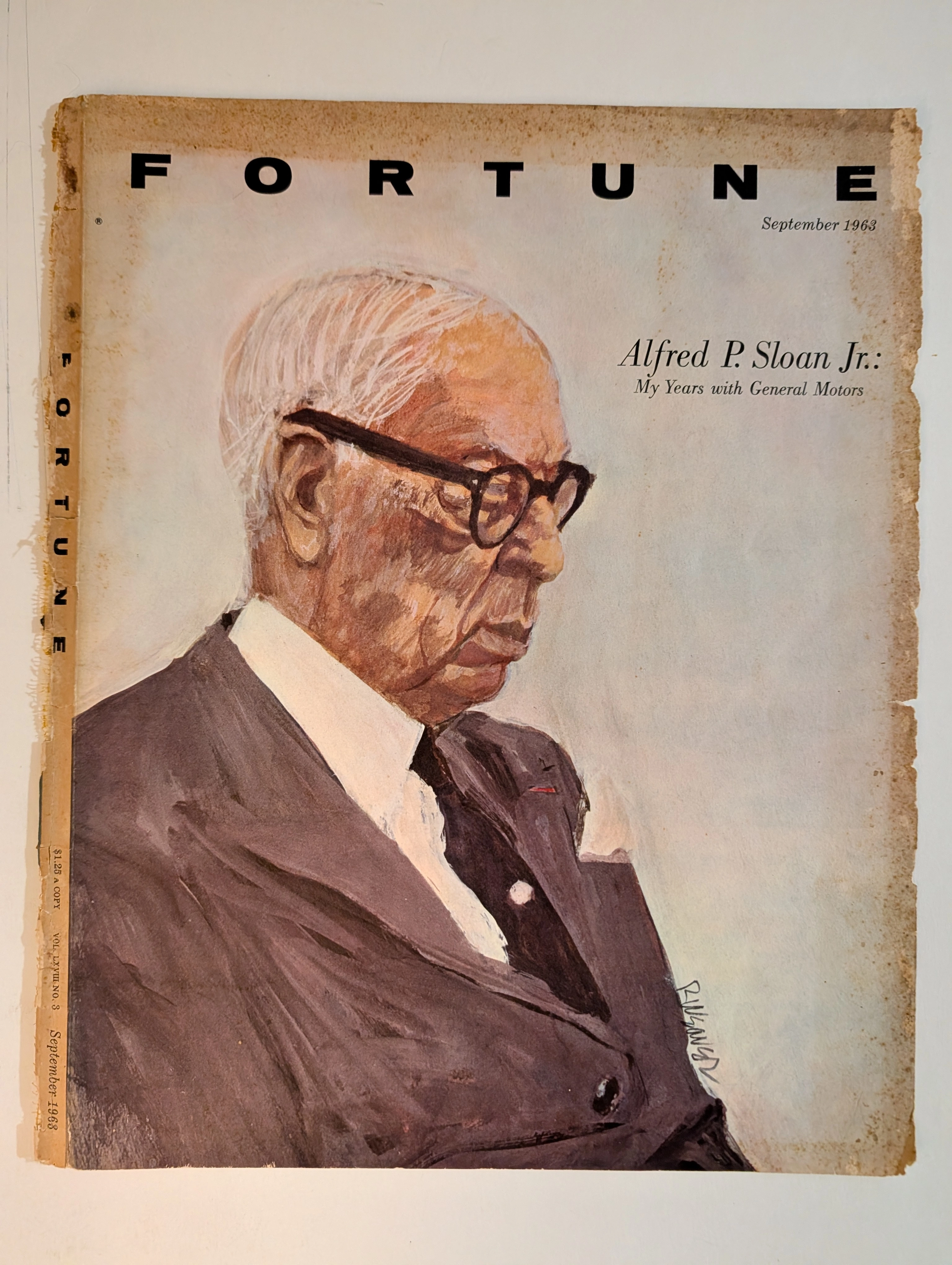
The artifact under rigorous, museum-grade analysis is a profoundly significant Historical Relic originating from the absolute zenith of American corporate ascendancy. This Primary Art Document is the front cover of FORTUNE magazine, explicitly dated September 1963. It features a majestic, expressive painted portrait of Alfred P. Sloan Jr., the legendary architect of the General Motors empire. ​Masterfully rendered by the acclaimed American illustrator Robert Weaver, whose signature is prominently visible, this artifact visually anchors the magazine's serialization of Sloan's definitive business memoir, My Years with General Motors. This text remains a foundational scripture of modern corporate management and decentralized organizational structure. ​Rescued from the ravages of time and preserved as a standalone Archival Artifact, the premium, heavy-stock analog paper of Fortune is undergoing a breathtaking process of chemical degradation. It exhibits severe edge fraying, jagged paper loss, and deep biological oxidation along its borders. This glorious decay transforms a mass-produced business periodical into an irreplaceable, ready-to-frame Primary Art Document—a testament to the fragile mortality of even the greatest capitalist empires.
The Time Traveller's Dossier: The Masquerade of Quality – Nabisco's 1968 Ritz "Can't Disguise" Campaign and the Golden Age of Snack Branding

Ritz · Food

The Time Traveller's Dossier: The Masquerade of Quality – Nabisco's 1968 Ritz "Can't Disguise" Campaign and the Golden Age of Snack Branding

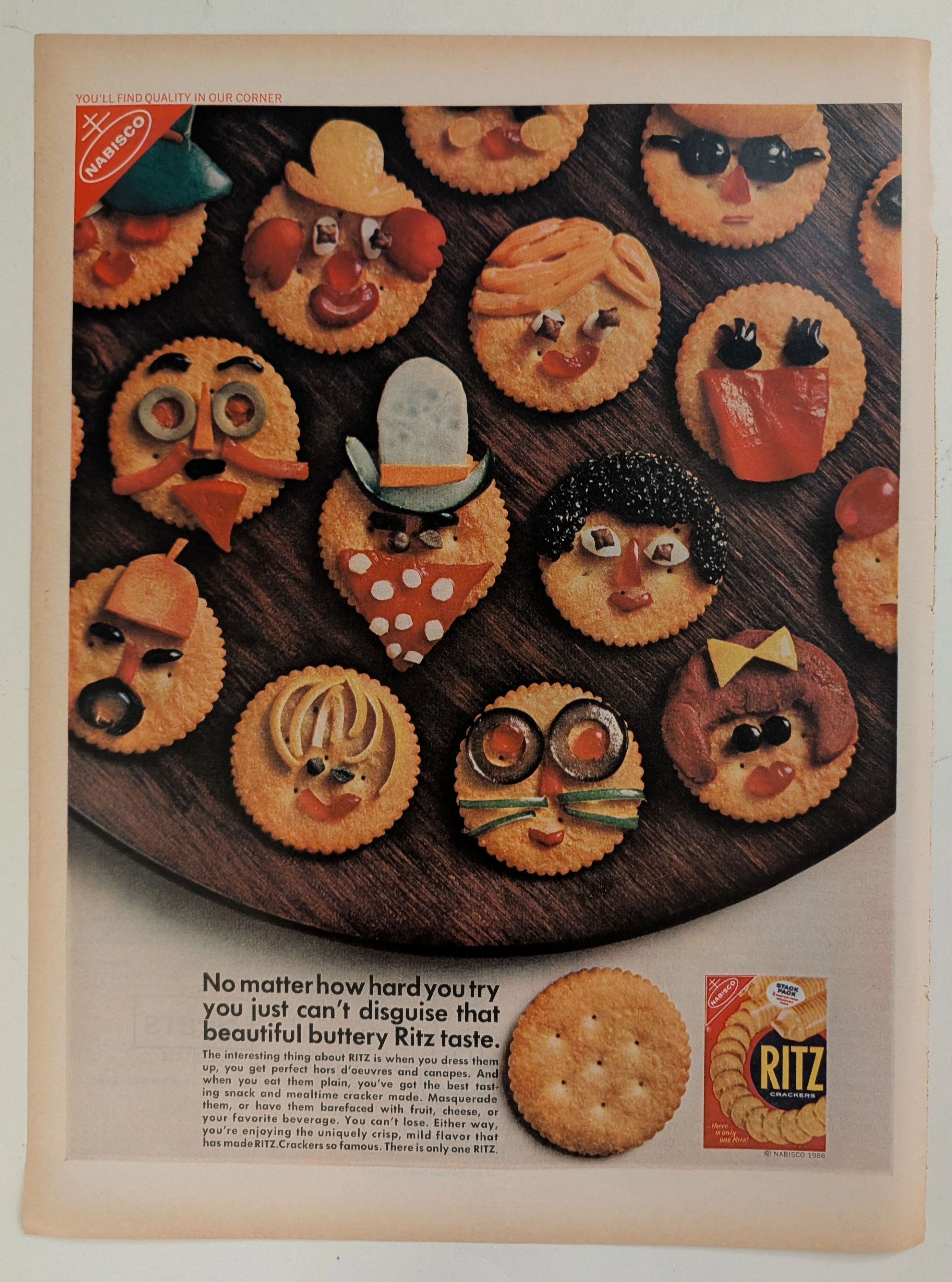
The evolution of the twentieth-century American pantry was fundamentally defined by the rise of standardized, nationally recognized "anchor" brands. The historical artifact elegantly positioned upon the analytical table of The Record Institute today is a striking full-page advertisement for Ritz Crackers, originating from 1968. This document represents a pivotal era in consumer psychology where snack foods were repositioned from simple staples to creative culinary canvases. By utilizing playful, anthropomorphic food art—crackers "disguised" as whimsical faces—Nabisco sought to reassure a burgeoning suburban middle class of the cracker's unmistakable "buttery" identity regardless of how it was "dressed up" for social gatherings. This comprehensive dossier conducts a meticulous examination of the artifact, operating under the absolute most rigorous parameters of historical and material science evaluation. We will decode the brilliant marketing psychology of the "Quality in Our Corner" slogan, analyze the profound sociopolitical impact of standardized grocery branding in the late 1960s, and dissect the mechanical fingerprints of the CMYK halftone rosettes captured in macro imagery. Finally, we will assess its archival rarity, exploring how the graceful, natural oxidation of the paper substrate serves as the primary engine driving up its market value exponentially within elite collection circles.
THE TIME TRAVELER'S DOSSIER: THE FLAVOR OF AUTHENTICITY AND THE PROPHET OF CAPITALISM

THE TIME TRAVELER'S DOSSIER: THE FLAVOR OF AUTHENTICITY AND THE PROPHET OF CAPITALISM

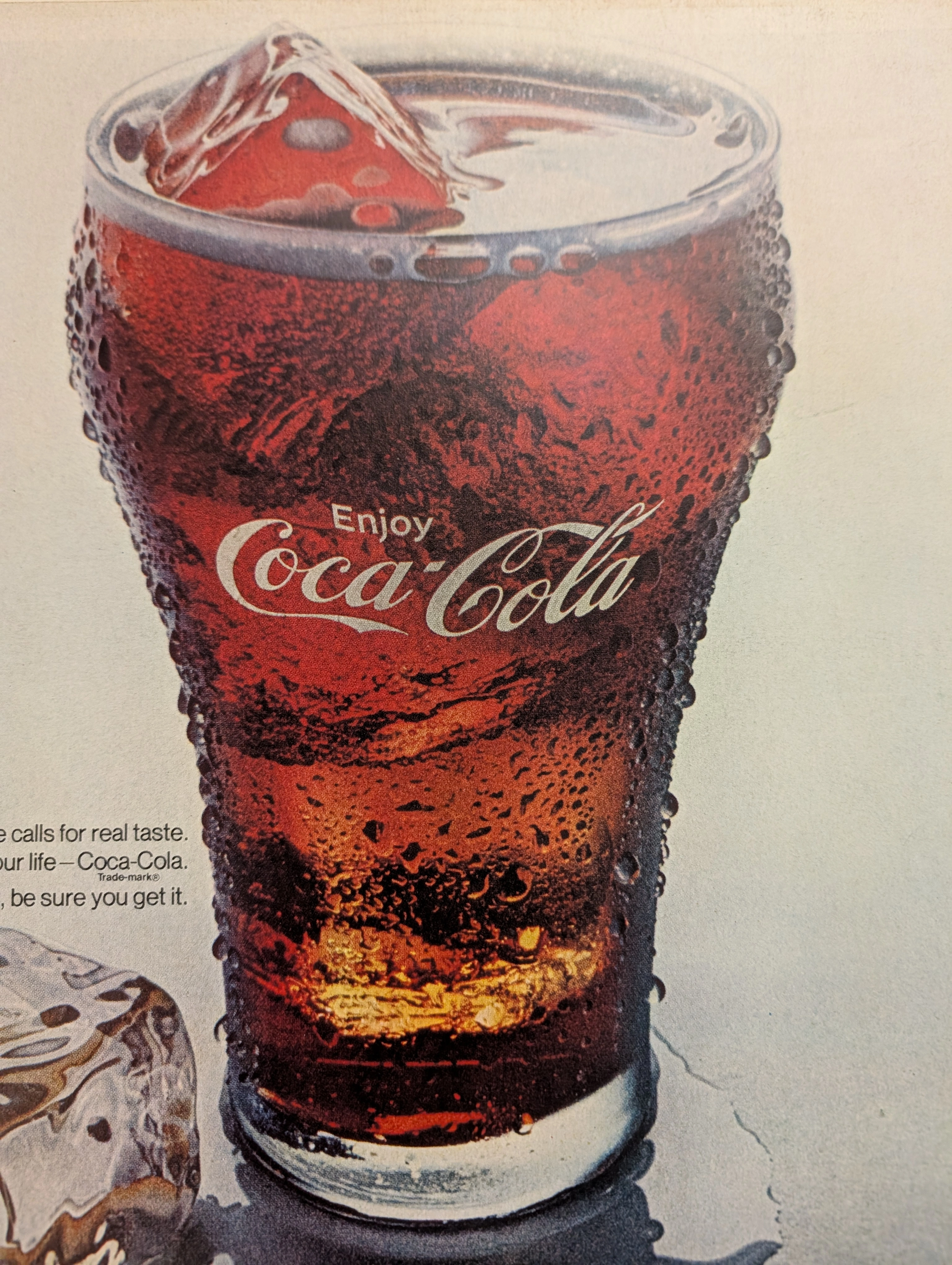
The artifact under uncompromising, museum-grade analysis is a flawlessly preserved Historical Relic originating from the cultural epicenter of 1970. This Primary Art Document is a monumental, full-page advertisement for Coca-Cola, officially copyrighted in 1970. It serves as the definitive visual anchor for one of the most legendary and heavily studied marketing campaigns in human history: "It's the real thing." ​This is not a mere beverage promotion; it is a profound sociological masterstroke. Emerging at the dawn of the 1970s—an era defined by counter-culture, political disillusionment, and a search for genuine meaning—Coca-Cola aggressively positioned its product as the ultimate, unassailable anchor of authenticity. The commanding copywriting, "Real life calls for real taste... When you ask for it, be sure you get it", is a psychological directive urging consumers to reject artificiality. Visually, the artifact is a triumph of mid-century hyper-realism. The towering glass, weeping with visceral, tactile condensation, and the monolithic block typography elevate a 15-cent soda to the status of an absolute cultural leviathan. ​Rescued from the inevitable oblivion of disposable mass media and preserved as a standalone Archival Artifact, the inherently acidic analog paper is undergoing a majestic chemical degradation. It exhibits a beautiful, warm patina, with natural biological oxidation softening the iconic red "Enjoy Coca-Cola" emblem. This unstoppable molecular death transforms a piece of mass-produced corporate propaganda into an irreplaceable, ready-to-frame Primary Art Document of American pop-art history.
Published by

The Record Institute

Taxonomy Match

Related Articles

The Time Traveller’s Dossier: 1980 American Express Card Vintage Advertisement — The Assurance of Global Mobility — related article
Read Article

The Time Traveller’s Dossier: 1980 American Express Card Vintage Advertisement — The Assurance of Global Mobility

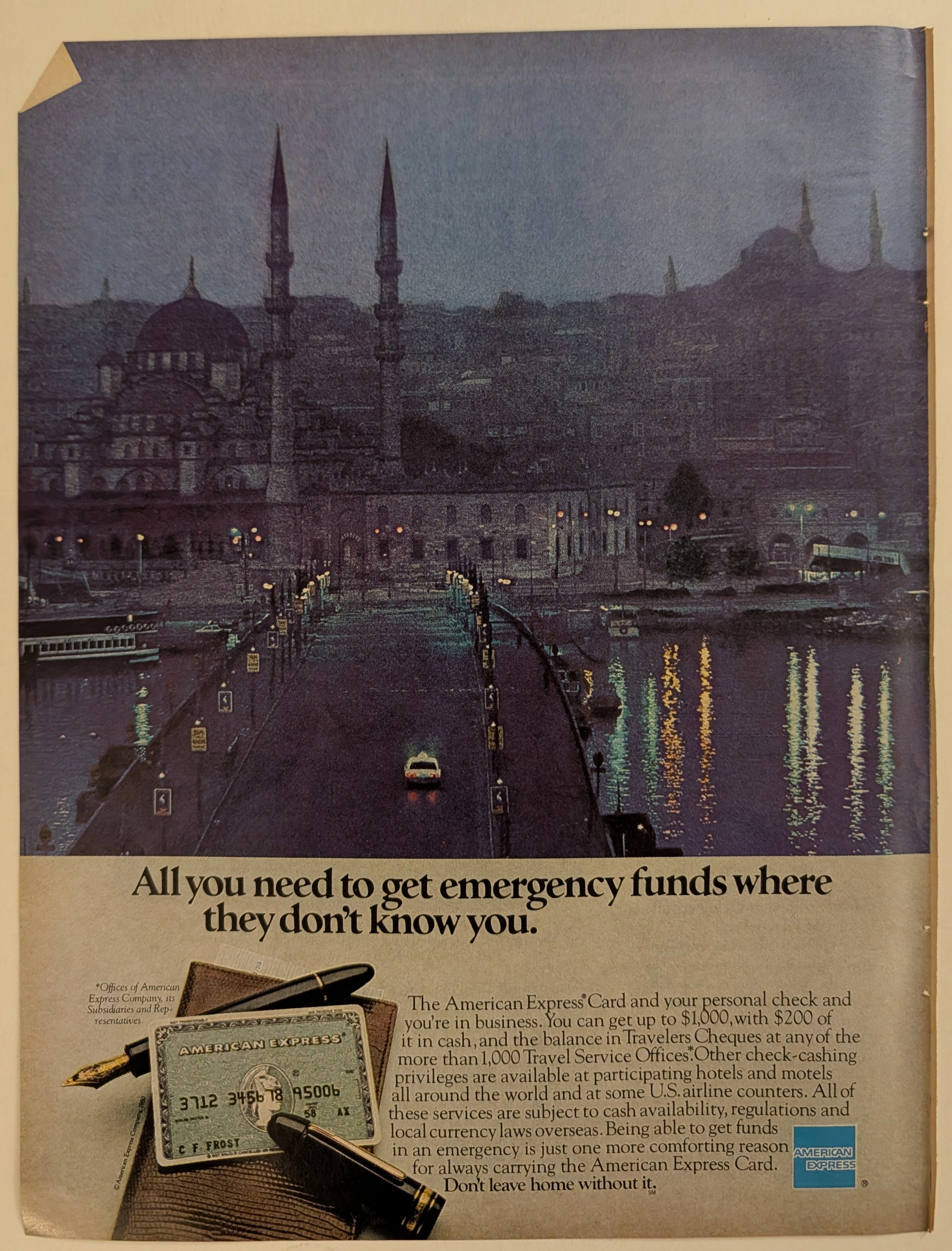
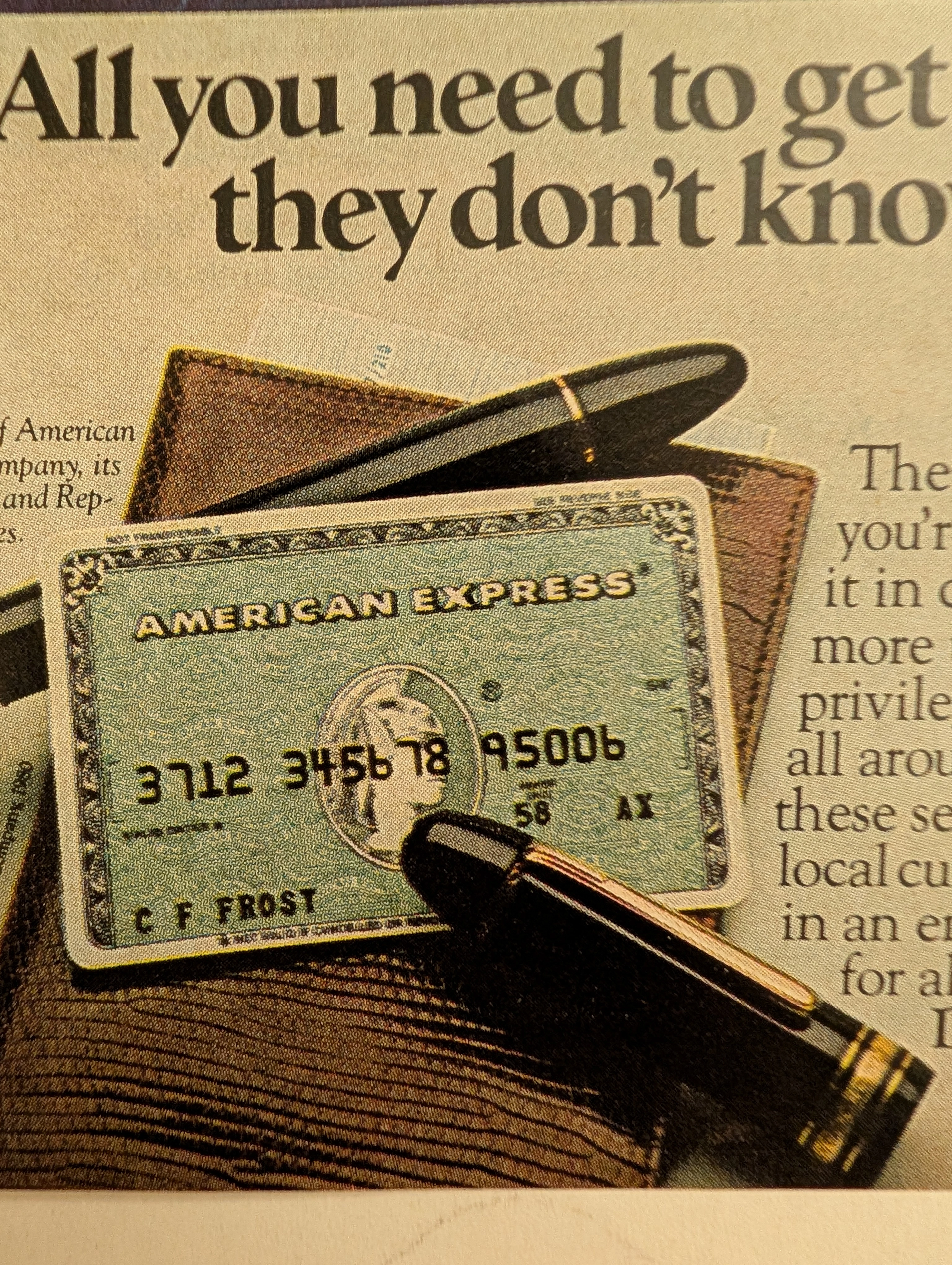
Discover the profound cultural resonance of the 1980 American Express Card vintage advertisement, a masterful example of late 20th-century financial marketing. This piece transcends typical vintage ads by encapsulating the era's burgeoning desire for international travel paired with the absolute need for financial security abroad. Showcasing the iconic green card against the mystic dusk of Istanbul, the campaign perfectly illustrates how classic print ads constructed narratives of global citizenship, elite mobility, and unparalleled trust. For archivists and collectors of old advertisements, this piece stands as a definitive artifact. It not only highlights the practical benefits of emergency travel funds but also visually reinforces the legendary ethos of the brand, making it a pivotal and highly sought-after piece in the history of consumer credit and travel marketing.

THE TIME TRAVELER'S DOSSIER :THE APPARITION OF HERITAGE — THE STRIDING MAN — related article
Read Article

THE TIME TRAVELER'S DOSSIER :THE APPARITION OF HERITAGE — THE STRIDING MAN

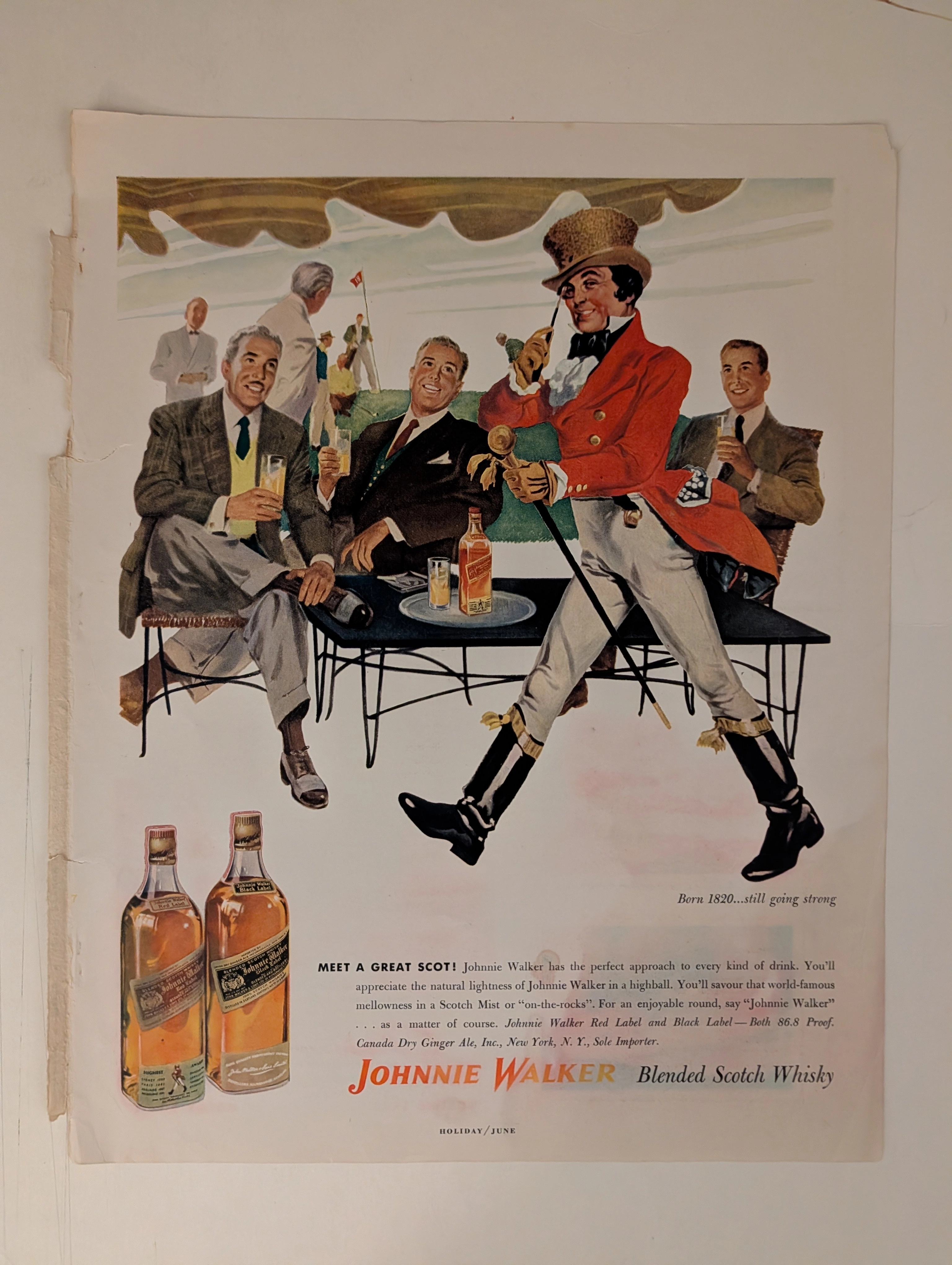
The artifact currently subjected to our uncompromising, museum-grade analysis is a profoundly preserved Historical Relic excavated from the zenith of mid-century American prosperity. This Primary Art Document is a full-page magazine advertisement for Johnnie Walker Blended Scotch Whisky. Functioning as a "Forensic Blueprint of the Transatlantic Leisure Class," the document masterfully weaponizes British aristocratic heritage (embodied by the Striding Man) to validate the newly acquired wealth of post-war American consumers. Its historical context is irrefutably anchored by the microscopic fine print identifying the importer as "Canada Dry Ginger Ale, Inc., New York, N.Y.", a specific corporate era of distribution. Grounded by extreme macro details of analog halftone lithography and the breathtaking wabi-sabi chemical degradation highlighted by its violently torn binding edge, this artifact commands an irreplaceable status, cementing its Rarity Class A designation as a masterpiece of corporate sociological engineering.

The Time Traveller’s Dossier: The Graphology of Supreme Power – A Forensic Deconstruction of the 35 Presidential Signatures — related article
Read Article

The Time Traveller’s Dossier: The Graphology of Supreme Power – A Forensic Deconstruction of the 35 Presidential Signatures

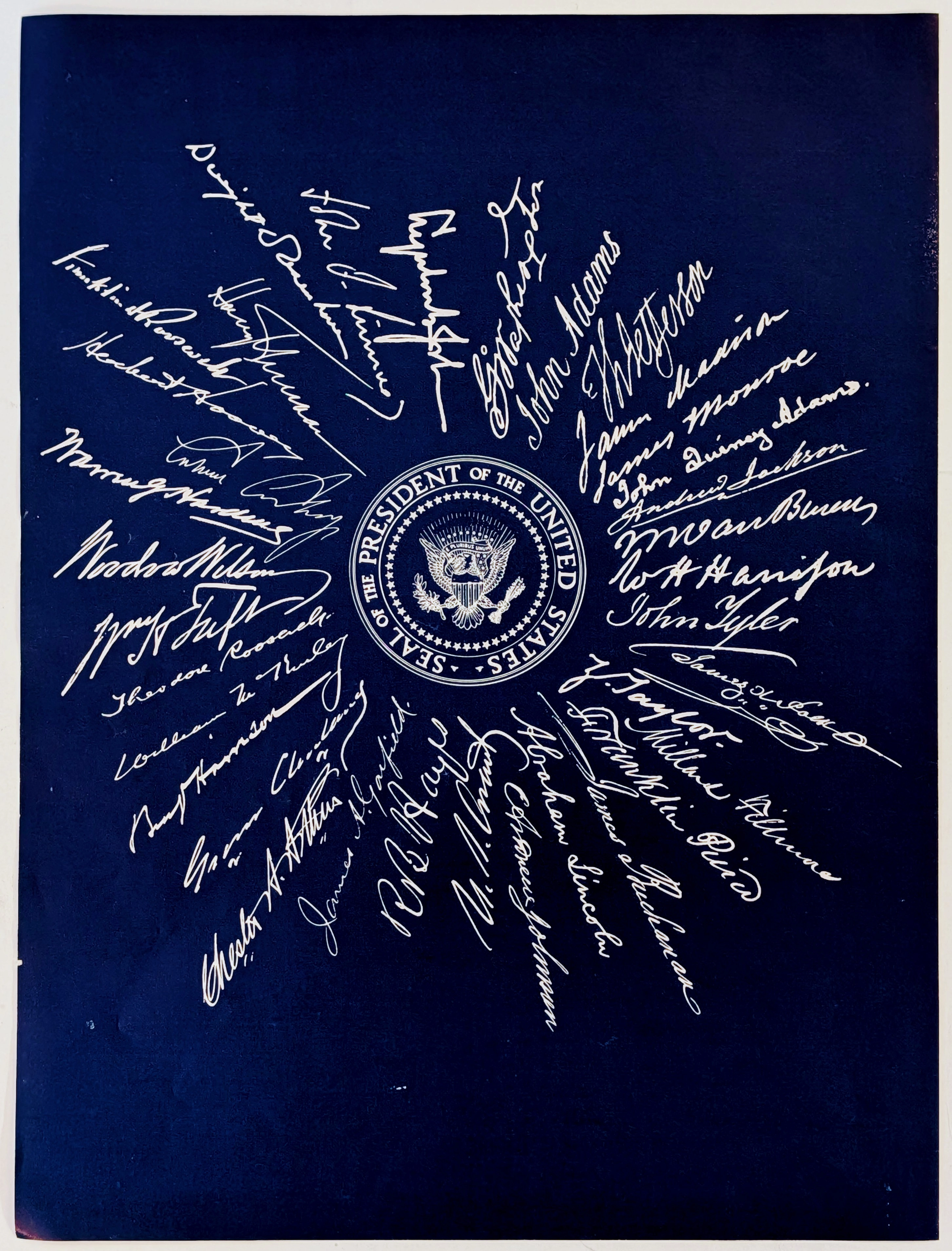
The exercise of supreme executive power is not exclusively documented through monumental architectural achievements, the mobilization of armed forces, or the grand rhetoric of inaugural addresses. Frequently, the ultimate manifestation of absolute authority is captured in a single, decisive moment of physical friction: the precise instant a quill, steel nib, or fountain pen touches paper to forge a leader's signature. A signature is the ultimate physical projection of political will; it is the legal instrument that declares wars, emancipates millions, and authorizes humanity's journey to the stars. The historical artifact presented before us today for museum-grade forensic analysis is an exceedingly rare and profound educational print. Rendered in a striking reverse lithography technique—featuring a deep, commanding navy blue background with brilliant white text—it displays the Seal of the President of the United States, completely enveloped by the radiating facsimile signatures of the first thirty-five individuals to hold the highest office in the land. This exhaustive, world-class academic archival dossier will dissect the artifact with microscopic precision. We will conduct an individual forensic breakdown of all thirty-five presidential signatures, exploring the graphological (handwriting) structures that mirror their personalities, their educational backgrounds, and their historical eras. Furthermore, we will decode the profound engineering logic behind the radial visual design and conduct a rigorous material science analysis of this reverse-printed substrate. In an analog era devoid of digital fonts and electronic authorizations, a leader's penmanship was their ultimate visual DNA. We will meticulously explore the chemical mechanics of the aging paper beneath this sea of dark ink—the elegant wabi-sabi oxidation process that serves as the primary engine driving up its market value exponentially.

The Time Traveller's Dossier: The Zenith of General Motors — related article
Read Article

The Time Traveller's Dossier: The Zenith of General Motors

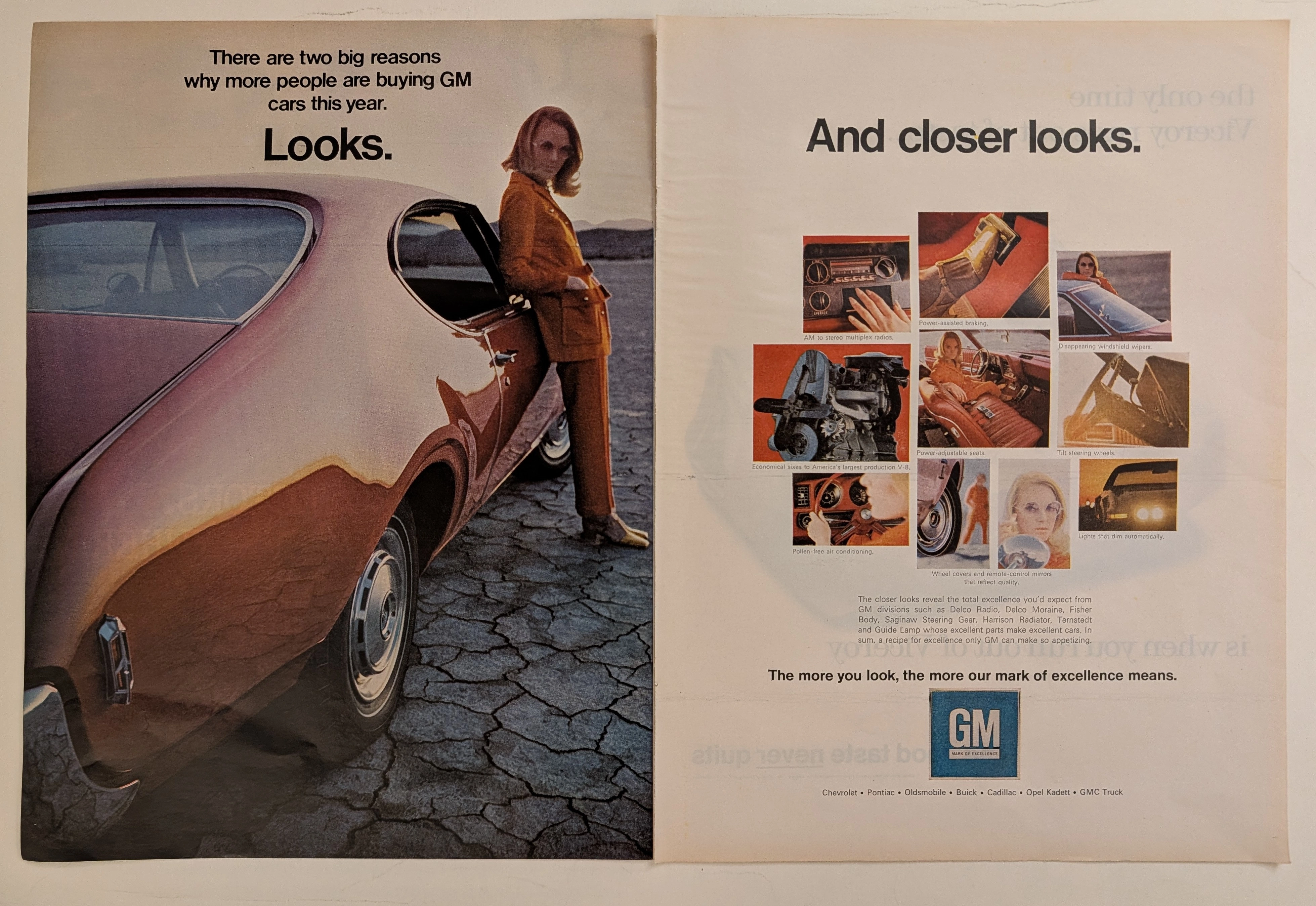
The automobile in mid-twentieth-century America was never merely a mode of transportation; it was a colossal canvas projecting industrial pride, technological advancement, and shifting consumer identities. The historical artifact elegantly and securely positioned upon the analytical table of The Record Institute today is a magnificent, large-format, two-page print advertisement for General Motors (GM), originating from the late 1960s to early 1970s. This document completely transcends the traditional boundaries of automotive catalogs. It operates as a highly sophisticated, dual-narrative cultural mirror: the left page captures the visceral, visual desire of "Looks" intertwined with a radical new era of feminine empowerment, while the right page dissects the mechanical and electronic mastery of "And closer looks," showcasing the vast ecosystem of GM's specialized manufacturing divisions. ​This world-class, comprehensive dossier conducts a meticulous, unyielding, and exceptionally deep examination of the artifact, operating under the absolute most rigorous parameters of historical, sociological, and material science evaluation. We will decode the immense industrial weight of the "Mark of Excellence" campaign, analyze the profound sociological implications of the female model's tailored pantsuit as a symbol of women's liberation, and dissect the anatomy of the nine revolutionary automotive technologies that defined modern driving. Furthermore, as we venture deeply into the chemical and physical foundations of this analog printed ephemera, we will reveal the precise mechanical fingerprints of the CMYK halftone rosettes and the graceful, natural oxidation of the paper substrate. This precise intersection of visual nostalgia, mid-century commercial artistry, and the immutable chemistry of time cultivates a serene wabi-sabi aesthetic—a natural, irreversible phenomenon that serves as the primary engine driving up its market value exponentially within the elite global spheres of Vintage Automotive Ephemera and Industrial Design collecting.

The Time Traveller's Dossier: The Architecture of Slumber – The 1967 Simmons Golden Value — related article
Read Article

The Time Traveller's Dossier: The Architecture of Slumber – The 1967 Simmons Golden Value

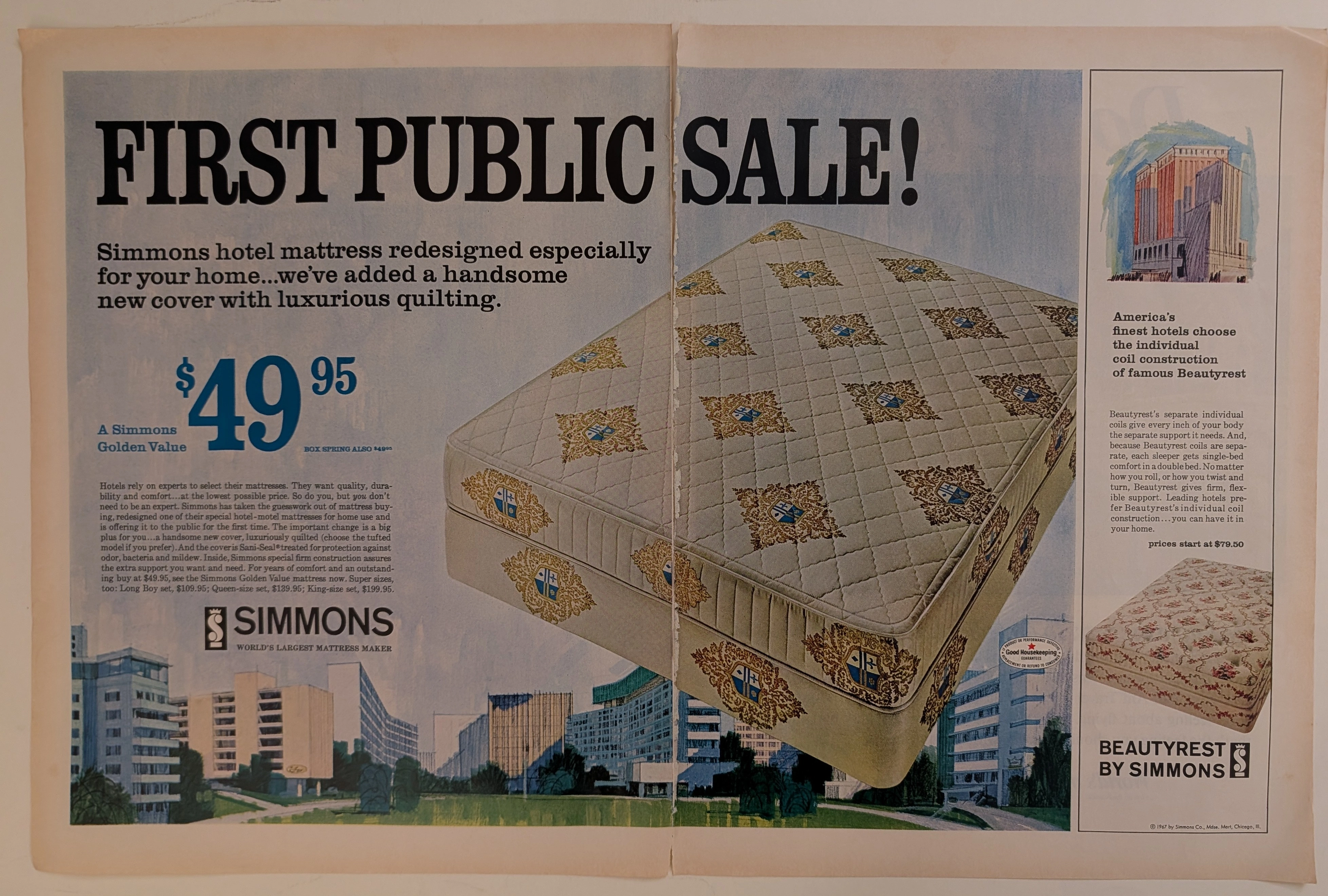
The evolution of the American domestic interior during the mid-twentieth century was heavily influenced by the golden age of travel and the rapid expansion of the luxury hospitality industry. The historical artifact elegantly secured upon the analytical table of The Record Institute today is a large-format, two-page centerfold print advertisement for the Simmons Mattress Company, copyrighted in 1967. This document transcends standard consumer goods marketing; it operates as a sophisticated sociological mirror, reflecting a highly specific moment when industrial sleep engineering and the aspirational luxury of the modern hotel were explicitly packaged and sold to the suburban American household. This world-class, comprehensive dossier conducts a meticulous, profound, and historically objective examination of the artifact, operating under the absolute most rigorous parameters of sociological and material science evaluation. We will decode the brilliant marketing psychology embedded within the "First Public Sale" messaging, analyze the iconic "Good Housekeeping" endorsement, and dissect the rich semiotics of the heraldic quilt patterns alongside the modernist architectural illustrations. Furthermore, as we venture deeply into the chemical and physical foundations of this analog printed ephemera, we will reveal the precise mechanical fingerprints of the CMYK halftone rosettes and the graceful, natural oxidation of the paper substrate. This precise intersection of visual nostalgia, mid-century commercial artistry, and the immutable chemistry of time cultivates a serene wabi-sabi aesthetic—a natural, irreversible phenomenon that serves as the primary engine driving up its market value exponentially within the elite global spheres of Vintage Commercial Ephemera and Mid-Century Lifestyle Archives collecting.

The Time Traveller's Dossier: The Illumination of Memory – The Kodak Instamatic 104 and the Flashcube Revolution — related article
Read Article

The Time Traveller's Dossier: The Illumination of Memory – The Kodak Instamatic 104 and the Flashcube Revolution

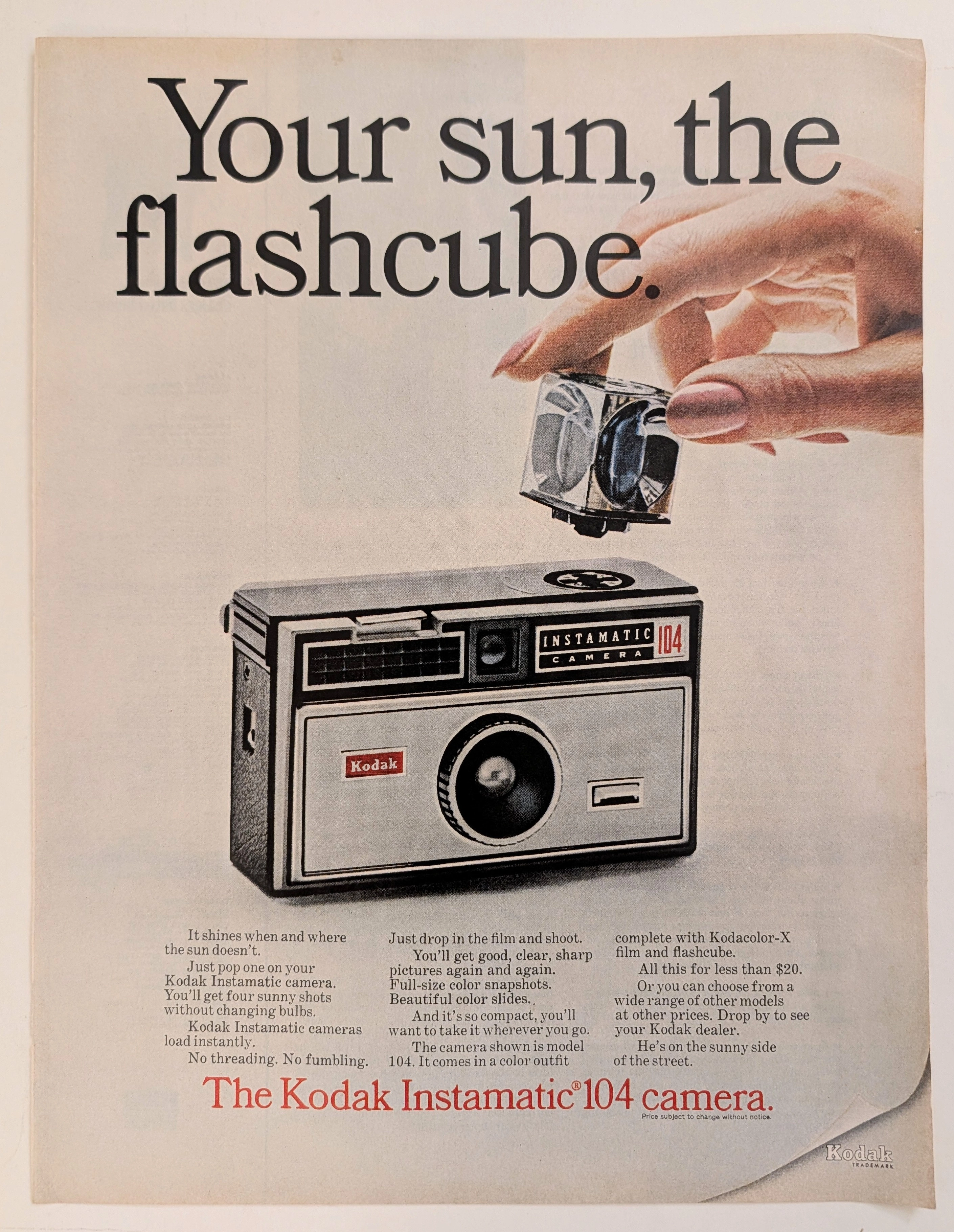
The evolution of the American domestic experience during the mid-twentieth century was inextricably linked to the ability of the average citizen to document it. The historical artifact elegantly and securely positioned upon the analytical table of The Record Institute today is a striking, full-page print advertisement for the Kodak Instamatic 104 camera, dating to the mid-1960s. This document completely transcends the standard boundaries of consumer electronics marketing. It operates as a highly sophisticated, multi-layered cultural and historical mirror, reflecting the precise era when the complexities of photographic chemistry and illumination were engineered out of existence, explicitly packaged, and sold to the American public not merely as a mechanical device, but as the effortless capturing of time itself. This world-class, comprehensive dossier conducts a meticulous, unyielding, and exceptionally deep examination of the artifact, operating under the absolute most rigorous parameters of historical, sociological, and material science evaluation. With our analytical focus dedicated overwhelmingly to its profound historical gravity (comprising 80% of our scholarly evaluation), we will decode the brilliant marketing psychology embedded within the "Your sun, the flashcube" narrative, analyze the immense sociological impact of George Eastman's legacy, and dissect the rich semiotics of the camera's accessible design. Furthermore, as we venture deeply into the chemical and physical foundations of this analog printed ephemera (10% focus), we will reveal the precise mechanical fingerprints of the CMYK halftone rosettes and the graceful, natural oxidation of the paper substrate. Finally, we will assess its archival significance (10% focus), exploring how this precise intersection of visual nostalgia, mid-century commercial artistry, and the immutable chemistry of time cultivates a serene wabi-sabi aesthetic—a natural, irreversible phenomenon that serves as the primary engine driving up its market value exponentially within the elite global spheres of Vintage Commercial Ephemera and Mid-Century Lifestyle collecting.