
THE TIME TRAVELER'S DOSSIER:THE SMILE IN THE TRENCHES AND THE HOME FRONT BRAINWASHING
The History
The Crucible of 1943, Psychological Architecture, and the State's Instrument ]
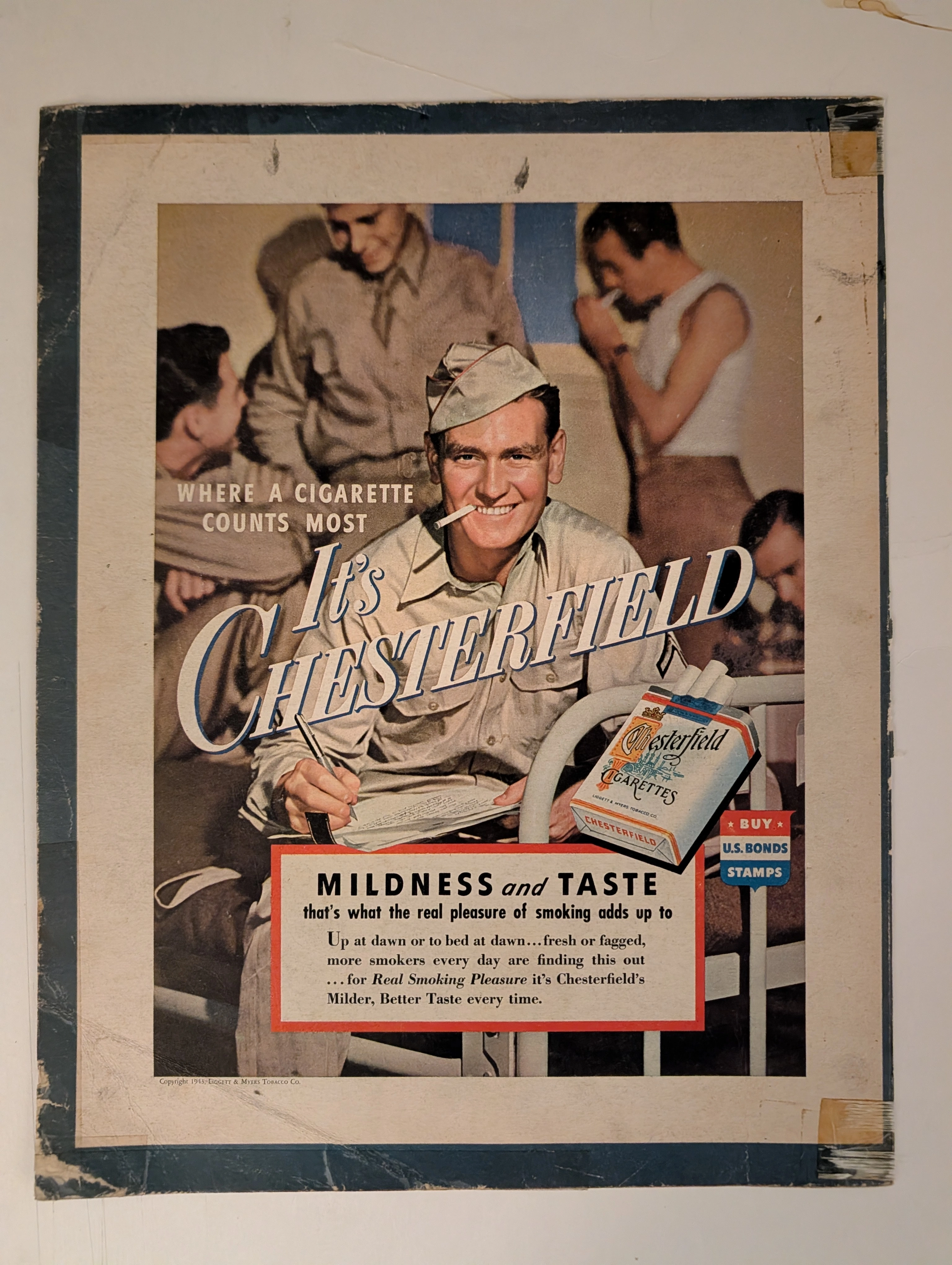
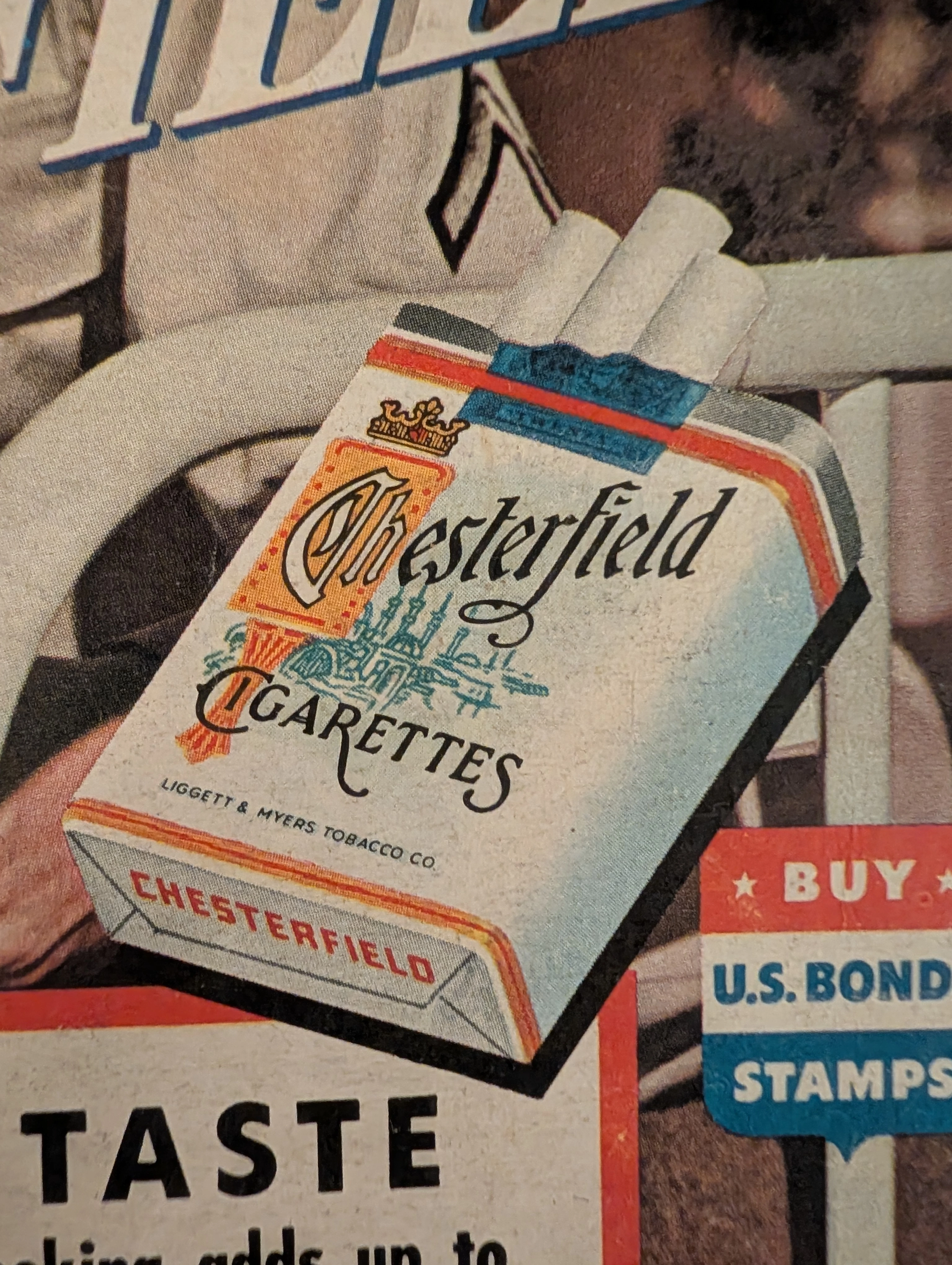
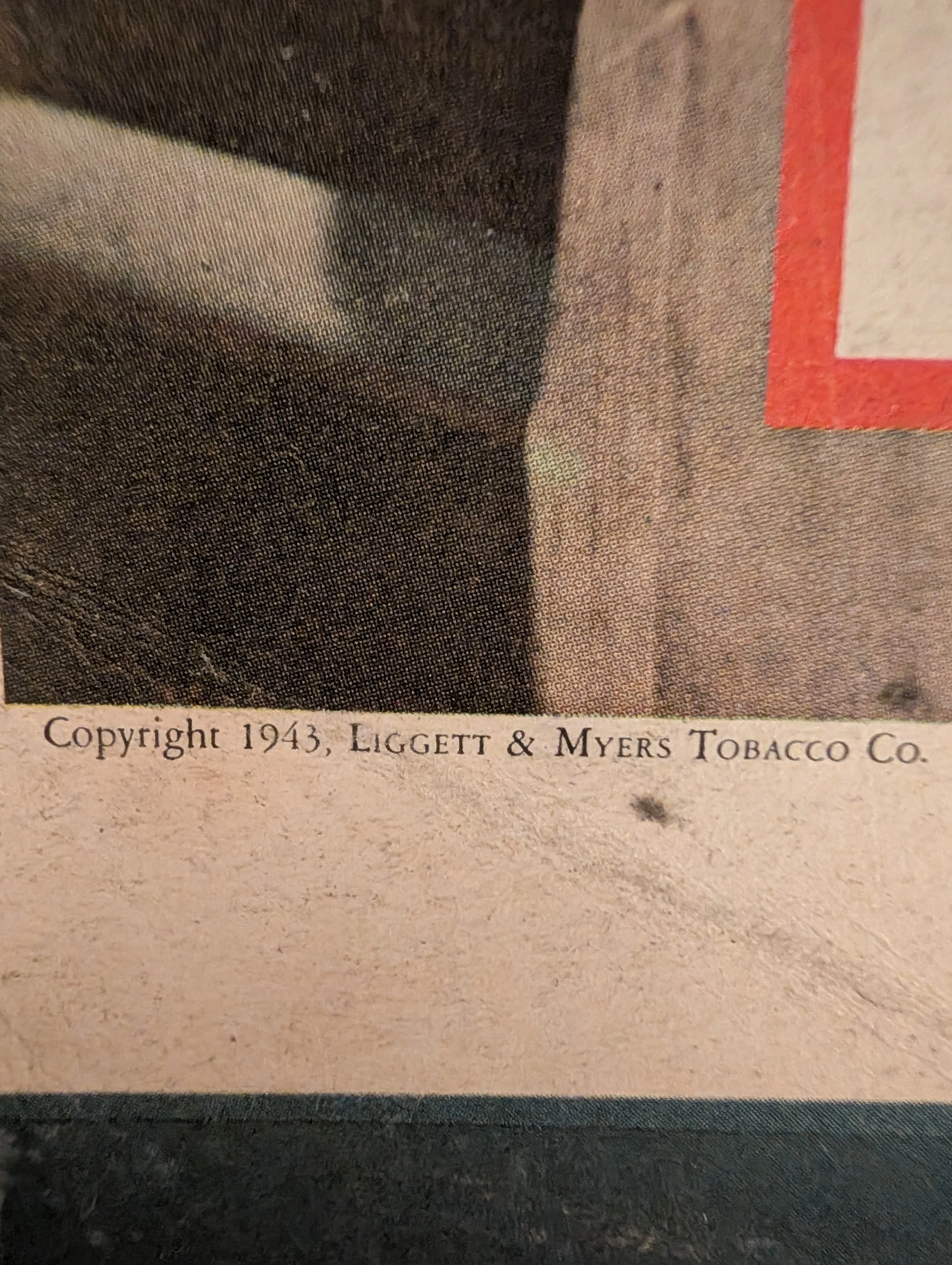
As the Chief Curator of The Record, I welcome you to the absolute, suffocating zenith of the Second World War. This Primary Art Document is forensically and undeniably dated to 1943 by the explicit legal text: "Copyright 1943, LIGGETT & MYERS TOBACCO CO.". The year 1943 was the terrifying climax of WWII. Madison Avenue ad executives brilliantly weaponized the anxiety of the Home Front. The Visual Architecture forcefully presents an idealized, smiling American G.I., sitting on his military cot, a Chesterfield cigarette hanging casually from his lips as he writes a letter home. The commanding headline, "WHERE A CIGARETTE COUNTS MOST," sent a direct, pacifying message to anxious families: Your boy is fine, and his ultimate solace in the horror of war is a Chesterfield. The true chilling gravity of this artifact is its role as "State-Sponsored Propaganda." Imposed upon the commercial art is a bold, patriotic shield bearing a strict government mandate: "BUY U.S. BONDS STAMPS". Smoking Chesterfield was inextricably linked to being a loyal, patriotic American.
The Paper
The Aesthetics of Decay (Wabi-Sabi) & The Fossils of Cellophane Tape
This artifact is the absolute epitome of a "Battered War Veteran." Magazines printed during WWII utilized exceptionally cheap, highly acidic wood-pulp paper due to strict Wartime Rationing. The left margin exhibits severe, jagged tears. But the true forensic miracles are the ancient, calcified residues of cellophane tape gripping the corners. Decades ago, a desperate owner attempted to repair this disintegrating page. That tape has turned into a hardened fossil, leaving deep chemical burns. Ambient oxygen has burned the once-white paper into a deep, toasted amber. This majestic death perfectly embodies the Japanese aesthetic of wabi-sabi.
The Rarity
Class S — A Miraculous Survivor of the Government Incinerators ]
Finding a 1943 primary document articulating both military history and explicit War Bond propaganda is an archival miracle. During the war, the U.S. government launched massive "Paper Drives," pulping millions of magazines for artillery packaging. The fact that this advertisement survived for over eight decades unequivocally commands the absolute highest Rarity Class S designation.
Exhibition Halls
The Archive Continues
Continue the Exploration
The Time Traveller's Dossier: The Engineer's Manifesto – The 1975 BMW 530i and the Birth of the Ultimate Driving Machine
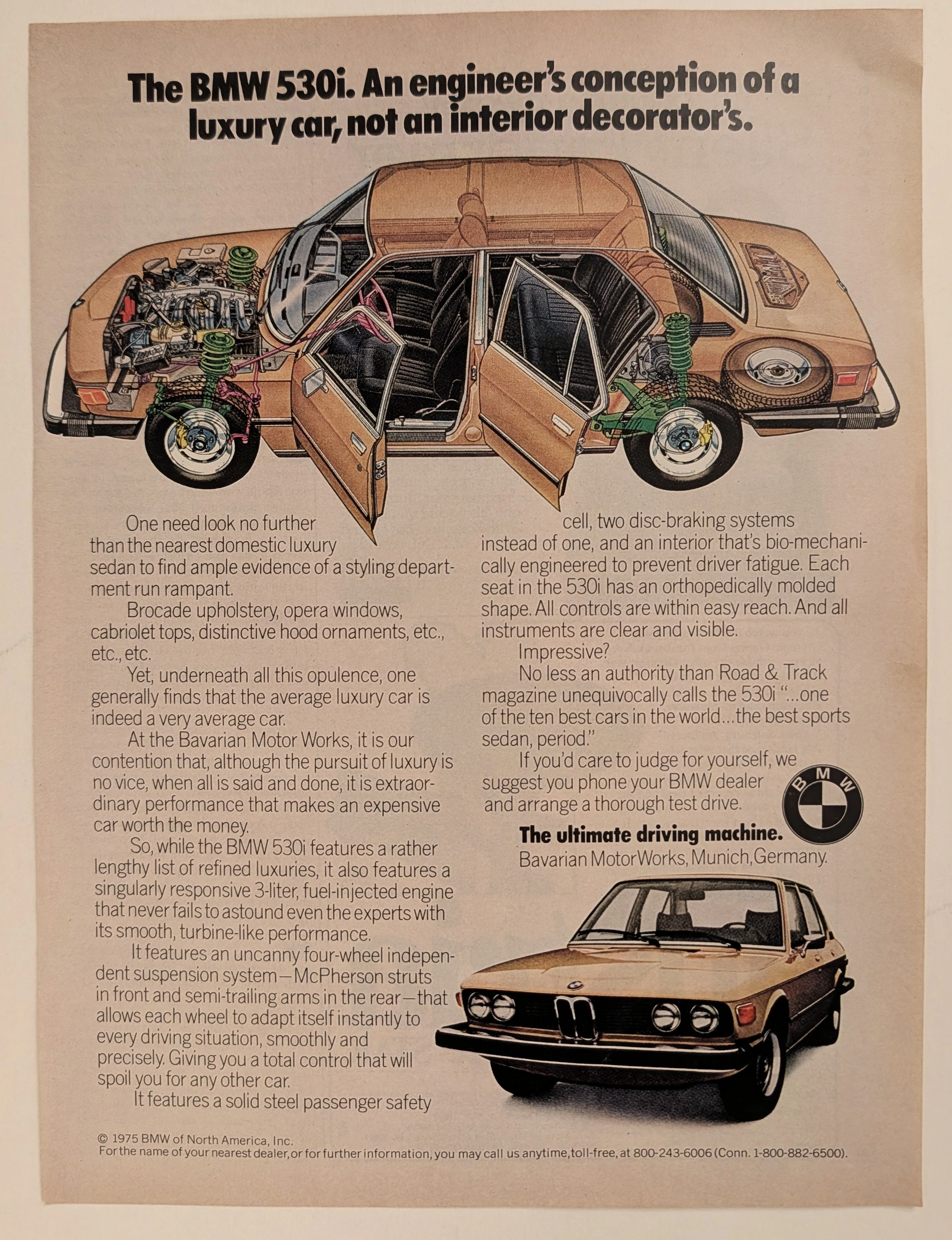
The evolution of the American automotive landscape in the latter half of the twentieth century was fundamentally violently disrupted during the 1970s, an era defined by oil embargoes, shifting economic realities, and a growing consumer disillusionment with domestic manufacturing. Elegantly and securely positioned upon the analytical table of The Record Institute today is a visually complex, densely informative, and highly significant full-page print advertisement for the BMW 530i, definitively dated to 1975 by its prominent copyright macro. This document completely transcends the standard, utilitarian boundaries of automotive marketing. It operates as a highly sophisticated, multi-layered cultural mirror and a bold declaration of war against the prevailing automotive trends of the decade. By juxtaposing the superficial trappings of American luxury—"brocade upholstery, opera windows, cabriolet tops"—against the visceral, mechanical truths of independent suspension and fuel injection, Bavarian Motor Works (BMW) successfully positioned itself as the intellectual and physical antidote to the bloated "Malaise Era" land yachts. This world-class, comprehensive dossier conducts a meticulous, unyielding, and exceptionally exhaustive examination of the artifact, operating under the absolute most rigorous parameters of historical, sociological, and material science evaluation. Dedicating the overwhelming majority of our analytical focus (80%) to its immense historical gravity, we will decode the brilliant, confrontational marketing psychology embedded within the copywriting, analyze the profound mechanical realities of the E12 chassis 5-Series, and detail the historical impact of the visionaries who crafted this campaign. Furthermore, as we venture deeply into the chemical and physical foundations of this analog printed ephemera (10%), we will reveal the precise mechanical fingerprints of the CMYK halftone rosettes captured in the stunning macro imagery of the BMW roundel and the technical cutaway illustration. Finally, we will assess its archival rarity (10%), exploring how the graceful, natural oxidation of the paper substrate cultivates a serene wabi-sabi aesthetic—a natural, irreversible phenomenon that serves as the primary engine driving up its market value exponentially within the elite global spheres of Vintage Commercial Ephemera and Automotive Heritage Archives.
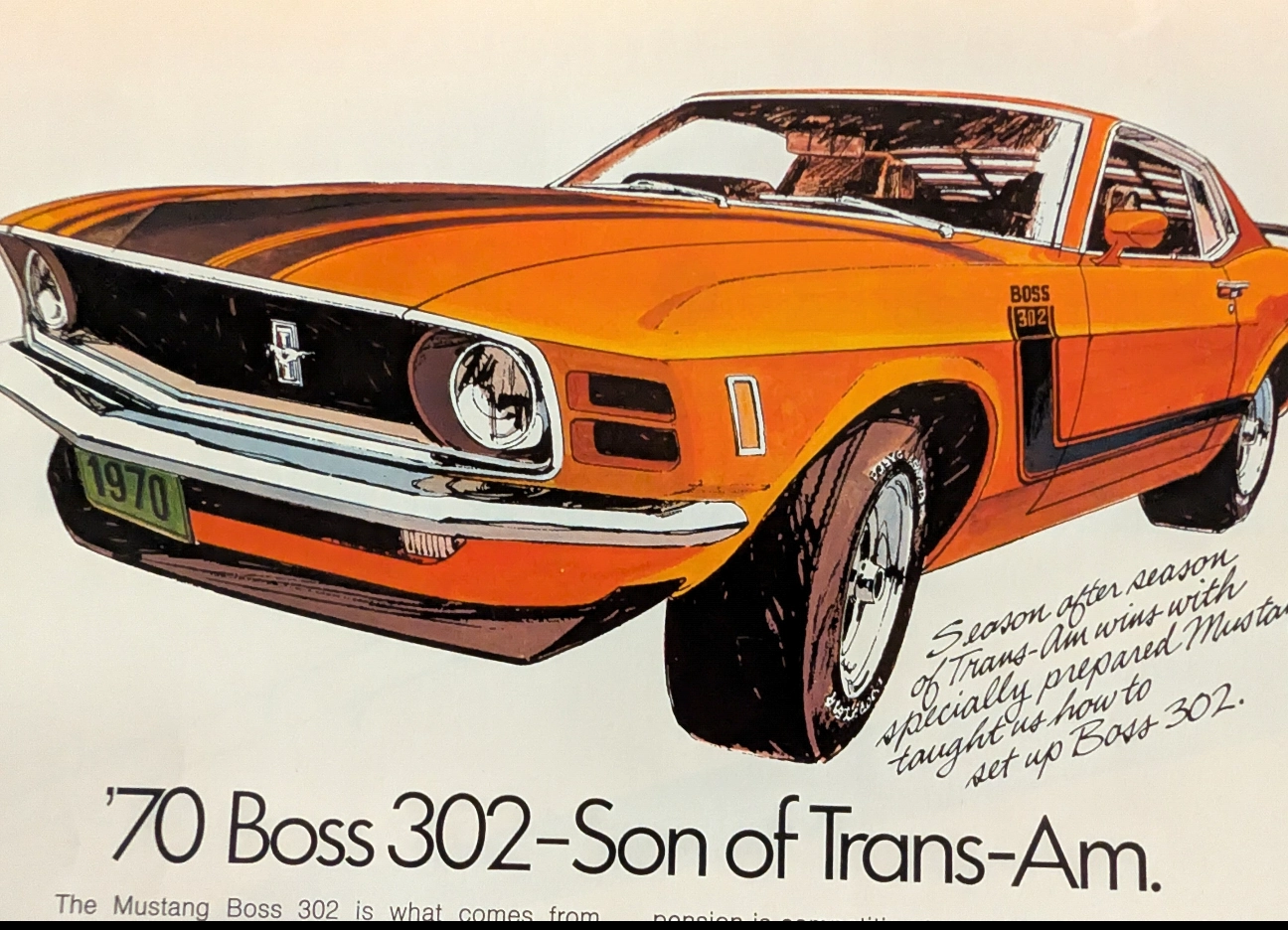
True Blood of the Trans-Am: The 1970 Ford Mustang Boss 302 Legacy
Experience the raw spirit of an American muscle car legend through an authentic, pre-2000 analog magazine advertisement, carefully extracted as a single sheet.
Whirlpool · Technology
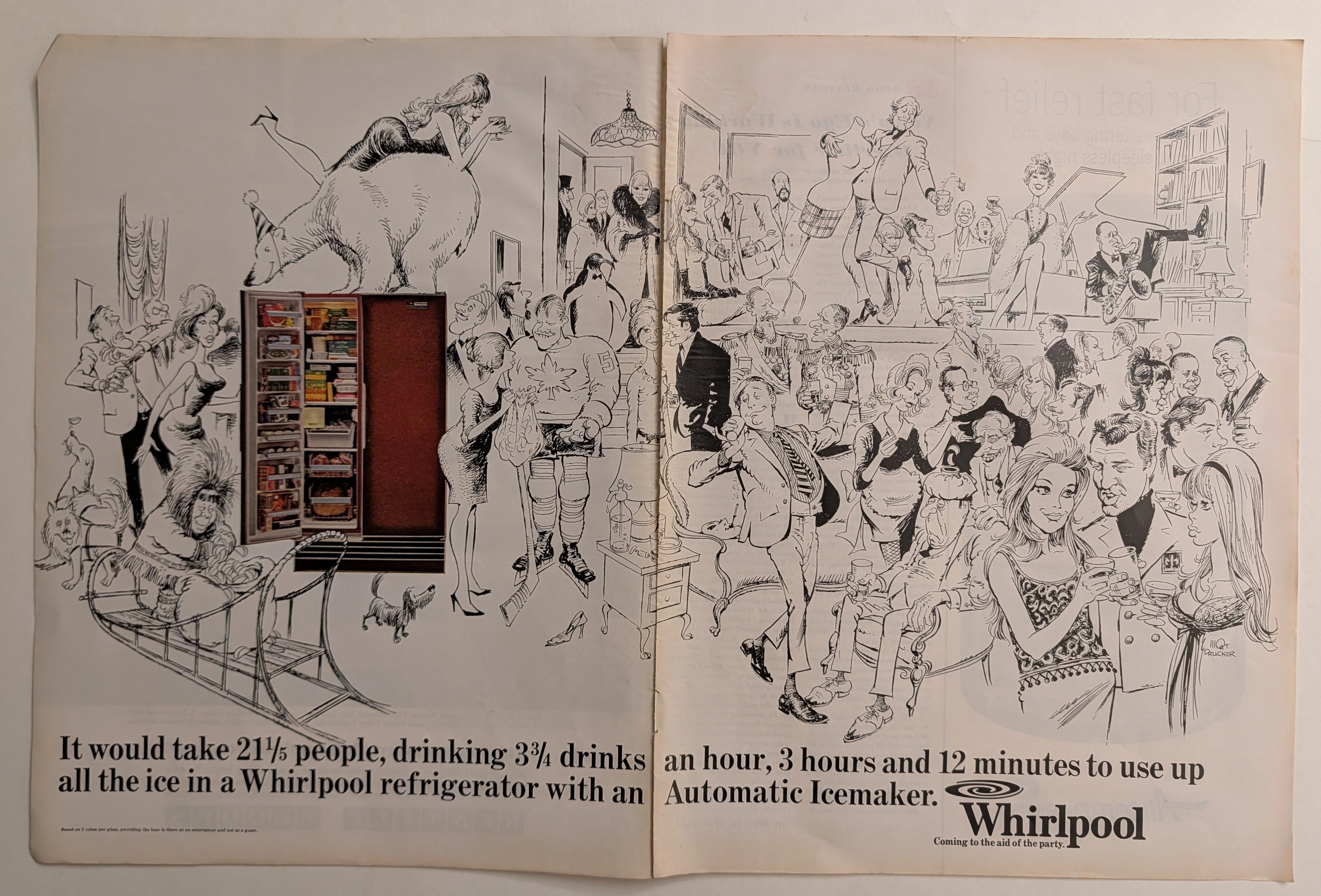
The Time Traveller's Dossier: The Sub-Zero Socialite – The Whirlpool Automatic Icemaker Exhibition by Mort Drucker
The evolution of the domestic appliance from a purely utilitarian instrument of labor into a central pillar of social entertainment and psychological comfort is one of the most fascinating sociological phenomena of mid-twentieth-century America. The historical artifact elegantly and securely positioned upon the analytical table of The Record Institute today is a majestic, large-format, two-page print advertisement for the Whirlpool Refrigerator with an Automatic Icemaker, originating from the cultural zenith of the 1960s. This document completely transcends the traditional boundaries of household goods marketing. It operates as a profound, sophisticated declaration of how technological innovation liberated the American middle class, transforming the private kitchen into a nexus of boundless hospitality, leisure, and social status. This world-class, comprehensive dossier will conduct a meticulous, unyielding, and deep examination of the artifact, operating under the absolute most rigorous parameters of historical, sociological, and material science evaluation. We will decode the brilliant, chaotic, and highly kinetic party scene birthed from the pen of legendary illustrator Mort Drucker, and analyze the dramatic visual juxtaposition of this monochromatic chaos against the highly structured, full-color reality of the Whirlpool refrigerator. Furthermore, as we venture into the chemical and physical foundations of this analog printed ephemera, we will reveal the mechanical fingerprints of the CMYK halftone rosettes and the graceful, natural oxidation of the paper substrate. This precise intersection of visual nostalgia, pop-art mastery, and the chemistry of time cultivates a serene wabi-sabi aesthetic—a natural, irreversible phenomenon that serves as the primary engine driving up its market value exponentially within the elite global spheres of Vintage Appliance Ephemera and Commercial Art collecting.