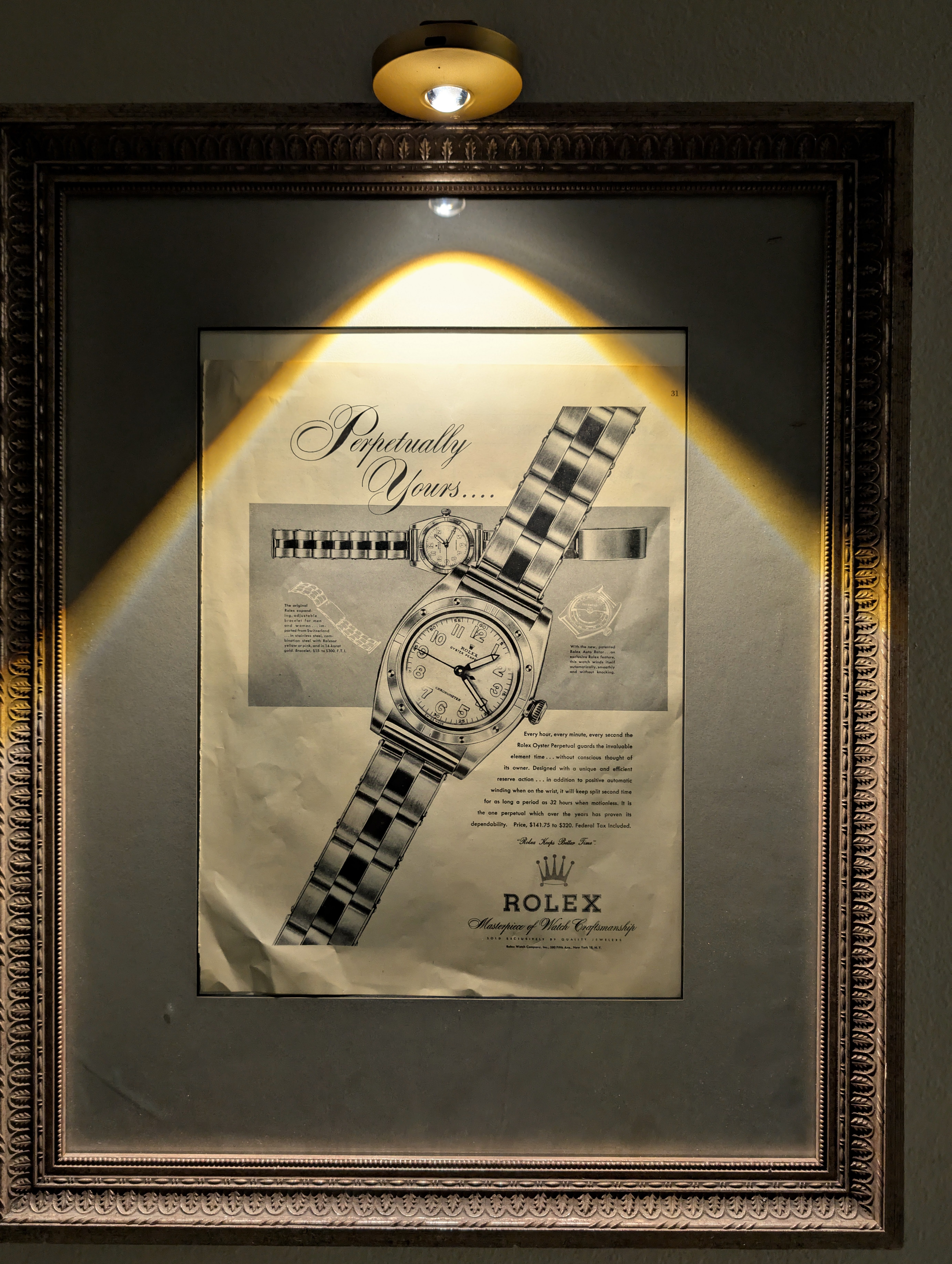
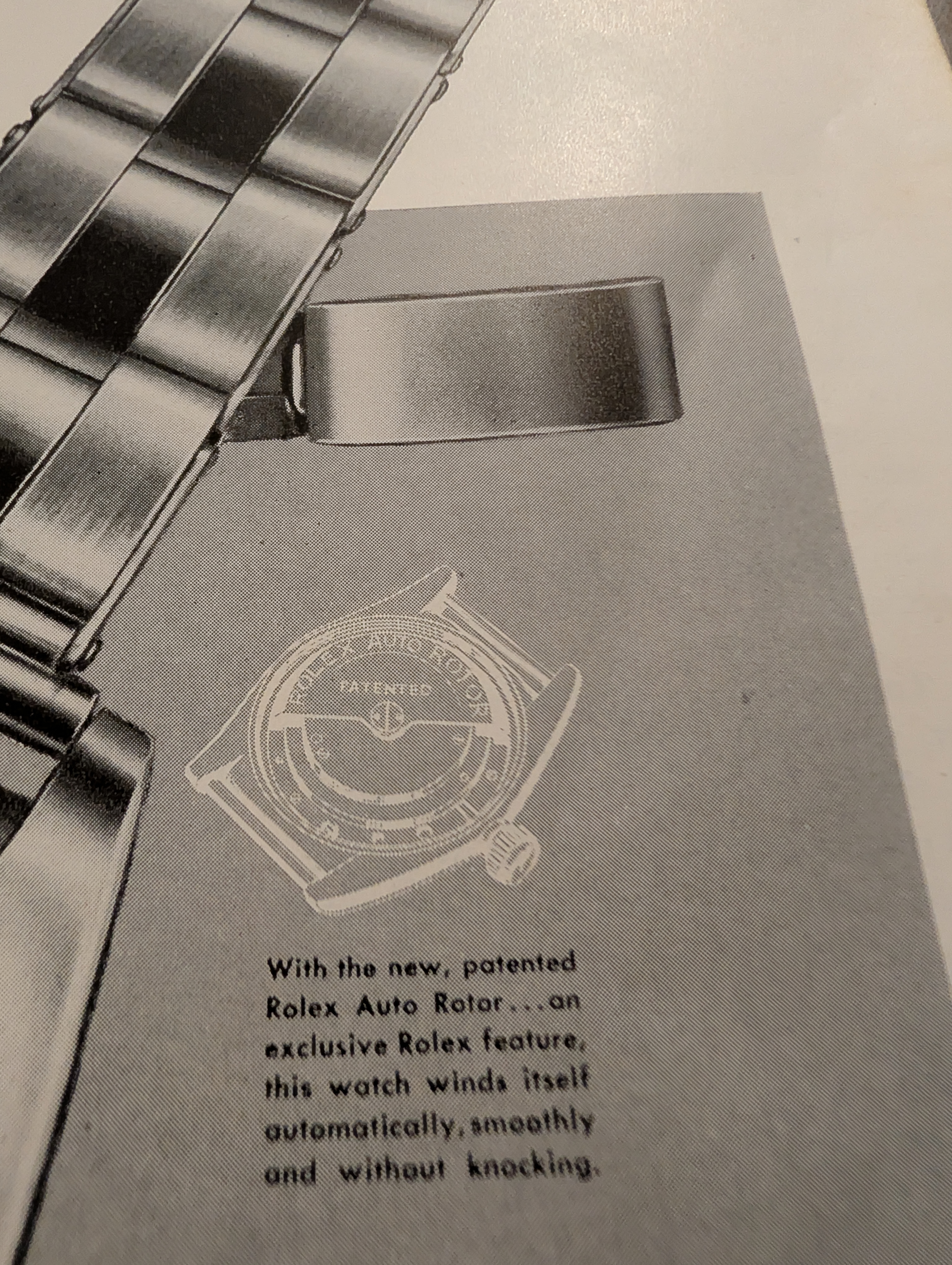
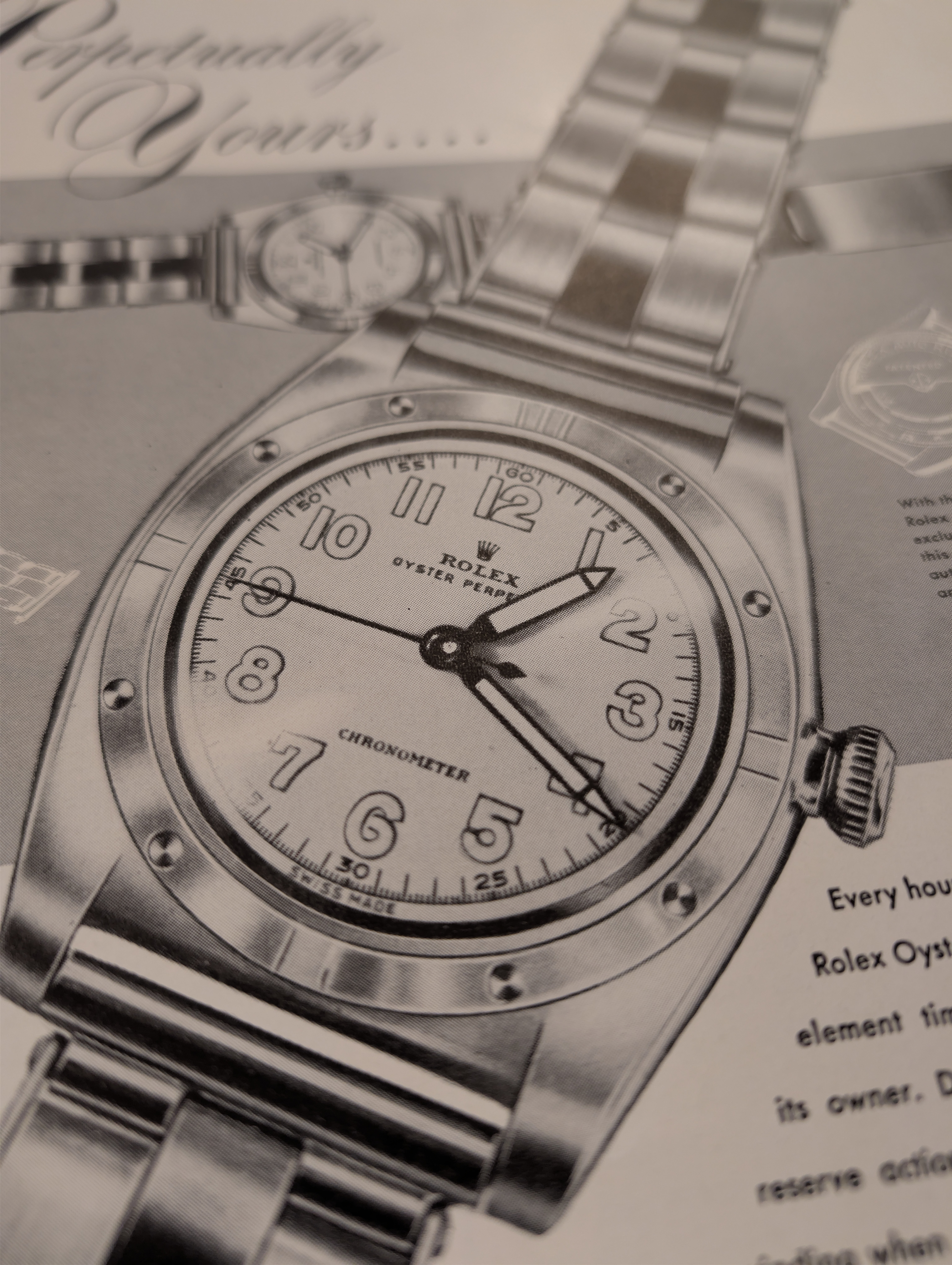
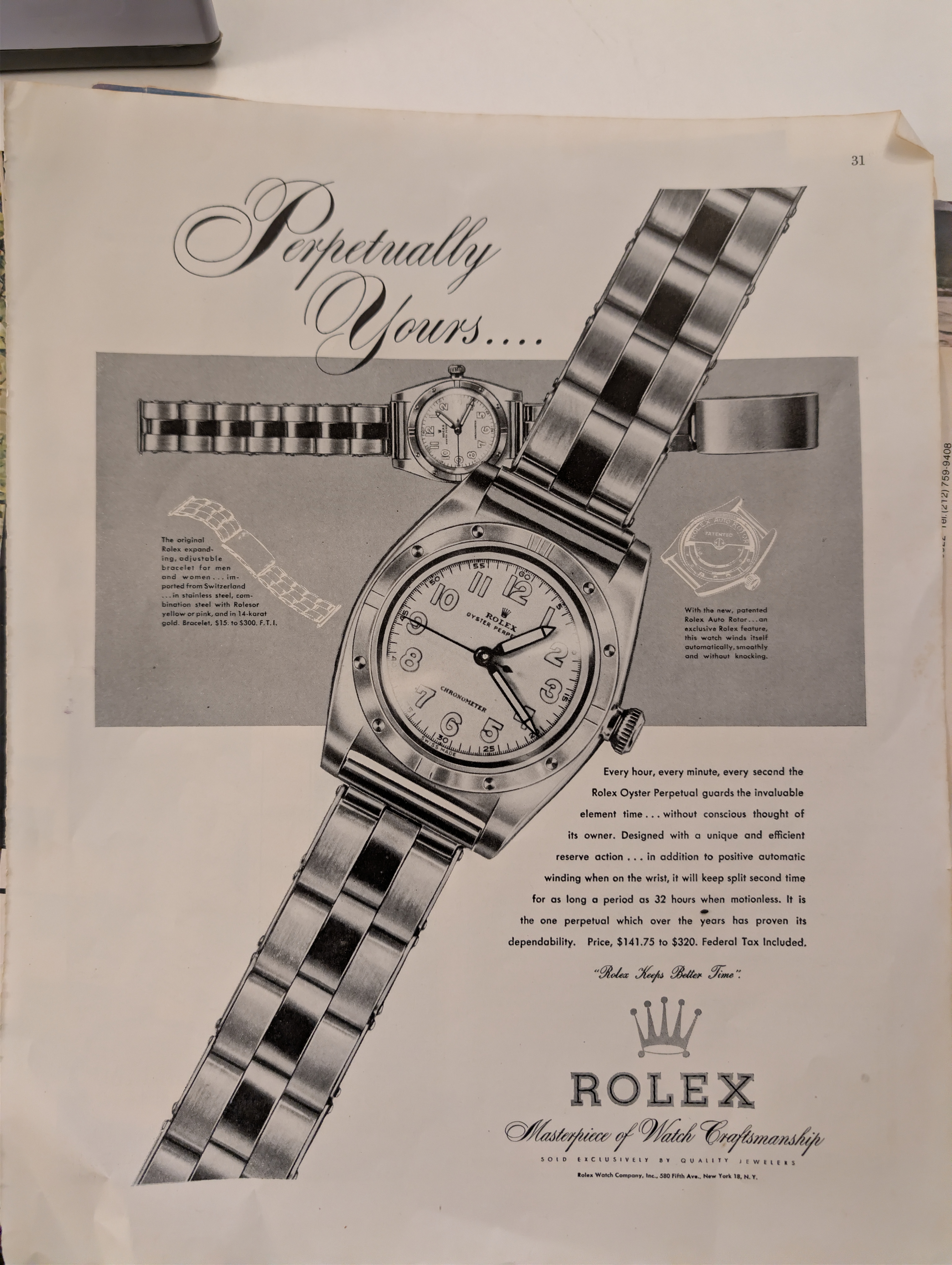
Rolex "Perpetually Yours"
The History
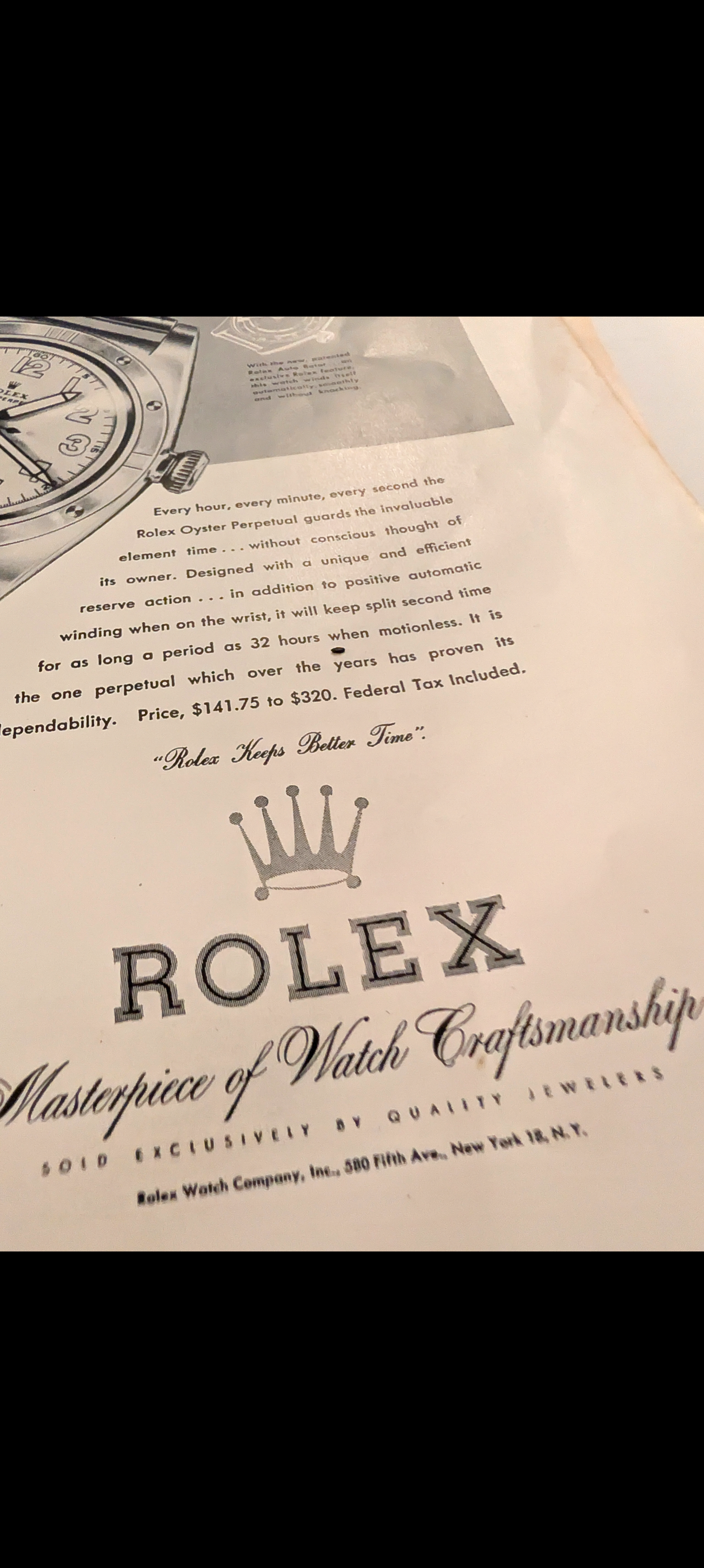
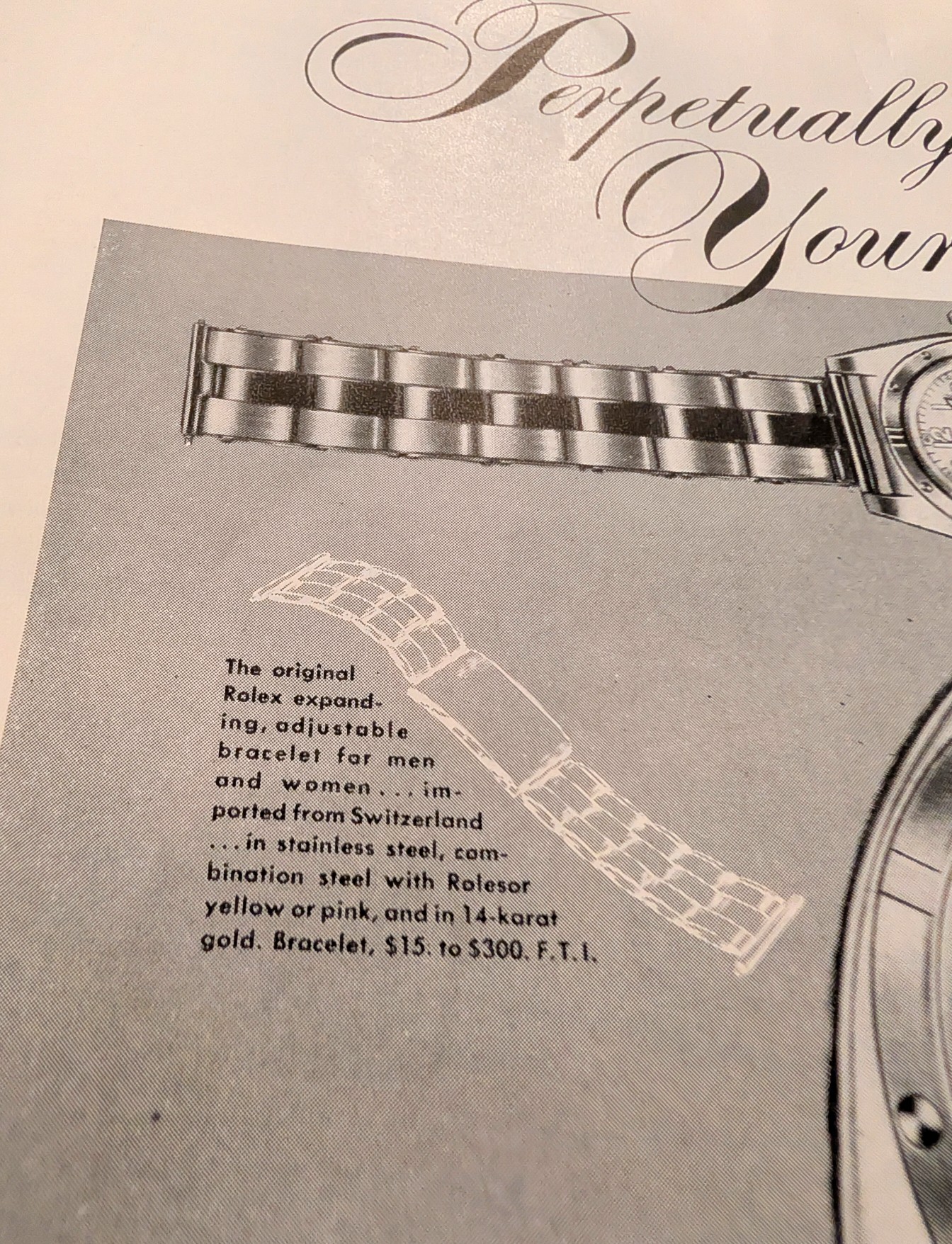
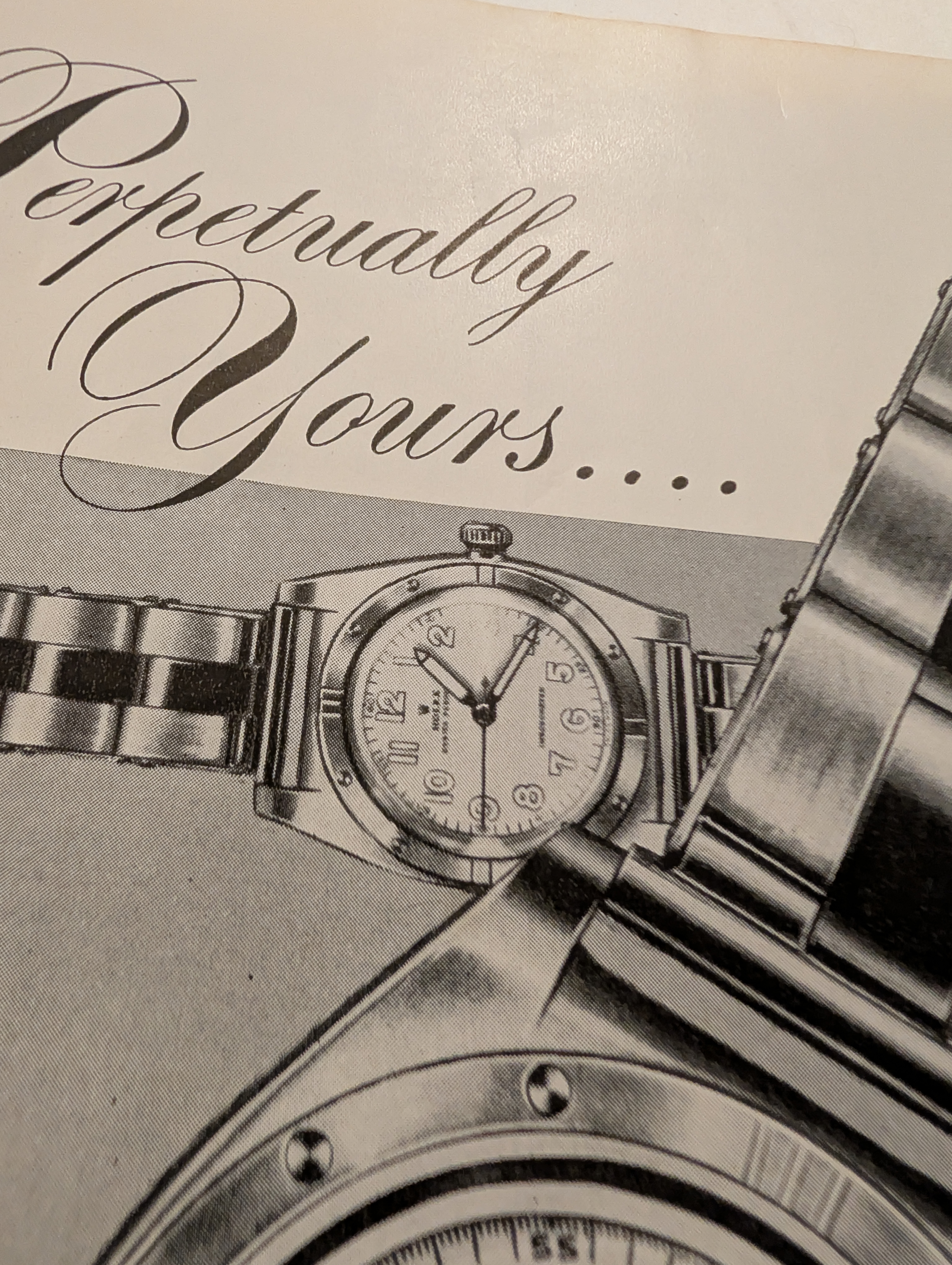
"Entitled 'Yours....', this remarkable mid-century (1950s-1960s) vintage advertisement is a profound historical artifact chronicling the genesis of the modern Rolex empire. The masterpiece featured is the legendary Rolex Oyster Perpetual, a timepiece that forever changed horological history. It represents the perfect union of Rolex's two most groundbreaking innovations: the 'Oyster' (the world’s first waterproof case, introduced in 1926) and the 'Perpetual' (the revolutionary self-winding rotor mechanism invented in 1931). This specific model served as the foundational blueprint, passing its mechanical DNA to every iconic Rolex sports watch that followed. The ad boldly highlights its ability to 'guard the invaluable element time... without conscious thought of its owner,' boasting a 32-hour power reserve. Preserved as a true museum-grade artifact, this monochrome print offers serious collectors a tangible connection to the ultimate horological ancestor—the very watch that established Rolex's eternal supremacy in precision, durability, and innovation."
Exhibition Halls
The Archive Continues
Continue the Exploration
Pontiac · Automotive
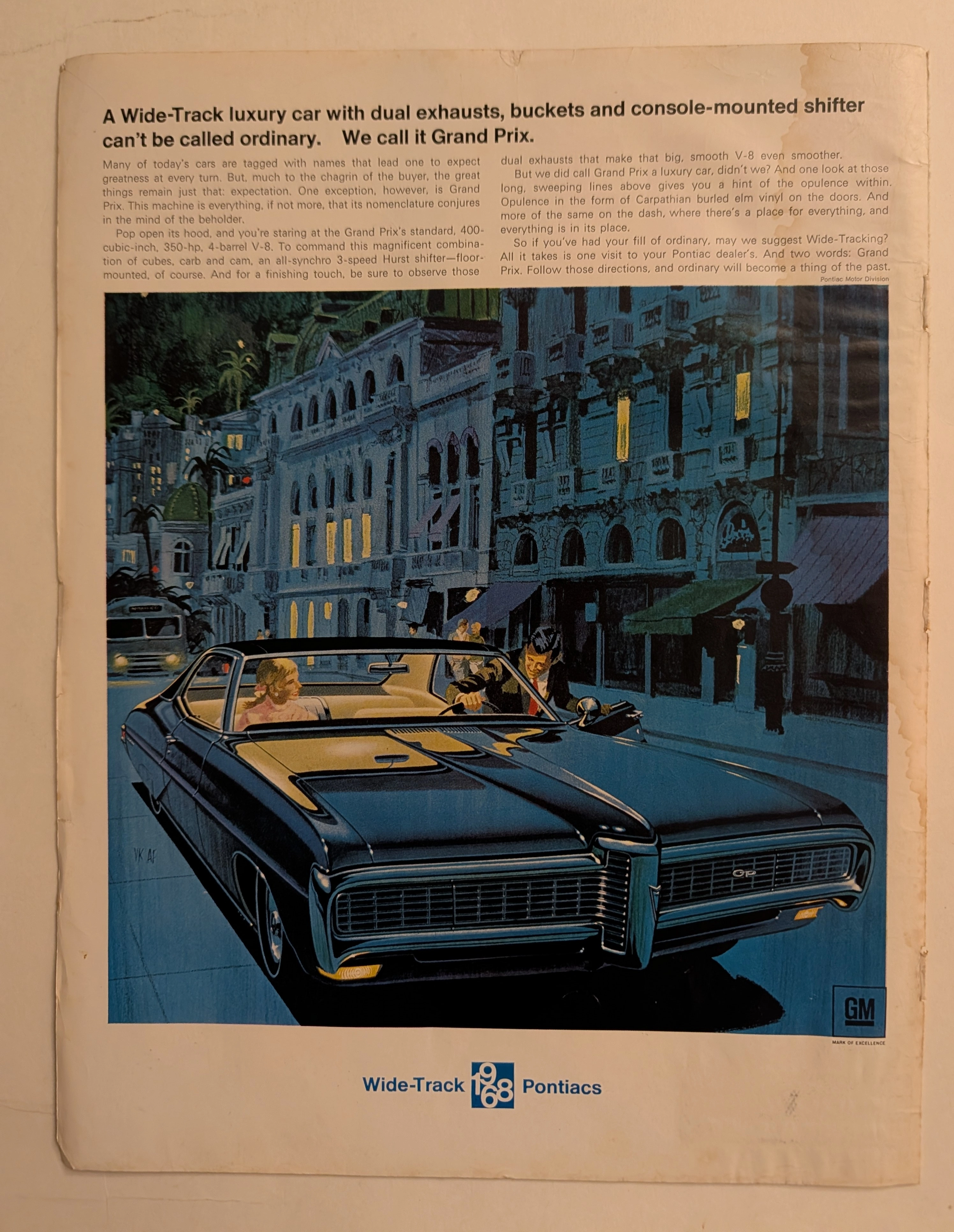
The Time Traveller's Dossier: The Wide-Track Illusion – The 1968 Pontiac Grand Prix Exhibition
The automobile in mid-twentieth-century America was never merely a utilitarian mode of transportation; it was a profound, rolling projection of identity, aspiration, and social status. The historical artifact elegantly and securely positioned upon the analytical table of The Record Institute today is a majestic, full-page print advertisement for the 1968 Pontiac Grand Prix, originating from the golden age of American muscle and luxury. This document completely transcends the traditional boundaries of automotive marketing. It operates as a highly sophisticated cultural mirror, reflecting the exact moment when Detroit automakers successfully blended brutal mechanical horsepower with the cosmopolitan allure of the European jet set on a single printed page. This world-class, comprehensive dossier conducts a meticulous, unyielding, and exceptionally deep examination of the artifact, operating under the absolute most rigorous parameters of historical, sociological, and material science evaluation. We will decode the brilliant "Wide-Track" advertising strategy that saved the Pontiac division, analyze the legendary artistic collaboration that defined an entire era of commercial illustration, and dissect the rich, aspirational semiotics embedded within the twilight European street scene. Furthermore, as we venture deeply into the chemical and physical foundations of this analog printed ephemera, we will reveal the precise mechanical fingerprints of the CMYK halftone rosettes and the graceful, natural oxidation of the paper substrate. This precise intersection of visual nostalgia, mid-century commercial artistry, and the immutable chemistry of time cultivates a serene wabi-sabi aesthetic—a natural, irreversible phenomenon that serves as the primary engine driving up its market value exponentially within the elite global spheres of Vintage Automotive Ephemera and Commercial Art collecting.
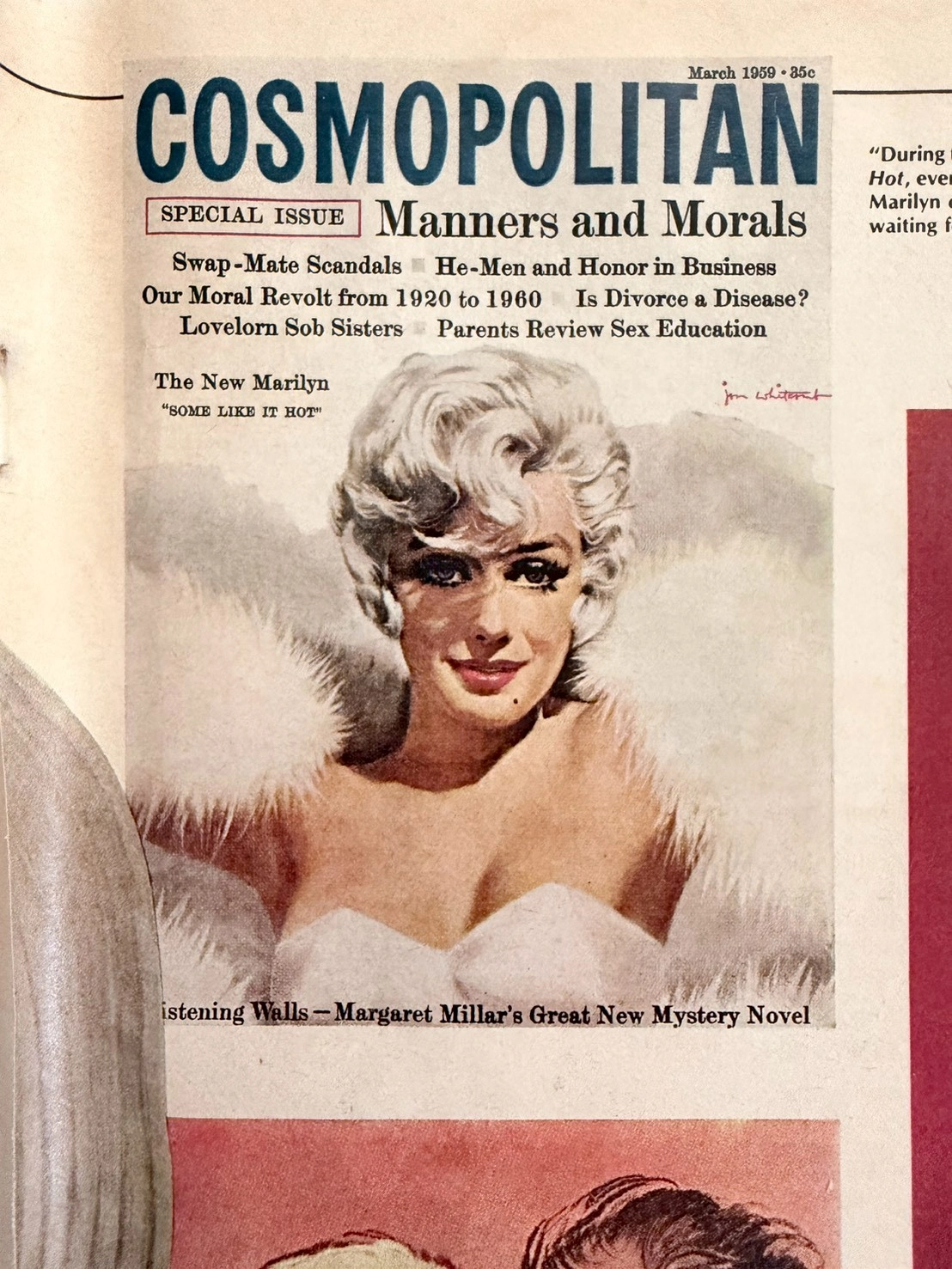
The Marilyn Monroe Enigma: Uncovering 1950s Hollywood Secrets Through Ultra-Rare Vintage Magazine Art (Class SS)
This museum-grade editorial explores an ultra-rare SS-Class archival piece from The Record Institute. It chronicles the 1980 Playboy magazine discovery of lost Marilyn Monroe negatives, eventually solved by legendary illustrator Jon Whitcomb. The artifact not only captures the vulnerability of the 1950s ultimate sex symbol alongside Arthur Miller but also serves as a poignant historical record of the transition from the Golden Age of Illustration to modern photography, celebrating the visceral charm of analog paper preservation.
Zippo · Tobacco
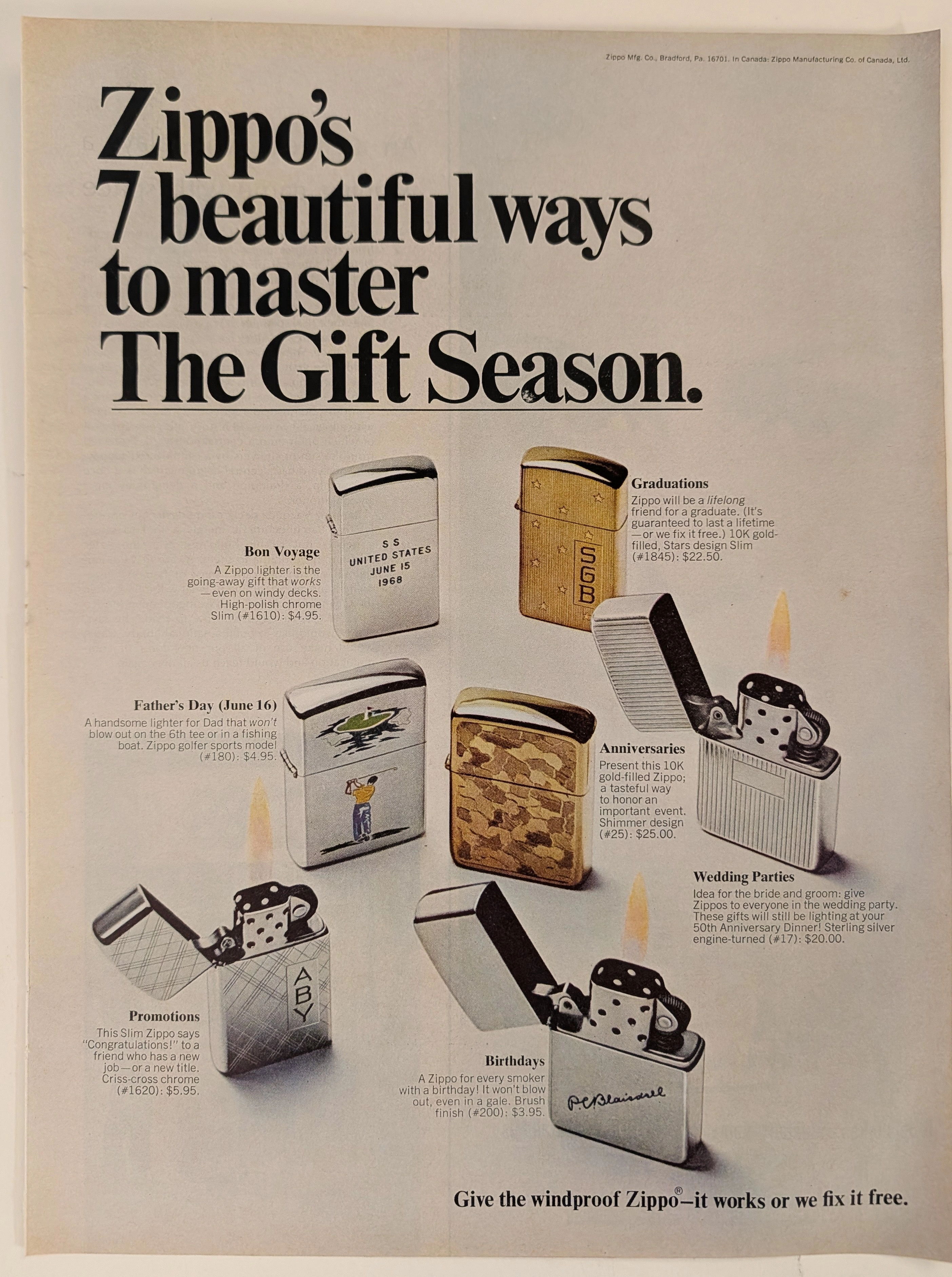
The Time Traveller's Dossier: The Archive of the Immortal Flame – The 1968 Zippo "7 Beautiful Ways" Advertisement
The act of creating fire is a profound symbol of mankind's mastery over nature and the mechanical authority we hold over physical elements. The historical artifact elegantly placed upon the examination table of The Record Institute today is a full-page print advertisement for Zippo from 1968, presented under the campaign "7 beautiful ways to master The Gift Season." This document transcends conventional marketing; it is a flawless psychological projection of the mid-twentieth-century American Dream, encapsulated in metal and backed by a lifetime guarantee. This world-class archival dossier will conduct a meticulous and profound analysis of the artifact, operating under the most rigorous parameters of historical and material science evaluation. We will explore the brand's sophisticated market segmentation through seven occasion-specific lighter models, ranging from high-polish chrome to 10K gold-filled and Sterling Silver editions. Furthermore, we will delve into the magnitude of the legendary declaration, "it works or we fix it free," a promise that confidently challenges the passage of time. Advancing into the chemical foundations of this analog offset lithography, we will reveal the mechanical fingerprints of the halftone rosettes and the natural oxidation of the paper substrate. This precise intersection of metallurgical mechanics and the chemistry of time produces a serene wabi-sabi aesthetic—a phenomenon that serves as the primary engine driving up its market value exponentially within the elite global spheres of Vintage Tobacciana collecting.