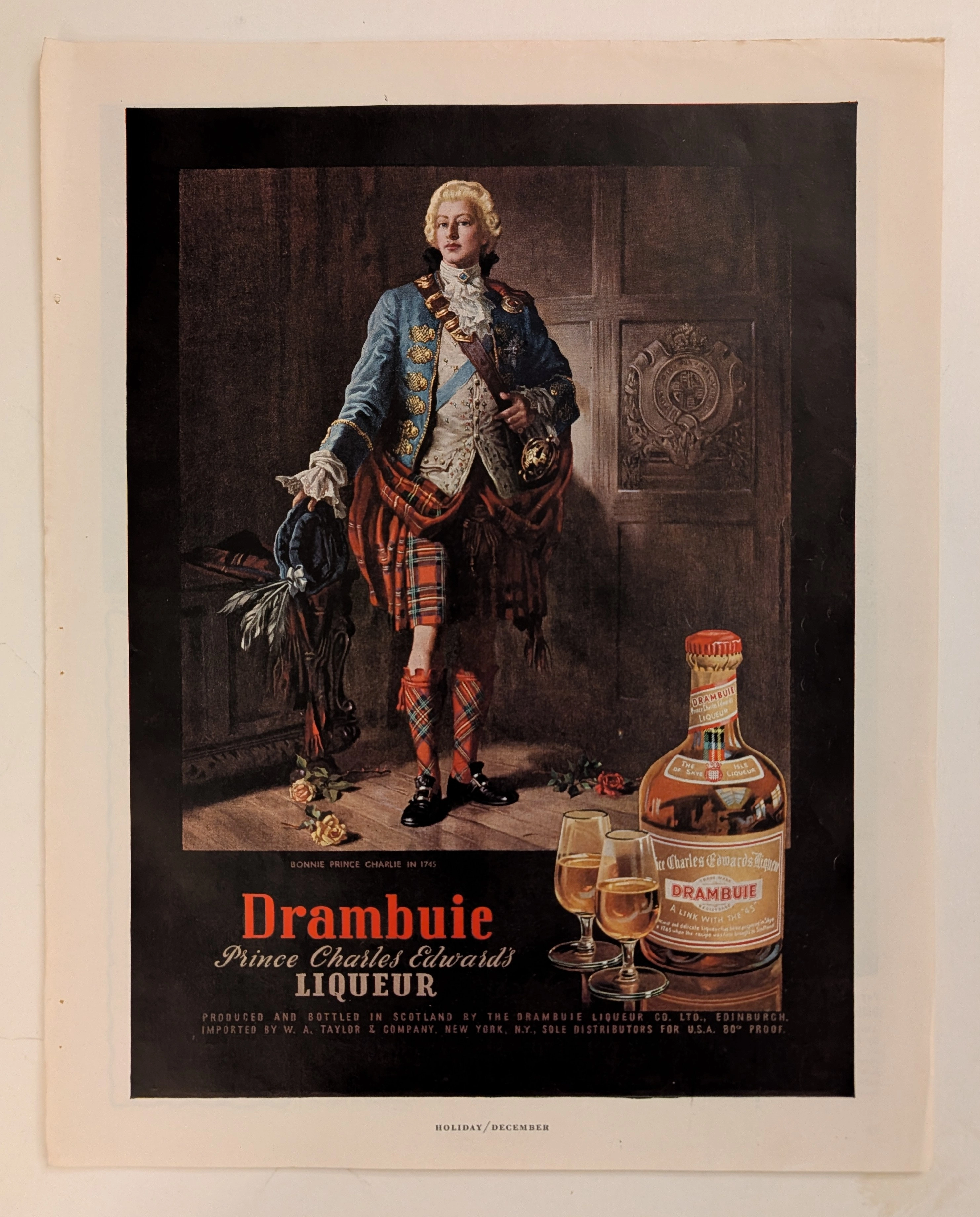
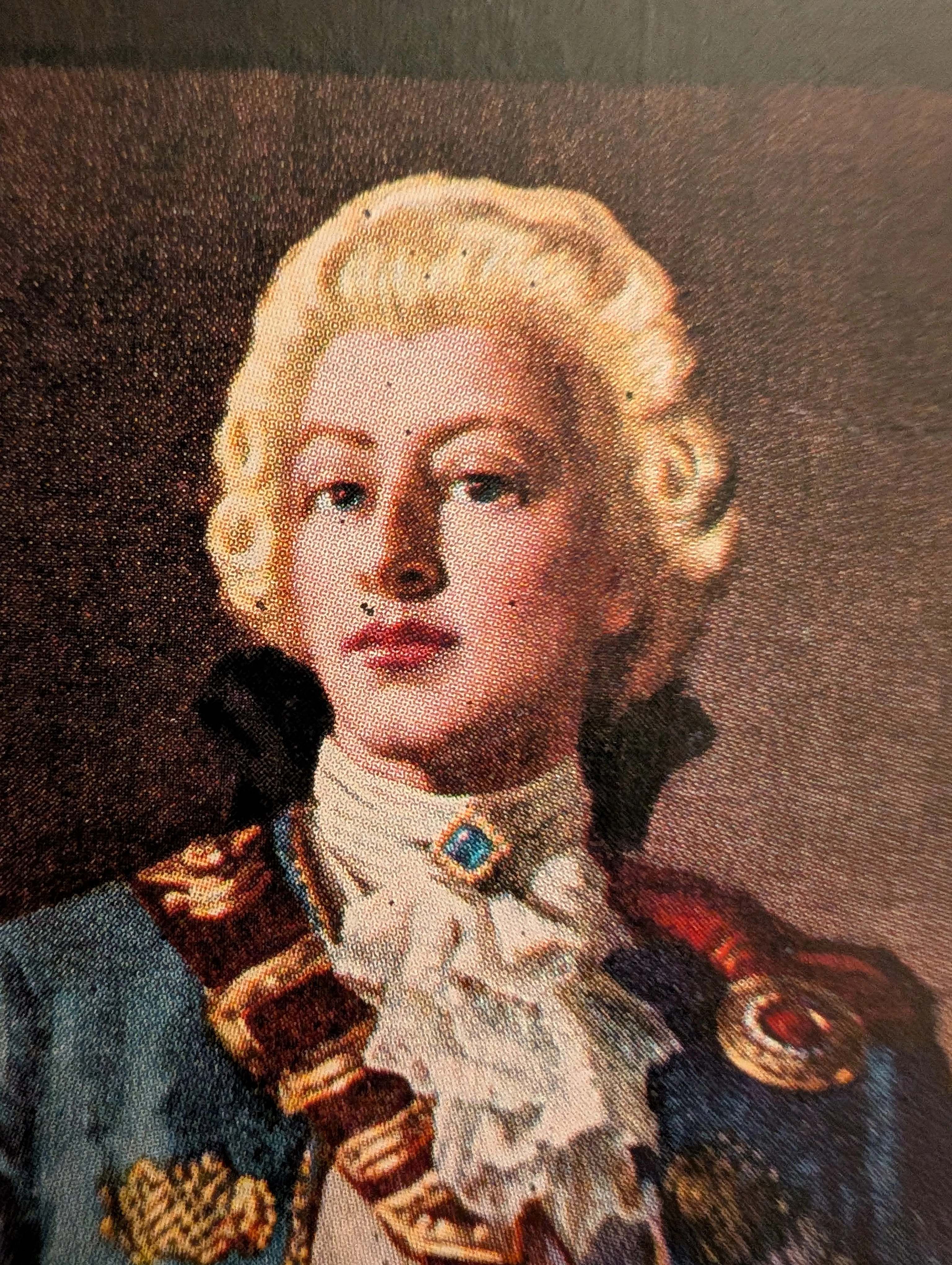
The Time Traveller's Dossier: The Alchemy of Royal Rebellion – Drambuie "Bonnie Prince Charlie" Advertisement (Circa Mid-20th Century)
The History
To genuinely decode the complex sociological architecture embedded within this printed artifact, one must pull back the lens to contextualize the historical mythology of the Scottish Jacobite rising and the audacious DNA of the Drambuie brand. The legend of Drambuie is inextricably linked to Prince Charles Edward Stuart, famously known as "Bonnie Prince Charlie." The historical reality of the 1745 Jacobite rising is one of brutal warfare, political maneuvering, and ultimate, devastating defeat at the Battle of Culloden. Following the slaughter of his highland supporters, the Prince fled to the Isle of Skye, aided by the Clan MacKinnon.
The corporate mythology of Drambuie dictates that as a reward for his loyalty and assistance, the fleeing Prince gifted the chief of Clan MacKinnon his personal, highly guarded recipe for a secret elixir—a potent blend of aged Scotch whisky, heather honey, herbs, and spices. For generations, this recipe remained a closely guarded secret on the Isle of Skye, known in Scottish Gaelic as An Dram Buidheach (The Drink that Satisfies). It wasn't until the late 19th and early 20th centuries that the recipe was commercialized.
By the mid-20th century, the era from which this advertisement hails, Drambuie faced the challenge of expanding beyond its Scottish roots into a booming, post-war global market, particularly in the United States. To achieve this, the brand could not simply sell a sweet whisky liqueur; they had to sell the legend. The brand deliberately ignored the bloody, tragic reality of the Jacobite defeat, choosing instead to weaponize the romanticized, melancholic myth of the exiled "Bonnie Prince." This advertisement is a direct product of that strategy. It is not selling alcohol; it is selling the elixir of a doomed, romantic rebellion.
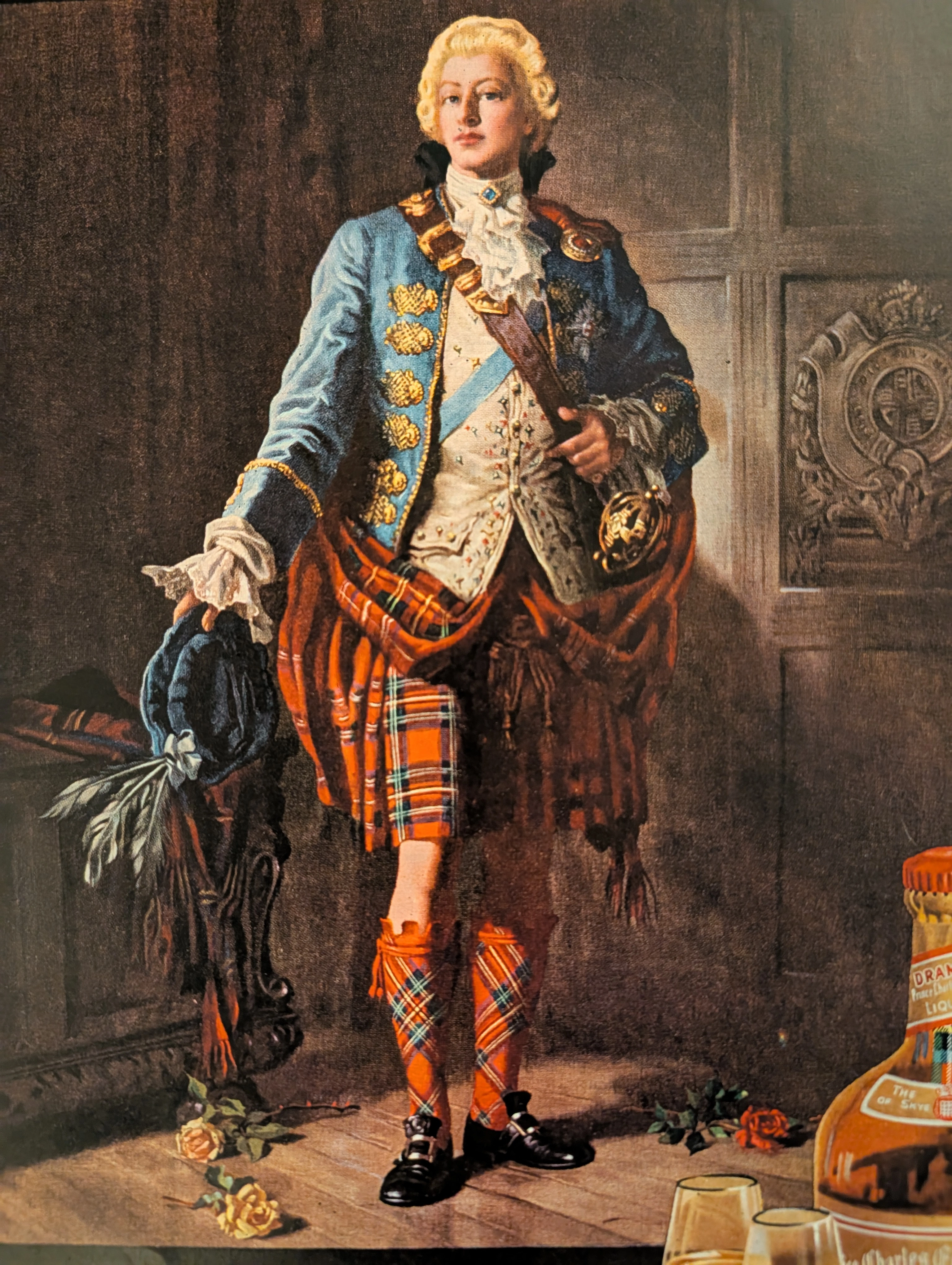
Creator / Illustrator Information: While this specific masterpiece of commercial art bears no official signature of a modern illustrator, it operates on a far more sophisticated level of visual appropriation. The central image is a direct reproduction of a classical historical portrait of Prince Charles Edward Stuart. By utilizing a painting that mimics the stylistic conventions of 18th-century royal portraiture (likely derived from or inspired by works of artists like Allan Ramsay or John Pettie), the advertising agency bypassed the need for a contemporary illustrator. Instead, they hijacked the inherent authority, authenticity, and aristocratic gravitas of historical fine art. This choice deliberately elevated the advertisement from a mere commercial pitch to a piece of curated history, framing the liqueur not as a manufactured product, but as an ancient, royal inheritance.
Part 1: The Binary Shift: The Tragedy of Defeat vs. The Romance of the Legend
The narrative architecture of this artifact is built upon a strict, uncompromising binary contrast against the grim historical reality of 1745. The actual history of Bonnie Prince Charlie is one of political failure, devastating military slaughter at Culloden, and a desperate, cowardly flight into exile. In the face of such a depressing reality, Drambuie presented a diametrically opposed concept: absolute, unyielding romantic heroism.
The advertisement violently obliterates the narrative of failure. It executes a flawless cultural pivot by centering the visual focus not on a defeated fugitive, but on a resplendent, defiant, and immaculately dressed royal prince. The message deliberately contrasts the tragedy of the historical outcome with the immortal, romantic glory of the attempt. The prince is not fleeing; he stands tall, his hand resting casually on his sword hilt, radiating aristocratic confidence. This represents a profound conceptual transition: the brand is no longer merely selling a beverage; it is selling "psychological escapism." It is selling the absolute guarantee that by partaking in this specific liquid, the consumer is momentarily aligned with the bravery, the romance, and the aristocratic tragedy of the ultimate rebel prince.
Part 2: The Semantics of Royal Inheritance
To execute a strategy of this magnitude, the brand required a highly specific, psychologically resonant vocabulary. The copywriting on this page abandons all traditional descriptions of taste or distillation methods. It boldly crosses the line into the realm of historical fantasy and royal decree. It deliberately hijacks the lexicon of the British aristocracy to sanctify a commercial transaction:
"Drambuie"
"Prince Charles Edward's Liqueur"
"A LINK WITH THE '45"
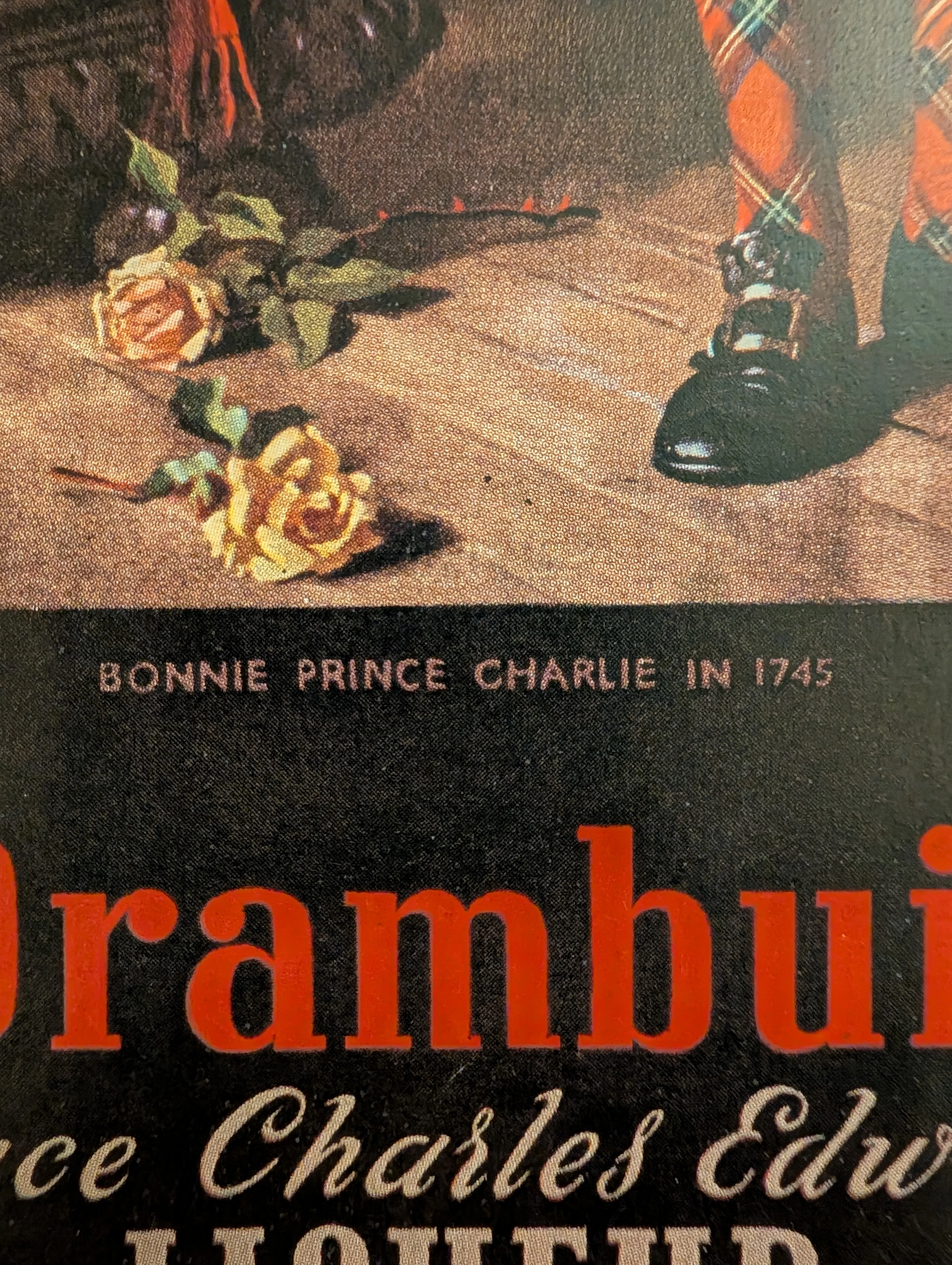
"BONNIE PRINCE CHARLIE IN 1745"
The deployment of this language is not mere descriptive text; it is a calculated psychological hijacking. This is the ultimate manifestation of "Heritage Branding." Drambuie makes no attempt to discuss the flavor profile of the liqueur in the primary text. Instead, it shamelessly elevates the act of purchasing a bottle of alcohol to the level of partaking in a royal bloodline. The psychological strike effectively fuses the romantic tragedy of the Jacobite rebellion directly into the amber liquid of the Drambuie bottle. By branding it explicitly as "Prince Charles Edward's Liqueur" and establishing it as "A Link with the '45," the price tag ceases to be a commercial transaction; it becomes a mandatory toll to access a piece of living history. If a consumer wished to experience the refined, aristocratic taste of a legendary prince, they were socially and psychologically obligated to purchase Drambuie.
Part 3: The Sovereign Consumer & The Illusion of Proximity
The socioeconomic structure of the post-war era was characterized by a booming middle class eager to signal upward mobility and sophistication. This advertisement serves as a masterclass in creating "Illusory Proximity" to power and aristocracy.
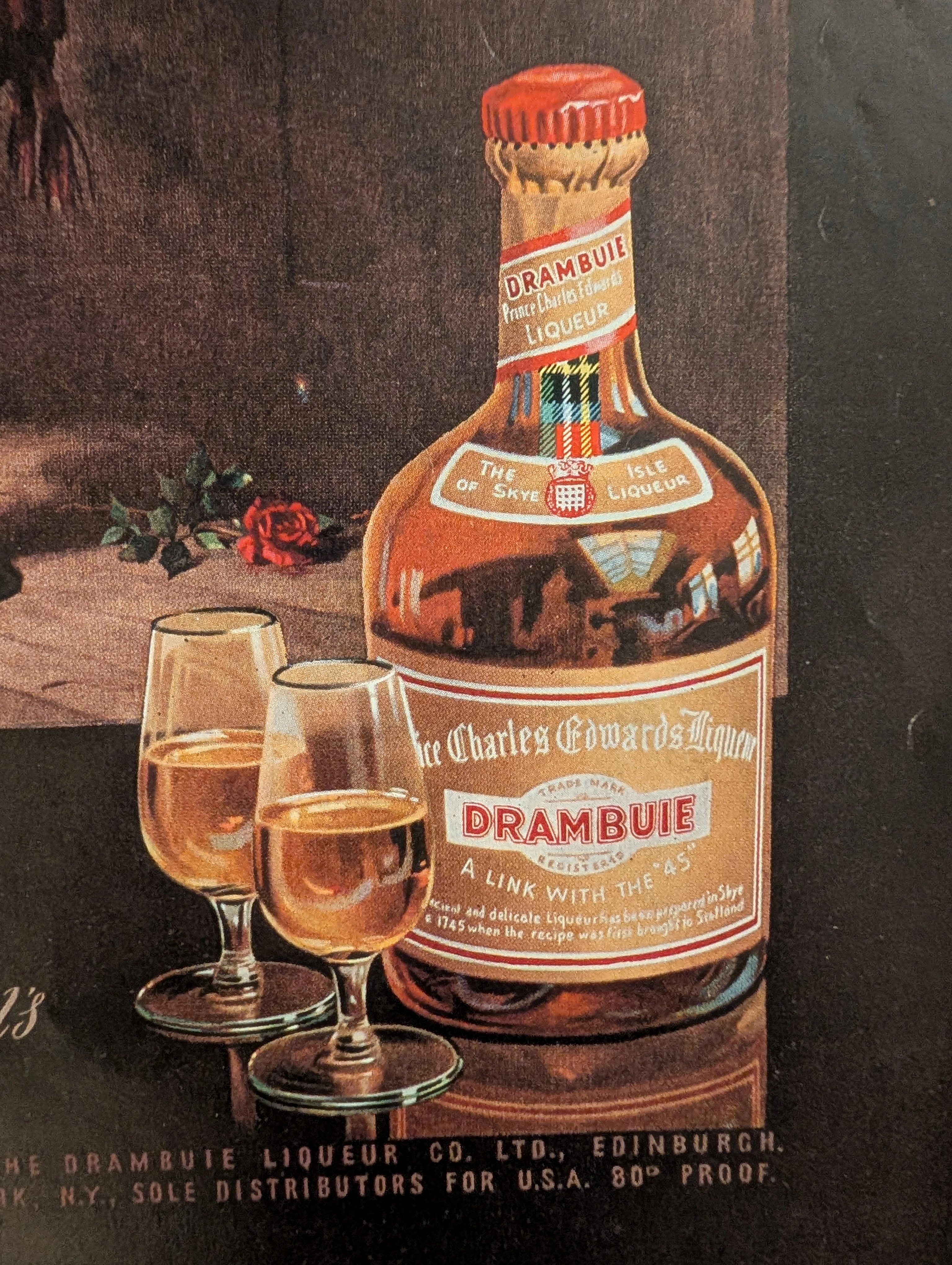
The visual layout places the consumer directly in the room with the Prince. The bottle and the two filled glasses in the foreground are not merely product placements; they are an invitation. They suggest that the Prince himself has just poured these glasses, and one is waiting for the viewer. This is an aggressive psychological conditioning. They were not just selling a liqueur; they were selling the American public an instant, purchasable connection to European royalty. Furthermore, the inclusion of the text "IMPORTED BY W.A. TAYLOR & COMPANY, NEW YORK, N.Y." serves a crucial purpose. It validates the product's authenticity as a genuine, exotic import, justifying a premium price tag while simultaneously making this piece of Scottish history conveniently accessible to the American consumer. It provided a moral loophole: allowing the buyer to indulge in a luxurious, foreign spirit while feeling sophisticated and worldly, having acquired a direct "link" to a romanticized past.
Part 4: Visual Semiotics: The Staged Rebellion
In an era where modern photography was readily available, the deliberate choice to render this advertisement through the medium of a classical, 18th-century style portrait acts as a precise and highly courageous semiotic indicator:
Institutional Eternity: A photograph is modern, transient, and inextricably linked to the present. A classical painting, however, represents history, endurance, and unquestionable authority. By depicting the Prince through the medium of historical fine art, Drambuie visually divorced the liqueur from the disposable, fast-paced world of modern consumer goods. It framed the bottle as an antique, an heirloom, a piece of eternal history that transcends the mortal coil.
The Architecture of Romance: The visual composition is heavily coded with symbols of romantic tragedy. The Prince stands before a heavy, carved wooden door bearing a crest—a symbol of the throne he was denied. At his feet lay scattered, fallen roses. The rose, particularly the white rose, was the symbol of the Jacobite cause. The fact that they are fallen and scattered on the floor subliminally references the doomed nature of his rebellion. However, the bottle of Drambuie stands erect and glowing next to them, implying that while the rebellion failed, the "spirit" of the Prince lives on in the liqueur. The visual composition forces the viewer's brain to equate the tragedy of the fallen roses with the enduring legacy contained within the bottle.
Part 5: Pop Culture Impact and Enduring Legacy
The marketing strategy pioneered by Drambuie left an indelible, ineradicable mark on the global spirits industry. This specific campaign strategy—fusing an alcoholic beverage with a highly specific, romanticized historical legend—was the absolute gold standard for "Heritage Branding."
Before brands like Drambuie successfully weaponized their origin stories, spirits were often sold purely on their intoxicating effects or basic flavor profiles. The cultural impact of this positioning engineered a societal norm where premium spirits are now expected to possess a rich, often exaggerated, historical pedigree. In the modern commercial arena, brands still desperately attempt to manufacture the aura of historical authenticity and royal endorsement that Drambuie achieved decades ago. This physical artifact is the foundational source code for the most arrogant, pervasive, and wildly successful psychological marketing mythology in the history of the modern liquor industry.
The Paper
As a physical entity, this tear sheet is an unrepeatable, isolated record of mid-20th-century offset lithographic printing. The medium-weight, uncoated magazine stock was originally engineered by the ton for mass distribution; however, its current, aged state demands a profound evaluation through the highest echelon of Japanese aesthetic philosophy: wabi-sabi (侘寂)—the acute recognition and appreciation of beauty found in impermanence, imperfection, and the ruthless, natural progression of time.
Visual Forensics & Substrate Analysis (The Economics of Ephemera):
Subjecting the extreme macro close-ups of this artifact to visual forensics reveals the mechanical heartbeat of the pre-digital printing press. Under high magnification, the illusion of the smooth, painted portrait violently shatters, dissolving into a precise, mathematically rigorous galaxy of CMYK (Cyan, Magenta, Yellow, Key/Black) halftone rosettes. The distinct, gritty grain of the offset printing process is aggressively visible within the transition zones of the Prince's face and the dark background. The typography below, exhibiting the slight ink spread characteristic of the era, anchors the piece in its historical reality.
However, the most crucial and valuable aspect of this specific artifact lies in its Material Degradation. Examining the margins and the unprinted negative spaces reveals authentic, undeniable "Toning." This is a gradual, irreversible yellowing, browning, and embrittlement effect caused by the natural chemical oxidation of organic lignin trapped within the wood pulp of the paper upon decades of exposure to air and ambient ultraviolet light.
It is vital to understand the archival and market significance of this ephemeral nature. Analog print media from the mid-20th century represents a vanishing breed of historical documentation that is slowly, yet unstoppably, disintegrating. This organic, breathing physical degradation is a fingerprint of time that can absolutely never be cloned, replicated, or faked by modern high-precision digital scanning or micro-jet printing processes. As these original pages slowly burn themselves out through oxidation, turning fragile and brittle, their supply in the global collector's market shrinks daily. It is precisely this ticking clock of physical impermanence—the fact that this paper is slowly returning to the earth—that drives up its market value exponentially. The evolving patina elevates the piece from a uniform, lifeless industrial print run into a singular, unique artifact covered in historical scars. The wabi-sabi nature of this decaying paper ensures that its aesthetic and financial worth will continue to skyrocket precisely because it is a dying medium.
The Rarity
Rarity Class: A (Advanced / Highly Desirable)
Within the strictest parameters of international archival evaluation, this artifact holds a definitive Class A designation. The ultimate paradox of mid-20th-century analog print ephemera lies in the violent contrast between its initial mass production and its extreme, near-extinct scarcity today. Vintage magazines from this era were quintessential "disposable media," destined to be read once and then mercilessly discarded.
For this specific, single-page advertisement to have miraculously survived several decades—resisting the ravages of destructive handling, severe moisture damage, and avoiding catastrophic structural center creases—is a pure statistical archival anomaly. Furthermore, finding a Drambuie advertisement featuring the classical portraiture of Bonnie Prince Charlie, complete with the glowing rendering of the bottle and glasses, wherein the CMYK pigments retain their original depth while exhibiting only the genuine, unforced hallmarks of wabi-sabi aging, is highly uncommon. Pristine, untouched remnants of this specific era of sociological marketing are fiercely hunted by curators of advertising history, spirits archivists, and collectors of Scottish ephemera. They are acquired with the sole intention of executing museum-grade, acid-free conservation framing, preserving them permanently as historical heirlooms of the era when corporate America successfully manufactured and monetized a royal legend.
Visual Impact
The aesthetic authority of this piece lies in an absolute masterclass of compositional hierarchy and atmospheric mood. The immediate focal point that hijacks the viewer's optic nerve is the figure of Bonnie Prince Charlie. His striking blue velvet coat, heavily embroidered with gold, and the vibrant red tartan of his kilt violently contrast with the dark, moody background. This chiaroscuro effect—the intense contrast between the brilliantly lit figure and the impenetrable shadow of the room—creates a profound sense of theatrical drama and historical gravity.
This visual weight is perfectly balanced by the brightly illuminated bottle and glasses in the lower right foreground. The amber liquid glows as if lit from within, mimicking the gold embroidery on the Prince's coat. This juxtaposition between the historical figure and the tangible product forces the viewer's brain to equate the two in terms of importance and value. The layout acts as a leading line, guiding the eye from the arrogant, confident gaze of the Prince, down the line of his tartan, directly to the glowing bottle, perfectly trapping the reader in a closed loop of historical fantasy and consumerist salvation.
Exhibition Halls
The Archive Continues
Continue the Exploration
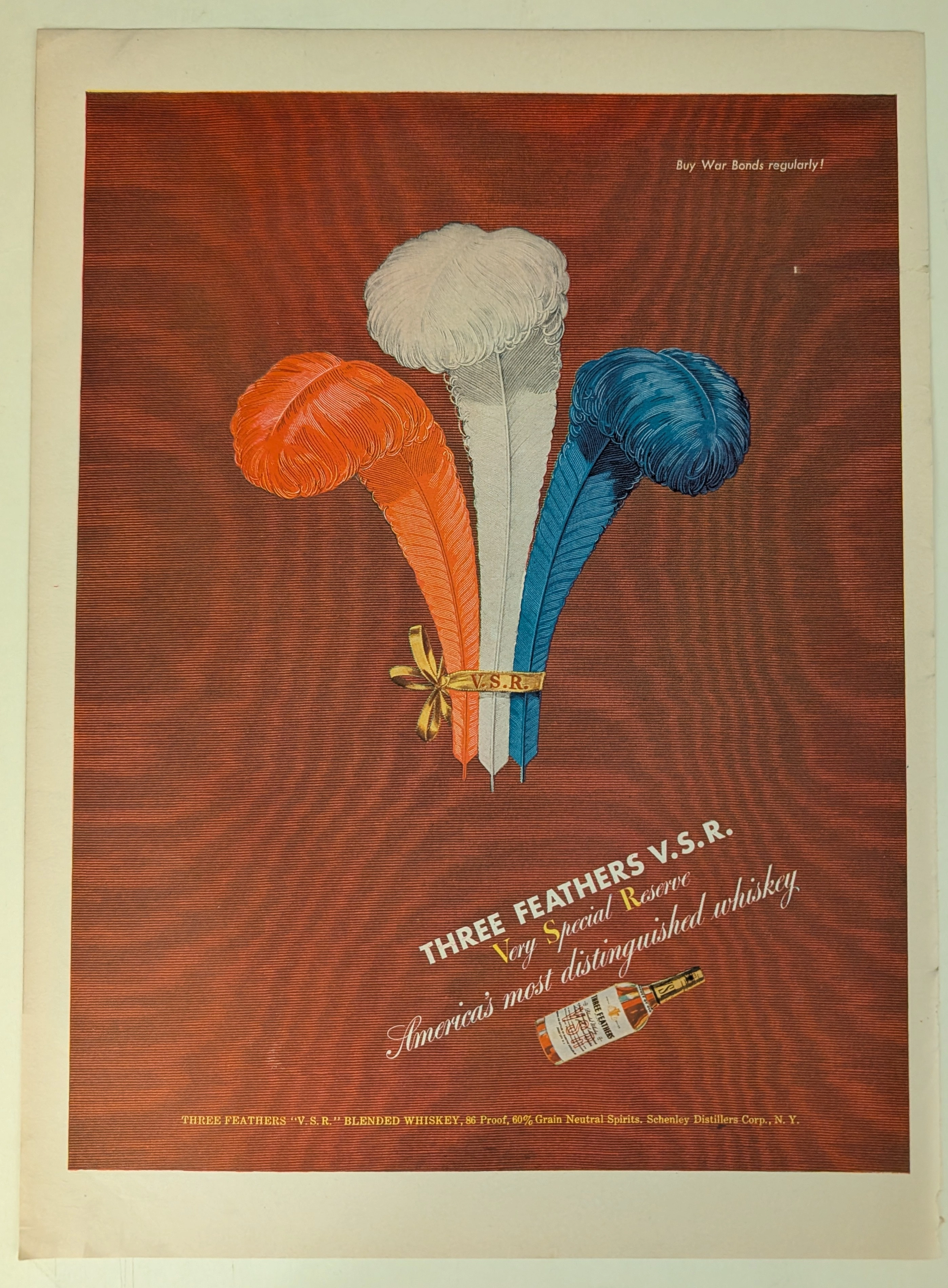
THE TIME TRAVELER'S DOSSIER: BLOOD CAPITALISM AND THE WEAPONIZATION OF WHISKEY
This impeccably preserved Historical Relic is a Primary Art Document from the brutal crucible of World War II, featuring a sweeping advertisement for THREE FEATHERS V.S.R. Blended Whiskey. It chronicles the ultimate mid-century psychological strategy of "Patriotic Capitalism." The artifact is forensically and definitively dated to the WWII era by the explicit, government-aligned directive in the upper right corner: "Buy War Bonds regularly!". Visually, the brand masterfully hijacked American nationalism by rendering its iconic three feathers in a vibrant Red, White, and Blue patriotic color scheme. Surviving the aggressive scrap paper drives of the 1940s, the acidic analog paper exhibits a profound integration of the deep crimson ink into its degrading fibers, perfectly encapsulating the analog aesthetic of wabi-sabi. This slow chemical death elevates this rescued wartime artifact to an irreplaceable Primary Art Document of Rarity Class A.
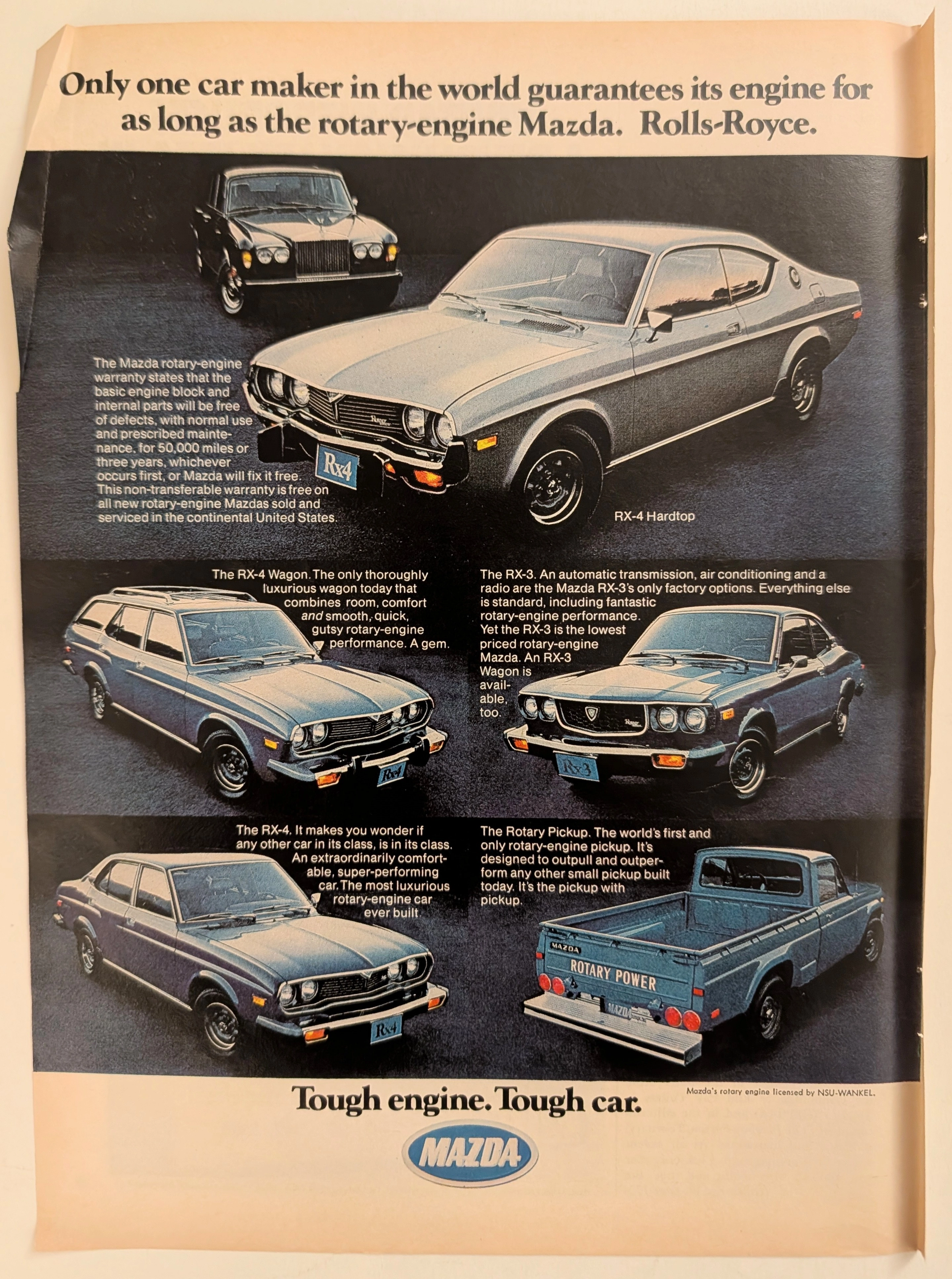
Mazda · Automotive
The Time Traveller's Dossier: Rotary Audacity – The Mazda Wankel Engine, the 1970s Oil Crisis, and the Rolls-Royce Provocation
The evolution of the global automotive landscape in the latter half of the twentieth century was violently disrupted during the 1970s, an era defined by stringent new environmental regulations, catastrophic oil embargoes, and a growing consumer disillusionment with traditional engineering paradigms. Elegantly and securely positioned upon the analytical table of The Record Institute today is a visually arresting, densely informative, and highly significant full-page print advertisement for the Mazda Rotary-Engine Lineup. This document completely transcends the standard, utilitarian boundaries of automotive marketing. It operates as a highly sophisticated, multi-layered cultural mirror and a bold declaration of mechanical survival against insurmountable odds. By audaciously juxtaposing their experimental rotary-engine vehicles against the ghostly, monolithic silhouette of a Rolls-Royce Silver Shadow, Mazda executed a masterclass in psychological marketing. They utilized the objective, undeniable metric of a "50,000-mile / 3-year warranty" to shatter the consumer anxiety surrounding the Wankel engine's durability. This world-class, comprehensive dossier conducts a meticulous, unyielding, and exceptionally exhaustive examination of the artifact, operating under the absolute most rigorous parameters of historical, sociological, and material science evaluation. Dedicating the overwhelming, massive majority of our analytical focus (80%) to its immense historical gravity, we will decode the brilliant, confrontational marketing psychology embedded within the copywriting, analyze the profound mechanical realities of the Wankel rotary engine, trace the epic engineering struggles of the "47 Ronin," and detail the historical impact of the legendary RX-3, RX-4, and the mythical Rotary Engine Pickup (REPU). Furthermore, as we venture deeply into the chemical and physical foundations of this analog printed ephemera (10%), we will reveal the precise mechanical fingerprints of the CMYK halftone rosettes captured in the stunning macro imagery of the blue metallic paintwork. Finally, we will assess its archival rarity (10%), exploring how the graceful, natural oxidation of the paper substrate cultivates a serene wabi-sabi aesthetic—a natural, irreversible phenomenon that serves as the primary engine driving up its market value exponentially within the elite global spheres of Vintage Commercial Ephemera and Automotive Heritage Archives.
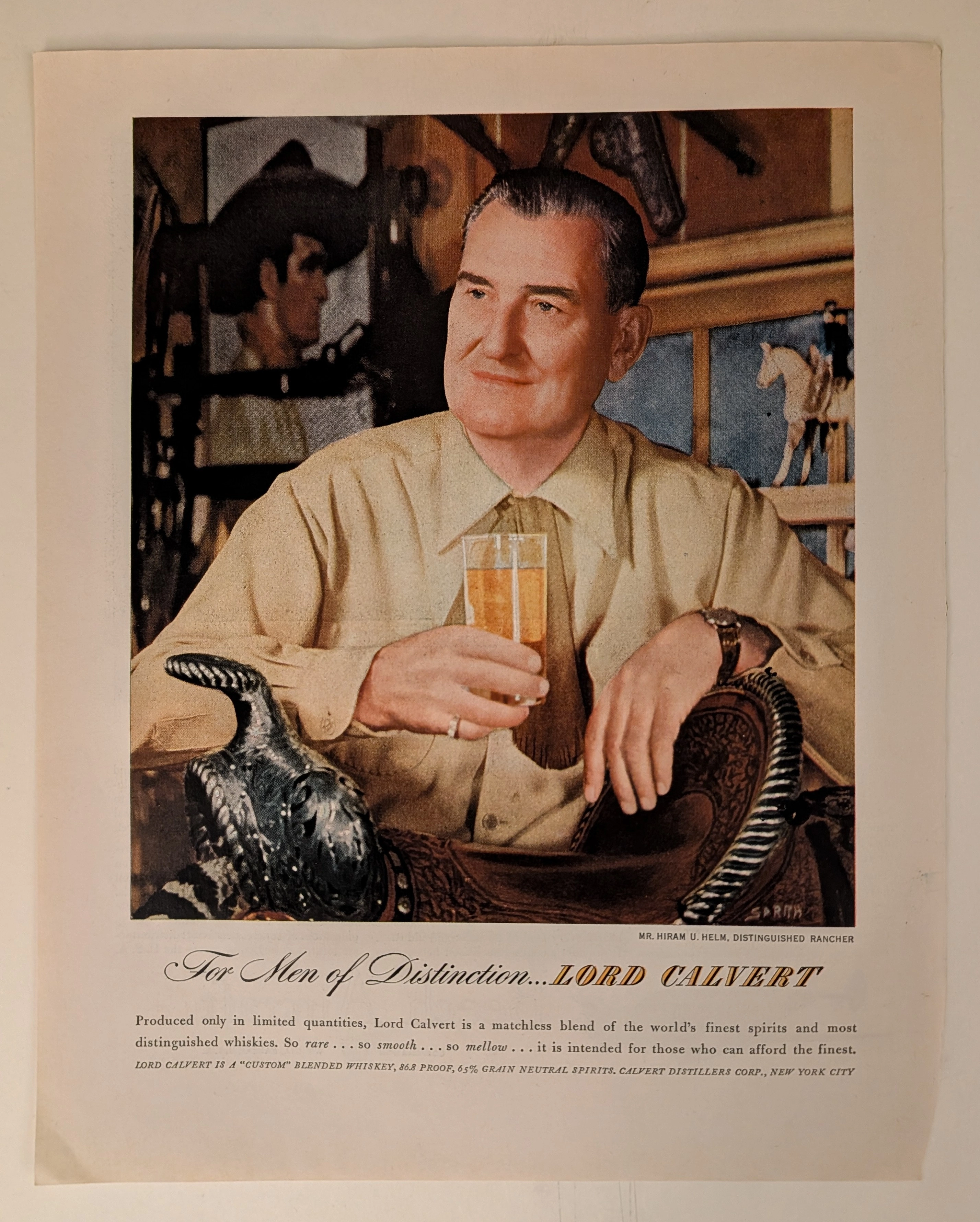
THE TIME TRAVELER'S DOSSIER: THE COMMODIFICATION OF STATUS AND THE ART OF THE ELEGANT ILLUSION
The artifact under exhaustive, uncompromising, and unprecedented museum-grade analysis is an exceptionally preserved Historical Relic originating from the absolute zenith of Madison Avenue's psychological marketing era (circa late 1940s to 1950s). This Primary Art Document is a monumental, full-page advertisement for LORD CALVERT, produced by the Calvert Distillers Corp., New York City. This piece represents the visual anchor for one of the most legendary, extensively studied, and phenomenally successful advertising campaigns in the history of American capitalism: "For Men of Distinction". It features a masterful, hyper-realistic portrait of Mr. Hiram U. Helm, Distinguished Rancher, deliberately painted/photographed to exude rugged sophistication, wealth, and aristocratic leisure. The artwork proudly bears the signature of SARRA (Valentino Sarra), a titan of mid-century commercial photography and illustration known for his cinematic lighting and profound character studies. This document is a profound "Sociological Blueprint of Aspirational Wealth." It masterfully utilized the psychology of exclusivity, marketing a blended whiskey composed of "65% Grain Neutral Spirits" as a "Custom" blend intended only "for those who can afford the finest". Rescued from the inevitable oblivion of disposable mass media, this mid-century analog artifact is a breathtaking embodiment of the Japanese aesthetic of wabi-sabi. Printed on inherently acidic wood-pulp paper, it exhibits a beautifully authentic, warm amber oxidation across its entire surface. This unstoppable molecular death transforms a piece of mass-produced corporate propaganda into an irreplaceable, ready-to-frame Primary Art Document of post-war sociological history.