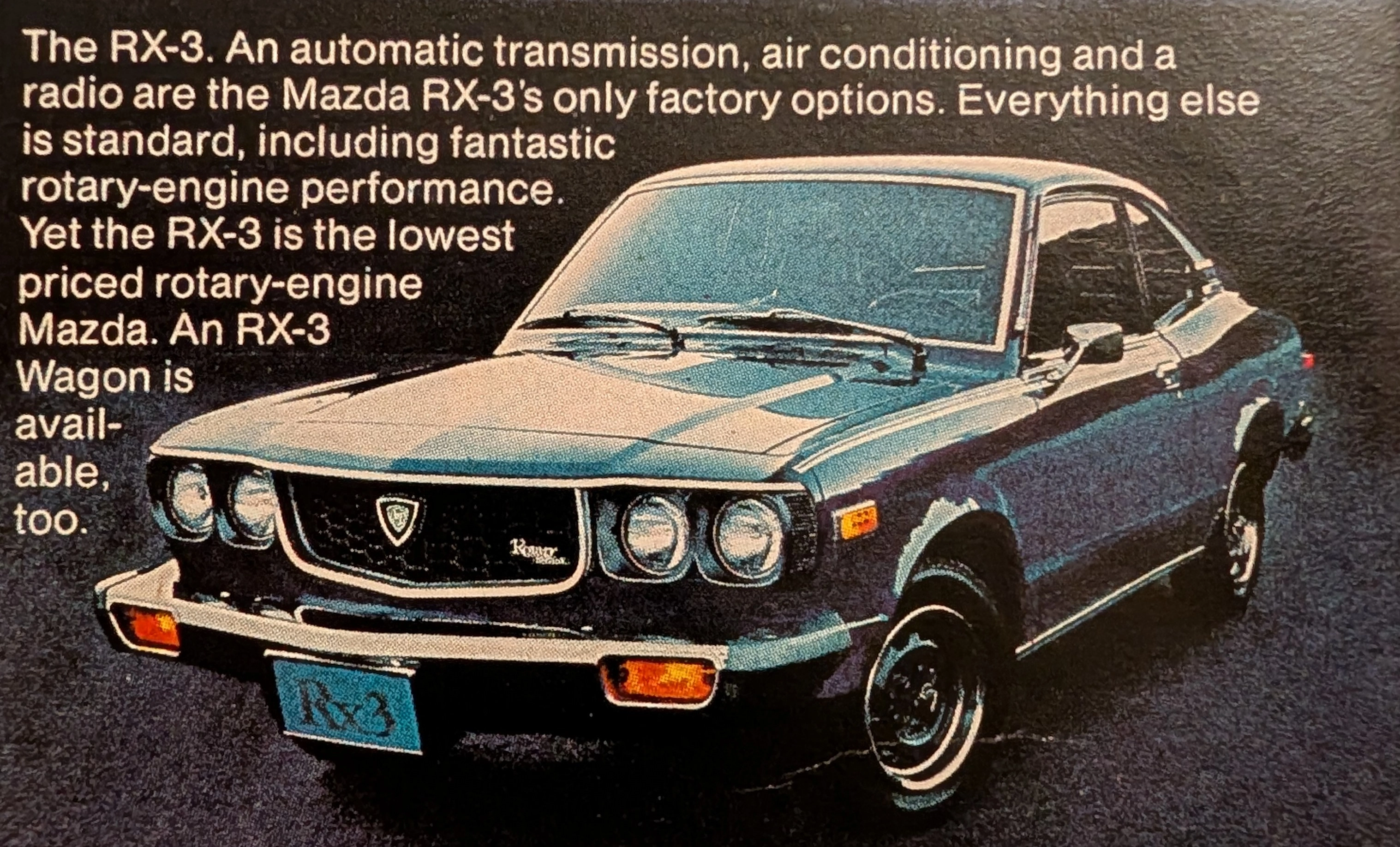
The Time Traveller's Dossier: Rotary Audacity – The Mazda Wankel Engine, the 1970s Oil Crisis, and the Rolls-Royce Provocation
The History
To fully appreciate the immense historical gravity, cultural magnitude, and sociological importance of this artifact, one must meticulously and exhaustively contextualize the complex, highly specific landscape of the global automotive industry leading up to the mid-1970s. The story embedded within the fibers of this advertisement is not merely about selling cars; it is an epic saga of technological obsession, existential corporate survival, international licensing wars, and the brutal realities of global geopolitics.
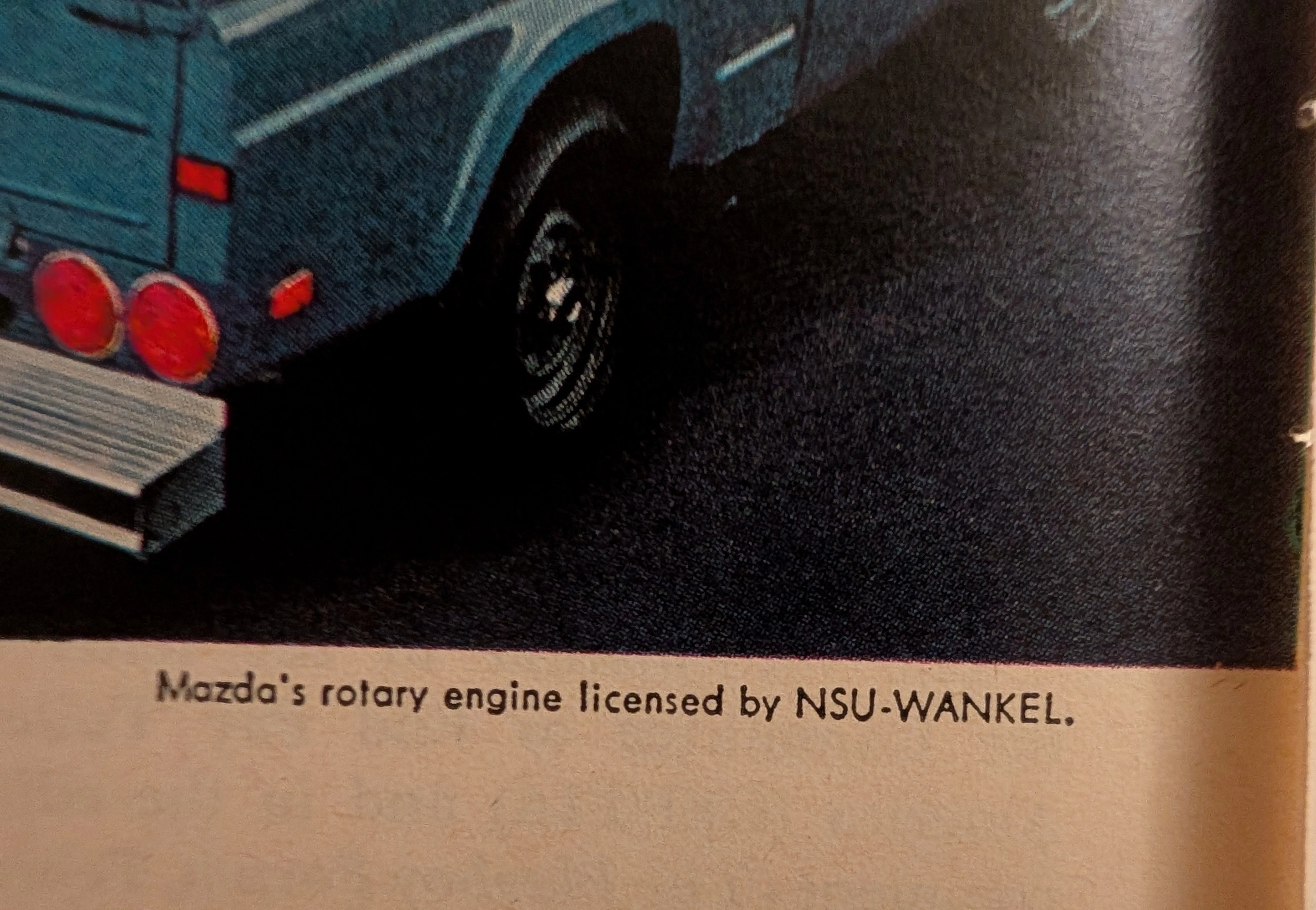
The narrative begins not in Japan, but in Germany with Felix Wankel, an eccentric and brilliant engineer who dreamed of an internal combustion engine that eliminated the violent, reciprocating mass of traditional pistons. His vision was the rotary engine: a smooth, high-revving, incredibly compact powerplant utilizing a Reuleaux triangle rotor spinning within an epitrochoidal housing. When the German firm NSU Motorenwerke announced the successful development of the Wankel engine in late 1959, it sent shockwaves through the global automotive industry. It was hailed as the definitive engine of the future. The bottom-right corner of this very artifact proudly bears the microscopic yet legally vital inscription: "Mazda's rotary engine licensed by NSU-WANKEL", a testament to the international technology transfer that defined the era.
In Japan, Toyo Kogyo (the parent company of Mazda) was facing an existential threat. In the early 1960s, Japan's powerful Ministry of International Trade and Industry (MITI) was aggressively pushing to consolidate the country's numerous, smaller automobile manufacturers into a few massive conglomerates (like Toyota and Nissan) to better compete on the global stage. Tsuneji Matsuda, the visionary president of Toyo Kogyo, realized that the only way to retain his company's independence was to possess a unique, proprietary technology that no other Japanese automaker had. In a massive financial gamble, Matsuda signed an exclusive licensing agreement with NSU in 1961.
However, acquiring the license was merely the beginning of a nightmare. The early Wankel engines suffered from a fatal, catastrophic flaw. As the triangular rotor spun, the apex seals at the three tips would vibrate, gouging deep, destructive grooves into the chrome-plated internal housing. These grooves, known infamously as "chatter marks" or the "devil's nail marks," would cause the engine to rapidly lose compression, consume massive amounts of oil, and ultimately fail, often within just a few thousand miles. The engineering challenge seemed insurmountable. NSU itself would eventually be driven to ruin by the warranty costs of their failing Ro 80 luxury sedans.
To solve this, Matsuda appointed a brilliant, fiercely dedicated engineer named Kenichi Yamamoto to lead a special rotary engine research division. Yamamoto assembled a team of young, exceptionally talented engineers who became known in corporate lore as the "47 Ronin" (echoing the legendary samurai who sought to avenge their master). Operating under immense pressure, the 47 Ronin worked relentlessly, testing hundreds of different materials—from animal bone to exotic alloys. Finally, they developed a revolutionary apex seal made from an aluminum-carbon composite, completely eliminating the devil's nail marks. This breakthrough allowed Mazda to launch the iconic Cosmo Sport 110S in 1967, proving the rotary engine was viable.
By the early 1970s, Mazda's rotary-powered cars were an absolute sensation in the United States. Americans were captivated by the rotary's unique characteristics: it was incredibly smooth, whisper-quiet at idle, and produced a seemingly endless surge of power that revved with a distinctive, turbine-like "brap-brap-brap" exhaust note. The RX-2 and the RX-3 models sold in massive numbers. The rotary engine was smaller, lighter, and produced more horsepower per liter than traditional, heavy American V8s. It seemed Mazda had conquered the world.
Then, the world changed overnight. In October 1973, the Organization of Arab Petroleum Exporting Countries (OPEC) proclaimed an oil embargo. The price of oil quadrupled. Long lines formed at gas stations across America, and the era of cheap, abundant fuel violently ended. Simultaneously, the US Environmental Protection Agency (EPA) enacted the stringent Muskie Act, heavily restricting automotive emissions. The Mazda rotary engine, for all its brilliance, had a fatal Achilles' heel: it was inherently less thermally efficient than a piston engine, meaning it consumed significantly more gasoline and produced higher hydrocarbon emissions. The EPA publicly released a devastating report highlighting the rotary's poor fuel economy. Almost instantly, sales of Mazda's rotary vehicles completely collapsed. Consumers fled the brand in terror, and Toyo Kogyo teetered on the absolute brink of catastrophic bankruptcy.
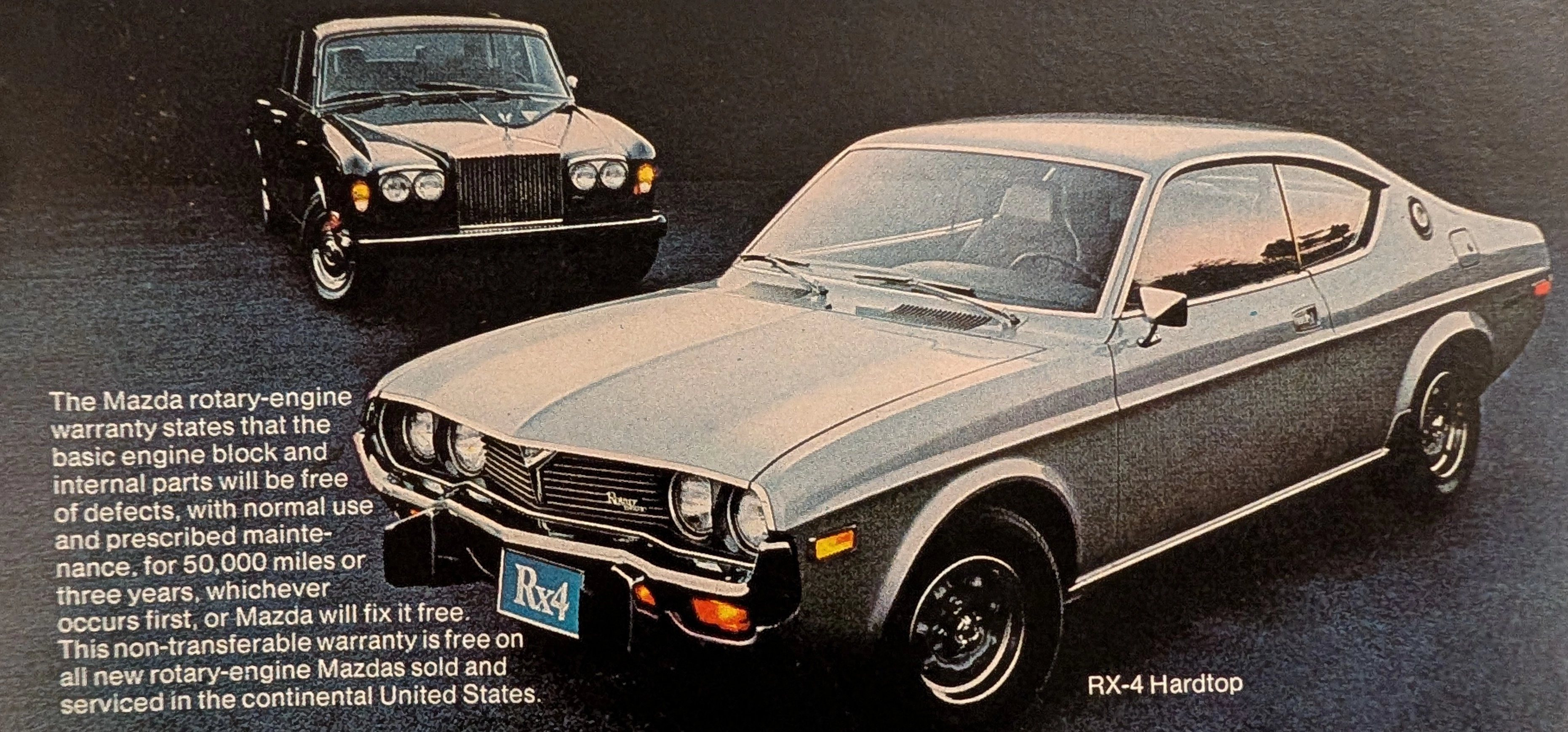
It is within this exact climate of desperate, existential corporate panic that this masterpiece of a commercial artifact was forged. Mazda realized they could not immediately fix the fuel economy, but they could definitively address the lingering consumer anxieties about the engine's long-term durability. To regain the trust of the American public, they launched an unprecedented psychological marketing assault. They introduced a staggering, industry-shaking "50,000-mile or three-year" warranty on the basic engine block and internal parts. This warranty was almost unheard of for economy and mid-range cars in the 1970s.
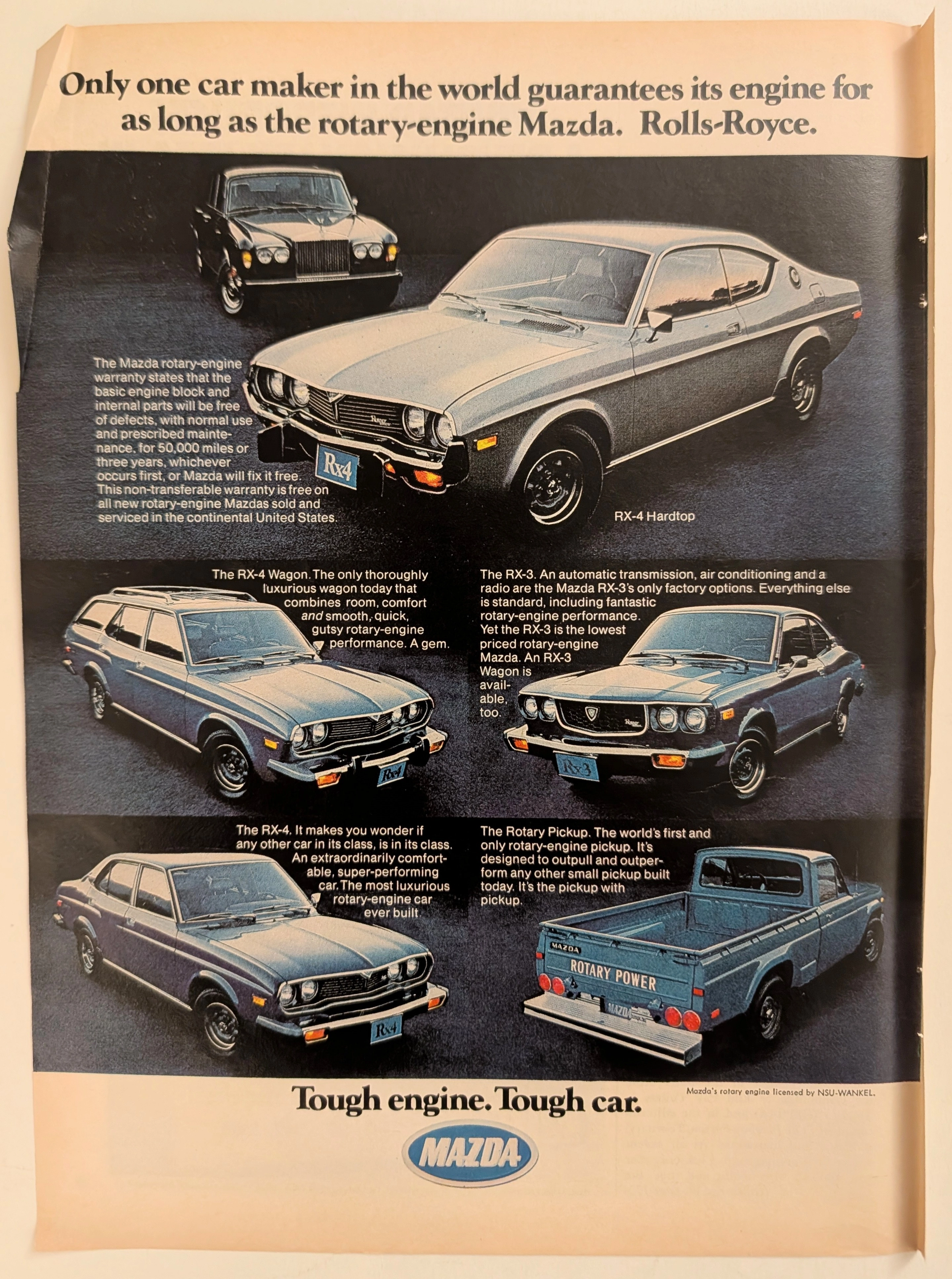
To visually and rhetorically anchor this audacious claim, the advertising agency made a brilliant, confrontational semiotic choice. They placed the majestic, monolithic silhouette of a Rolls-Royce Silver Shadow in the background of the advertisement. The headline is a masterclass in comparative authority: "Only one car maker in the world guarantees its engine for as long as the rotary-engine Mazda. Rolls-Royce." Rolls-Royce was the universally acknowledged zenith of over-engineered reliability, bespoke craftsmanship, and aristocratic perfection. By linking their experimental, mass-produced Japanese rotary engine to the British monarch of motoring, Mazda borrowed the halo effect of absolute invincibility. It was a statement designed to halt the skeptical consumer in their tracks and force them to re-evaluate their prejudices.
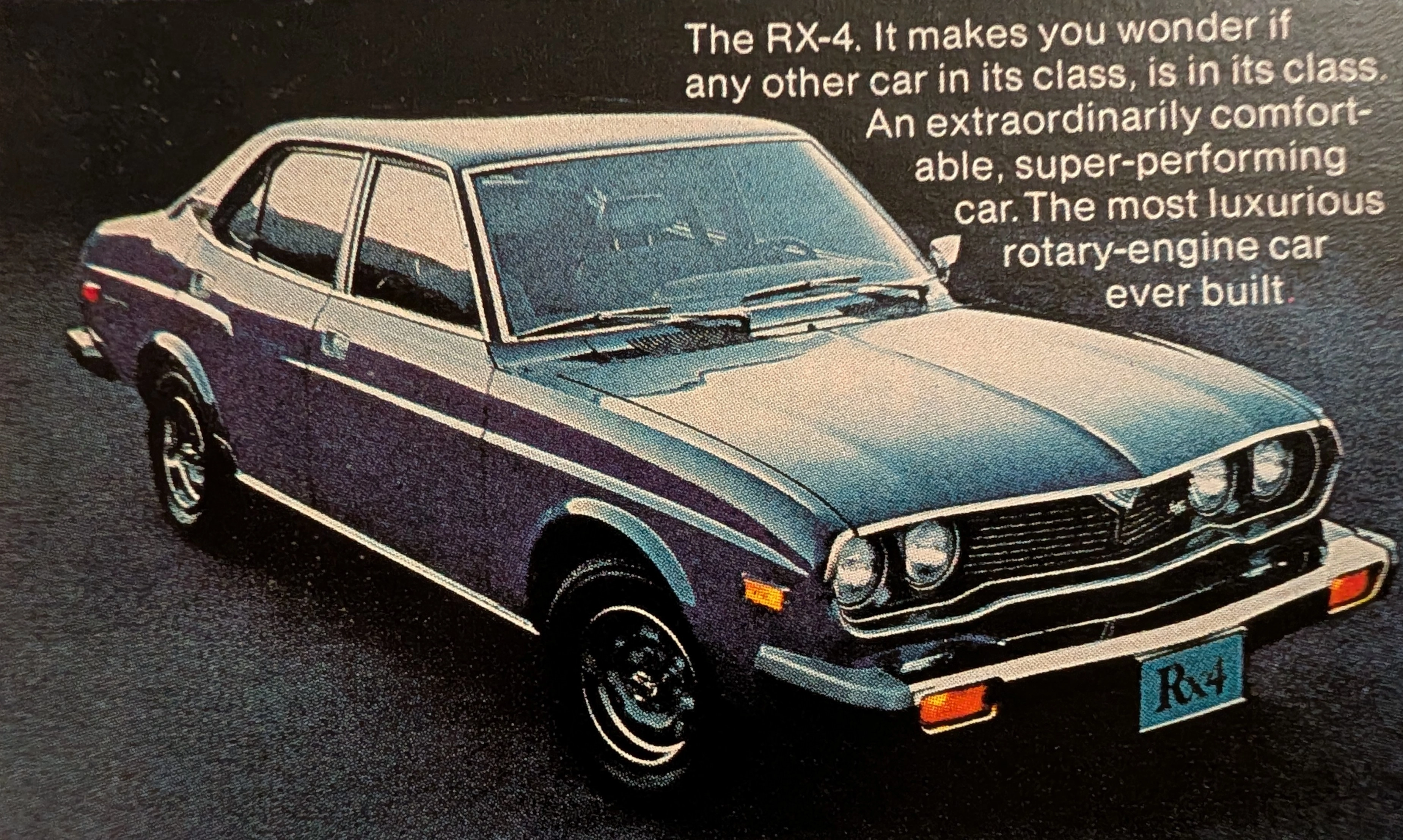
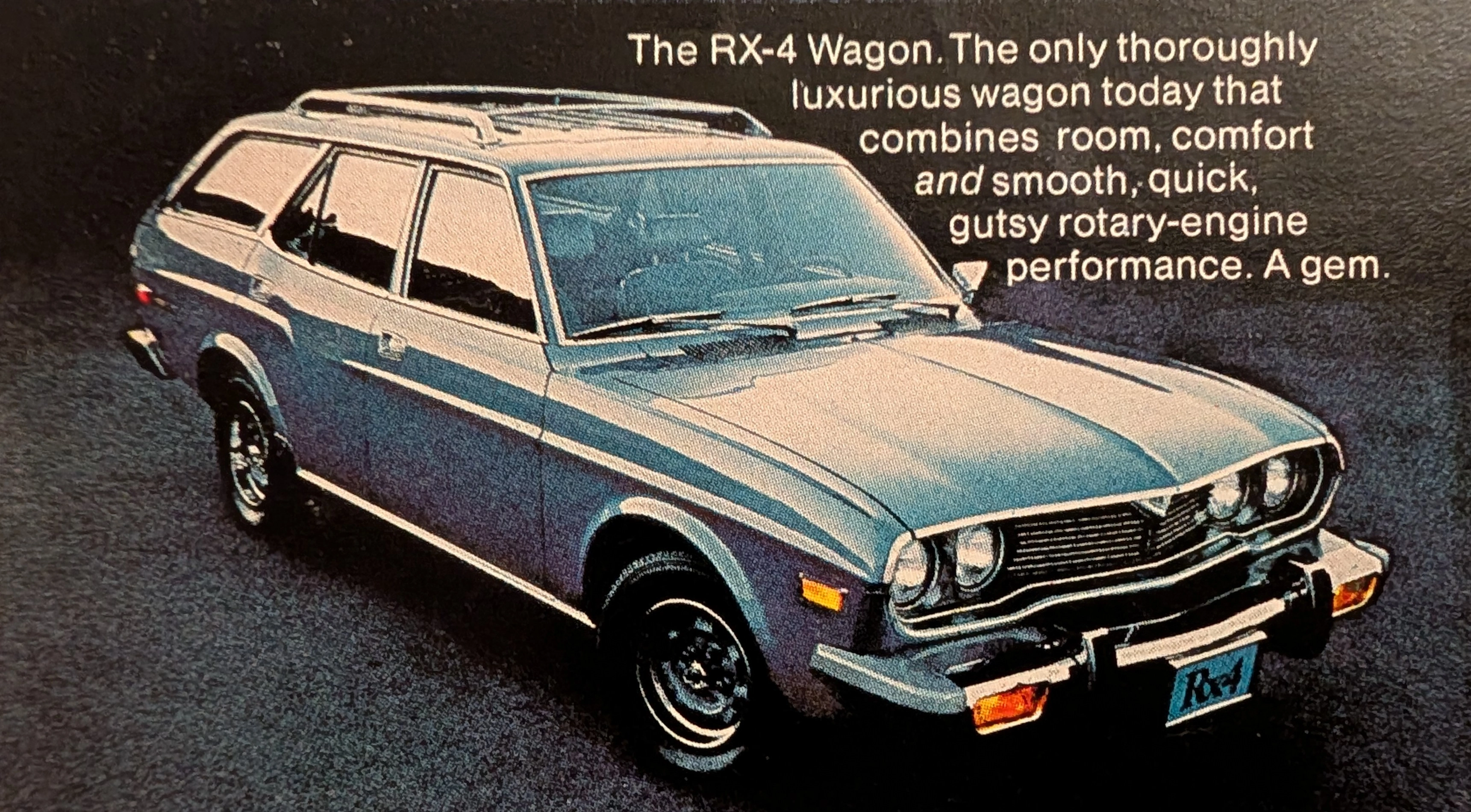
Furthermore, this artifact serves as a critical historical register of the incredible diversity and ambition of Mazda's 1970s rotary lineup. The advertisement showcases four distinct vehicles, each representing a different facet of the rotary's application. At the top and center-left is the RX-4 (Luce), available as a Hardtop coupe, Sedan, and an incredibly rare Wagon. The RX-4 was Mazda's attempt to push the rotary engine upmarket, offering a more luxurious, comfortable, and substantial vehicle to compete with European grand tourers, described in the copy as "The most luxurious rotary-engine car ever built." On the right is the RX-3 (Savanna), the lighter, more aggressive sports compact that achieved legendary status on the racetracks of Japan, famously breaking the consecutive win streak of the formidable Nissan Skyline GT-R.
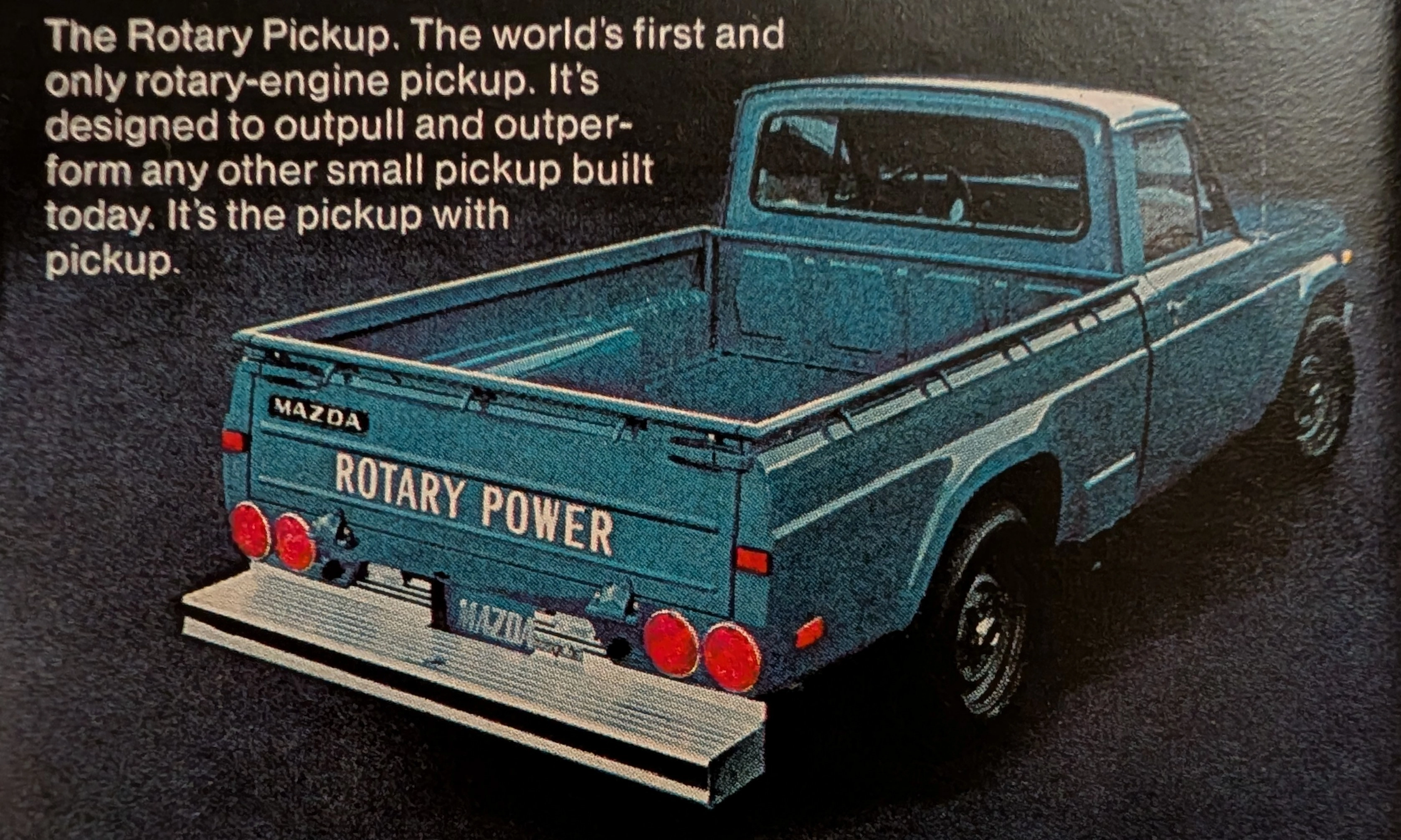
However, the absolute crown jewel of this artifact, the vehicle that makes automotive historians and elite collectors salivate, is positioned in the lower right quadrant: The Mazda Rotary Pickup, universally known among enthusiasts as the REPU. The REPU is an absolute unicorn in automotive history—the world's first and only rotary-powered pickup truck ever produced. Built on the B-Series chassis but featuring wider flared fenders, a bespoke dashboard, round taillights, and an aggressive front grille, it was powered by the larger 13B rotary engine to provide the necessary torque for hauling. The REPU was sold exclusively in the North American market between 1974 and 1977. The sheer audacity of putting a high-revving sports car engine into a utilitarian work truck is a testament to Mazda's total, unwavering—and perhaps slightly manic—devotion to the Wankel technology. The prominent "ROTARY POWER" lettering stamped onto the tailgate of the REPU in the illustration is a defiant battle cry from an engineering team that refused to surrender.
The Paper
As a physical entity, this printed artifact functions as a living, breathing, and profoundly detailed record of mid-twentieth-century graphic reproduction, technical illustration, and substrate chemistry. Under exceptional, high-magnification macro-lens examination, this document reveals the stunning complexity and mathematical precision of analog color offset lithography.
The visual brilliance of this artifact is anchored by its capacity to render the cold, hard texture of automotive sheet metal using only microscopic deposits of liquid pigment. The macro photography of the Mazda RX-3 and the REPU tailgate provides a textbook, museum-grade visualization of a CMYK halftone rosette pattern. The cool, icy metallic blue of the car bodies, contrasting sharply with the deep, abyss-like black of the asphalt background, is not a continuous, solid swatch of ink. Instead, these hues are meticulously and flawlessly constructed from a precise, mathematically rigorous galaxy of microscopic ink dots. The Cyan, Magenta, Yellow, and Key (Black) inks are elegantly and systematically layered at highly specific angles (traditionally 15, 75, 90, and 45 degrees respectively) to trick the human eye and the biological visual cortex into perceiving a continuous, dimensional reality out of mere clusters of overlapping pigment. The texture of the uncoated magazine paper stock further illustrates how the liquid ink was absorbed into the organic cellulose fibers, creating a soft, matte finish characteristic of commercial printing in the 1970s.
Yet, the most profound and beautifully impactive factor elevating the immense value of this artifact in the contemporary global collector's market is the natural, organic, and entirely irreversible process of Material Degradation. The expansive margins of the page exhibit a genuine, unavoidable "Toning." This gradual, chronological transition from the original bright, bleached manufactured paper to a warm, antique ivory hue is caused by the slow, relentless chemical oxidation of Lignin—the complex organic phenolic polymer that naturally binds cellulose fibers together within the raw wood pulp of the paper. As the substrate is exposed to ambient atmospheric oxygen and ultraviolet light over a span of five decades, the molecular structure of the lignin gracefully breaks down, forming chromophores that darken the paper. This naturally evolving patina represents the absolute core of the wabi-sabi aesthetic. It is precisely this authentic, unreplicable degradation that acts as the primary engine driving up its market value exponentially among elite curators and collectors. It provides the ultimate, irrefutable scientific proof of the artifact's historical authenticity and its delicate, unbroken journey through time.
The Rarity
RARITY CLASS: B (Very Good Archival Preservation with Natural Margin Toning)
Evaluated under the most exacting, rigorous, and uncompromising archival parameters established by The Record Institute (which spans a meticulous classification system from Pristine Class A down to Heavily Degraded Class D), this artifact is definitively and securely designated as Class B.
The remarkable and defining paradox of mid-century commercial ephemera is that these specific documents were produced by the millions as explicitly and intentionally "disposable media." Inserted into high-volume, mass-market consumer or automotive publications in the mid-1970s, they were inherently destined by their very nature to be briefly observed, casually folded, used as scrap paper, or ultimately discarded into the recycling bins and incinerators of history. For a full-page, graphically complex, and heavily ink-saturated advertisement (especially one utilizing massive amounts of black ink for the background, which often causes the paper to warp or degrade faster) to survive entirely intact without catastrophic structural tearing, without destructive moisture staining (foxing), or without the fatal, irreversible fading of the delicate analog inks constitutes a highly significant statistical archival anomaly.
The structural integrity of this paper remains exceptionally sound. While the rich analog colors—particularly the vibrant reds of the taillights and the cool metallic blues of the car bodies—remain astonishingly vivid, there is a beautiful, mathematically even, natural lignin oxidation reflecting its 1970s origin. This displays a pronounced, warm ivory patina heavily along the margins. This environmental interaction does not detract from its immense value; rather, it authentically validates the document's chronological journey. The sheer sociopolitical and engineering weight of the subject matter—the definitive documentation of Mazda's desperate survival strategy, the audacious Rolls-Royce comparison, and the presence of the mythical REPU—makes this a highly prized, museum-worthy piece of consumer culture heritage. It demands to be preserved via acid-free, UV-protected conservation framing, perfectly aligning with an aesthetic that appreciates the intersection of fine mechanics and curated history.
Visual Impact
The aesthetic brilliance and psychological power of this artifact lie in its masterful execution of "Comparative Authority and Technological Exhibition." The art director was tasked with communicating the invisible durability of an internal combustion engine to a deeply skeptical consumer base, requiring a layout that functioned as both an aggressive psychological statement and a comprehensive product catalog.
The composition utilizes a highly effective visual hierarchy. The upper section acts as a psychological anchor. The ghostly, aristocratic silhouette of the black Rolls-Royce Silver Shadow sits quietly in the dark background, casting a massive halo of unassailable reliability over the sleek, modern Mazda RX-4 Hardtop positioned in the foreground. The Rolls-Royce is not explicitly detailed; it doesn't need to be. Its iconic grille and headlights are enough to instantly trigger the consumer's subconscious association with perfection. The lower half of the page shifts from psychological warfare to an organized, didactic exhibition. The vehicles are arranged in a rigid, grid-like formation on the pitch-black asphalt, showcasing the incredible versatility of the rotary engine—from a luxury wagon to a hardcore sports coupe to a utilitarian pickup truck. The typography is stark, clean, and authoritative. The final, definitive statement at the bottom, "Tough engine. Tough car. MAZDA," acts as a blunt, rhythmic punctuation mark, cementing the brand's unwavering confidence in the face of a global crisis.
Exhibition Halls
The Archive Continues
Continue the Exploration
American Express · Travel
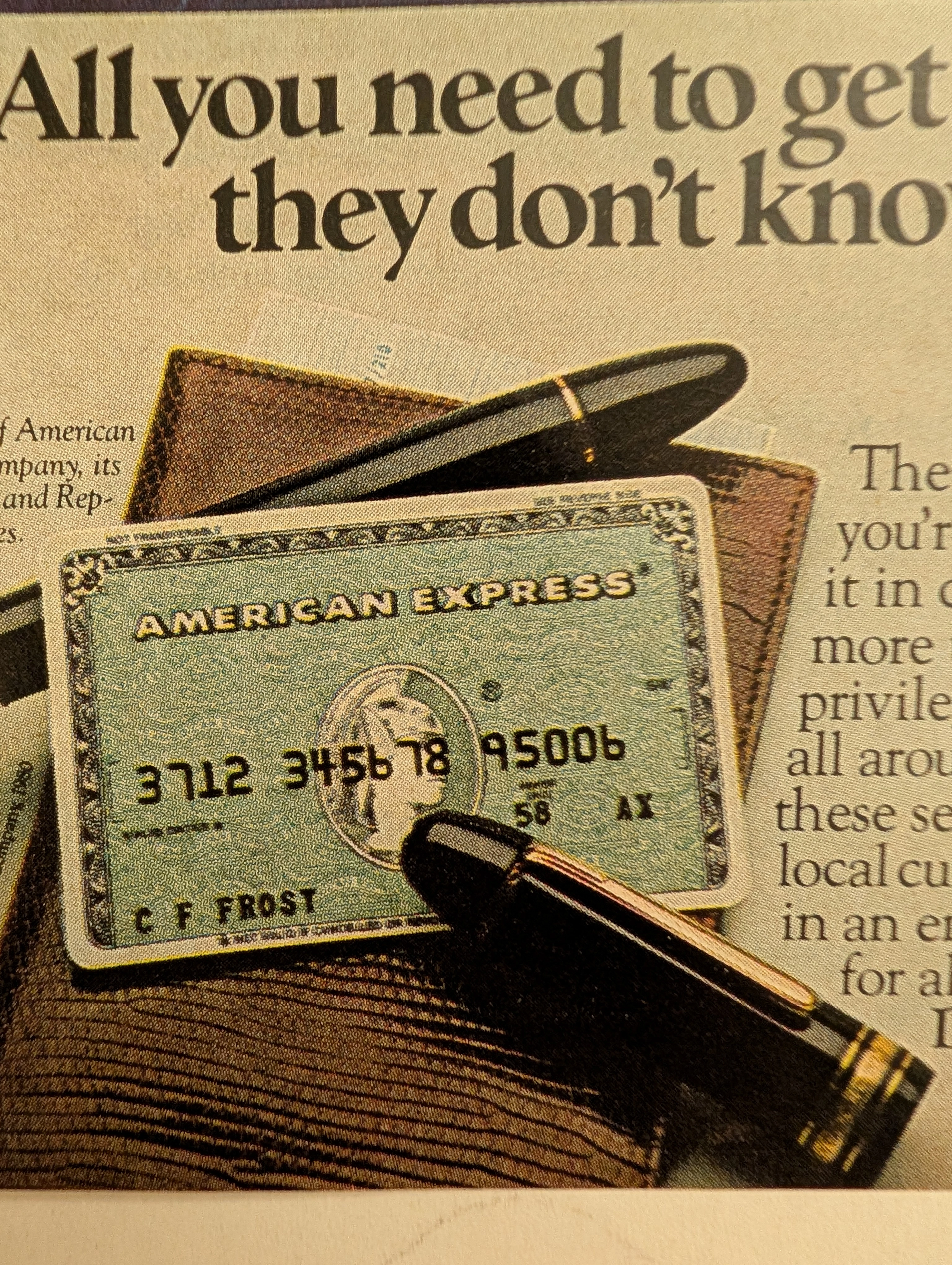
The Time Traveller’s Dossier: 1980 American Express Card Vintage Advertisement — The Assurance of Global Mobility
Discover the profound cultural resonance of the 1980 American Express Card vintage advertisement, a masterful example of late 20th-century financial marketing. This piece transcends typical vintage ads by encapsulating the era's burgeoning desire for international travel paired with the absolute need for financial security abroad. Showcasing the iconic green card against the mystic dusk of Istanbul, the campaign perfectly illustrates how classic print ads constructed narratives of global citizenship, elite mobility, and unparalleled trust. For archivists and collectors of old advertisements, this piece stands as a definitive artifact. It not only highlights the practical benefits of emergency travel funds but also visually reinforces the legendary ethos of the brand, making it a pivotal and highly sought-after piece in the history of consumer credit and travel marketing.
์Nocona · Fashion
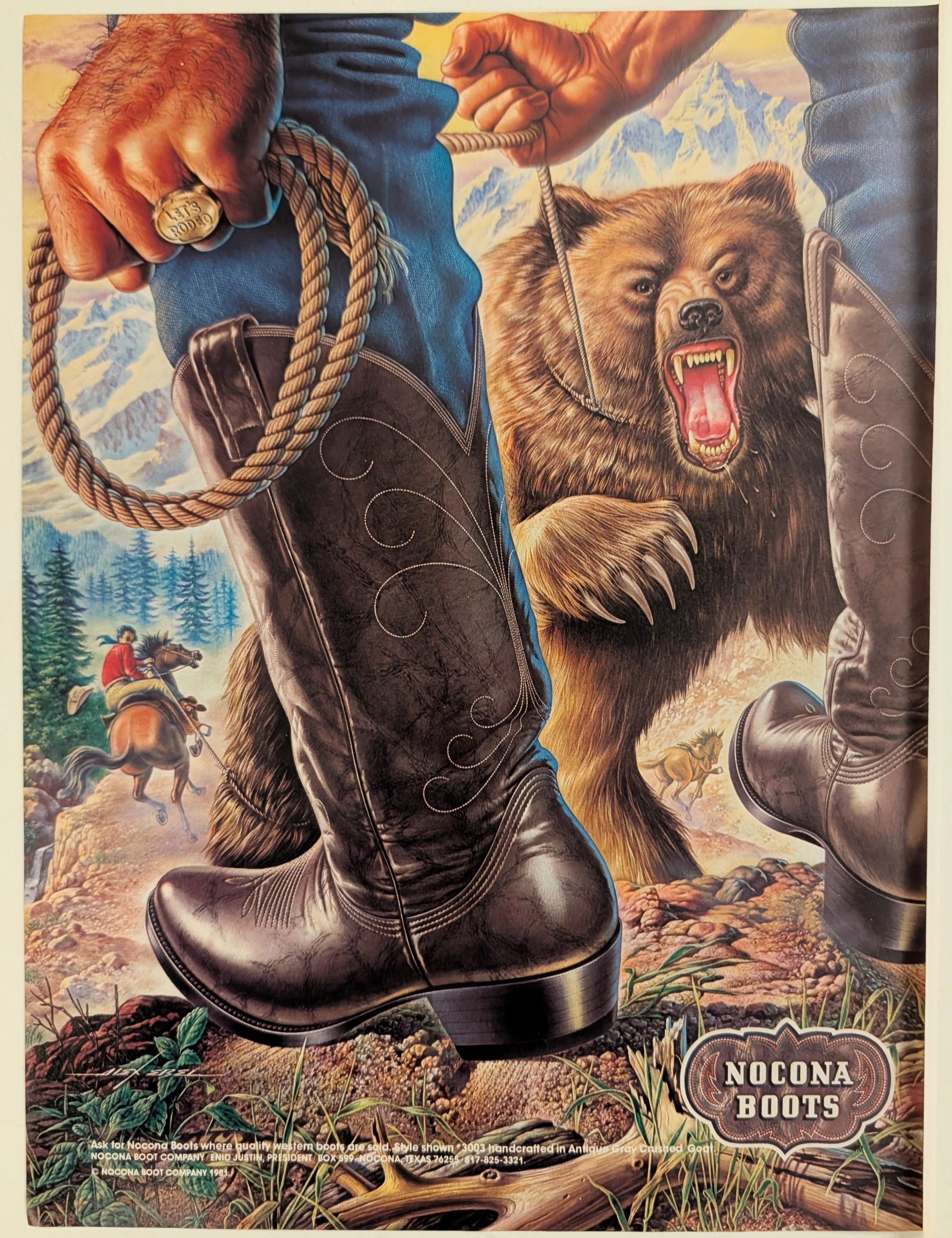
The Time Traveller’s Dossier: 1981 Nocona Boots Vintage Advertisement — The Hyper-Masculine Mythos of the American West
Discover the untamed and heavily romanticized spirit of the American frontier captured in the 1981 Nocona Boots vintage advertisement. This remarkable illustration transcends typical vintage ads by presenting a hyper-masculine, almost mythological vision of the cowboy ethos at the dawn of the 1980s. Depicting a larger-than-life figure casually lassoing a snarling grizzly bear while sporting a solid gold "Let's Rodeo" ring, this campaign perfectly illustrates how classic print ads constructed powerful narratives of rugged individualism, fearless attitude, and absolute dominance over nature. For archivists, cultural historians, and collectors of old advertisements, this piece stands as a definitive artifact of western Americana. It not only markets the exceptional craftsmanship of "Antique Gray Crushed Goat" leather but also immortally preserves the swagger of the rodeo lifestyle, making it a pivotal and highly prized document in the history of American apparel marketing.
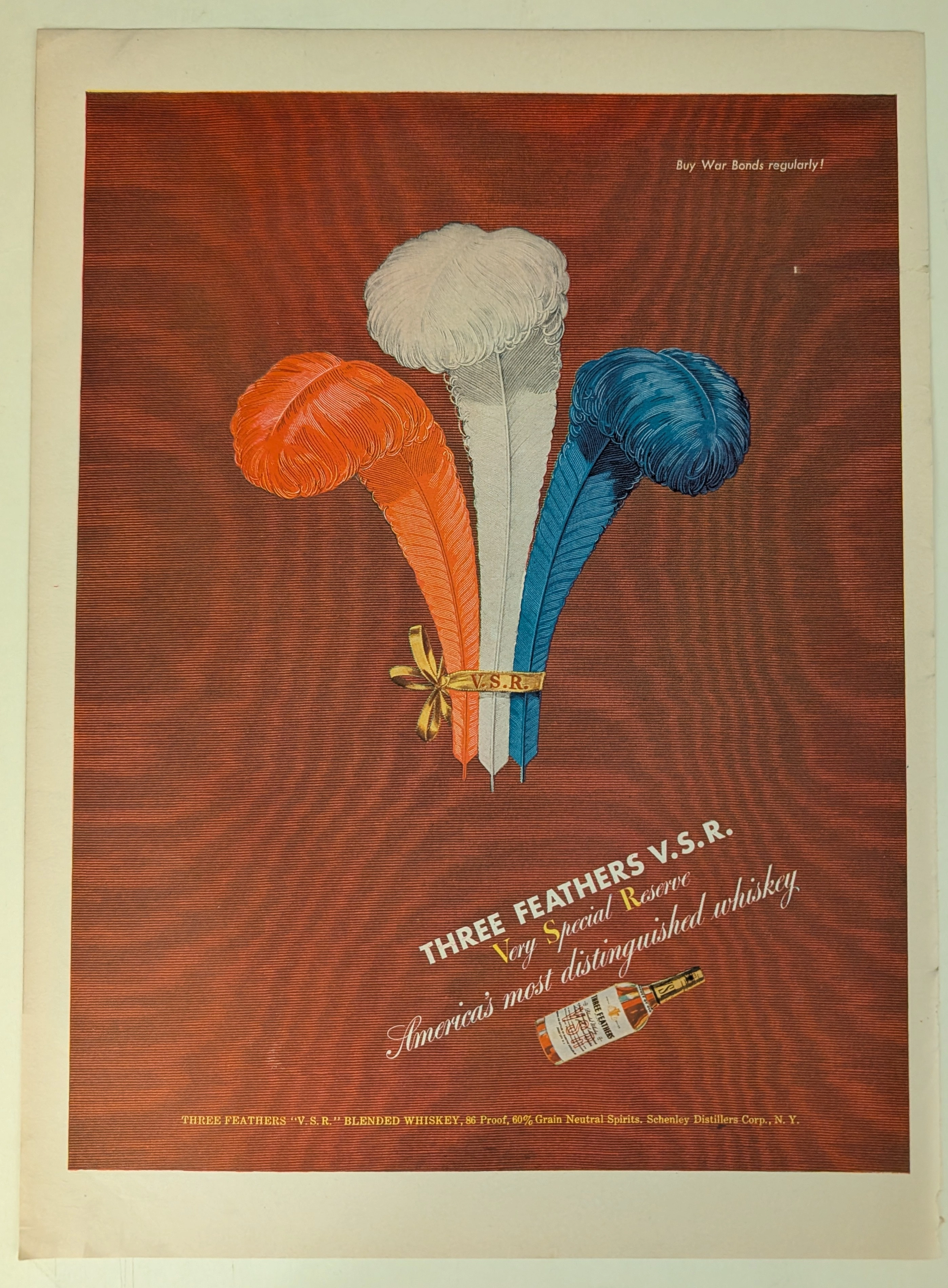
THE TIME TRAVELER'S DOSSIER: BLOOD CAPITALISM AND THE WEAPONIZATION OF WHISKEY
This impeccably preserved Historical Relic is a Primary Art Document from the brutal crucible of World War II, featuring a sweeping advertisement for THREE FEATHERS V.S.R. Blended Whiskey. It chronicles the ultimate mid-century psychological strategy of "Patriotic Capitalism." The artifact is forensically and definitively dated to the WWII era by the explicit, government-aligned directive in the upper right corner: "Buy War Bonds regularly!". Visually, the brand masterfully hijacked American nationalism by rendering its iconic three feathers in a vibrant Red, White, and Blue patriotic color scheme. Surviving the aggressive scrap paper drives of the 1940s, the acidic analog paper exhibits a profound integration of the deep crimson ink into its degrading fibers, perfectly encapsulating the analog aesthetic of wabi-sabi. This slow chemical death elevates this rescued wartime artifact to an irreplaceable Primary Art Document of Rarity Class A.