THE TIME TRAVELER'S DOSSIER: THE STRATOSPHERIC MANSION AND THE AESTHETICS OF DECAY
The History
( THE HISTORY: The Jet Age War, Aristocratic Architecture, and the Authority of the Stewardess )
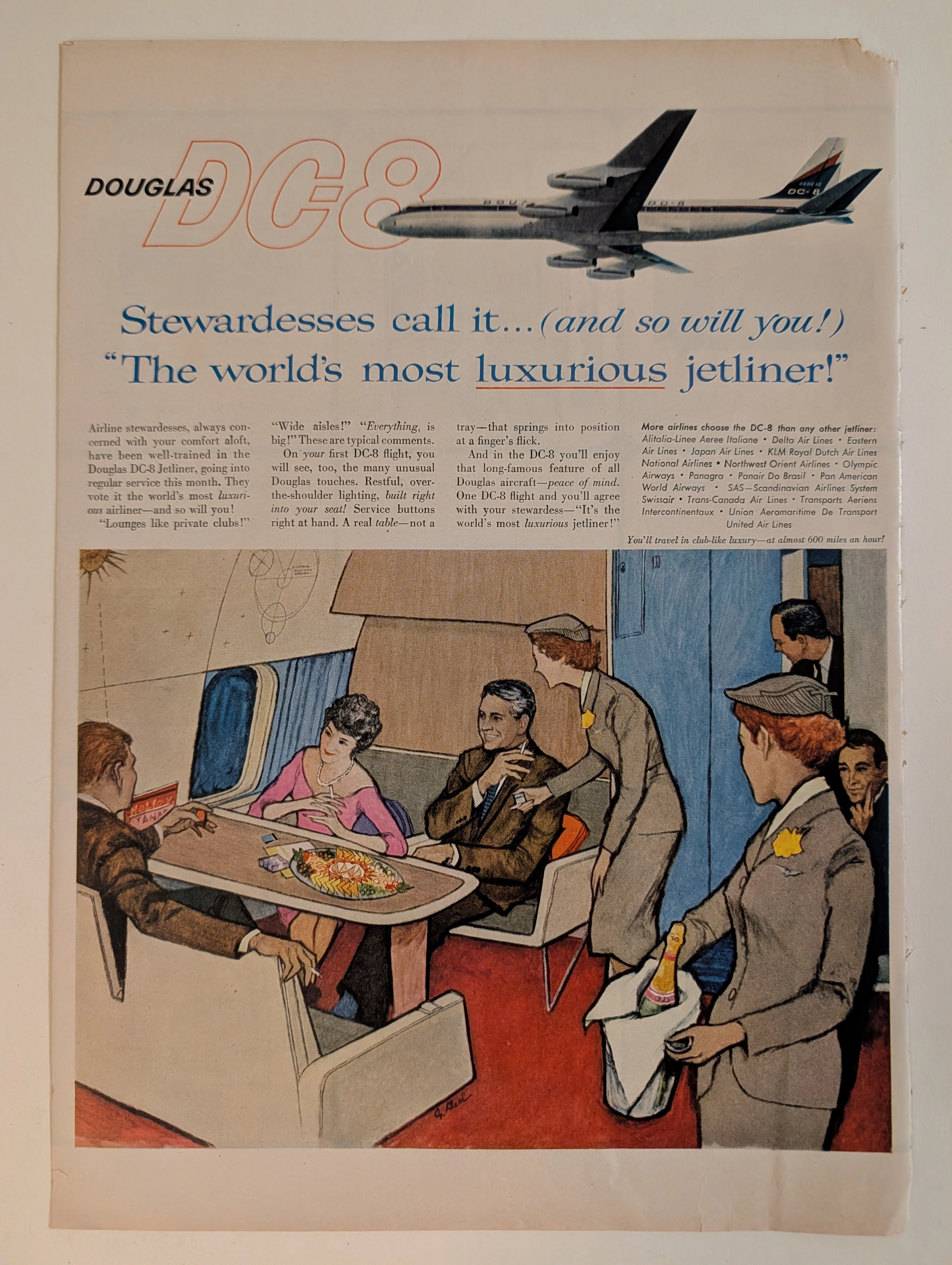
As the Chief Curator of The Record, I welcome you to the absolute stratosphere of mid-century capitalist ambition. The flawlessly preserved Historical Relic before you is not a mere aviation advertisement. It is a "Blueprint of Stratospheric Segregation," engineered during the most pivotal juncture in commercial aviation history: The Dawn of the Jet Age.
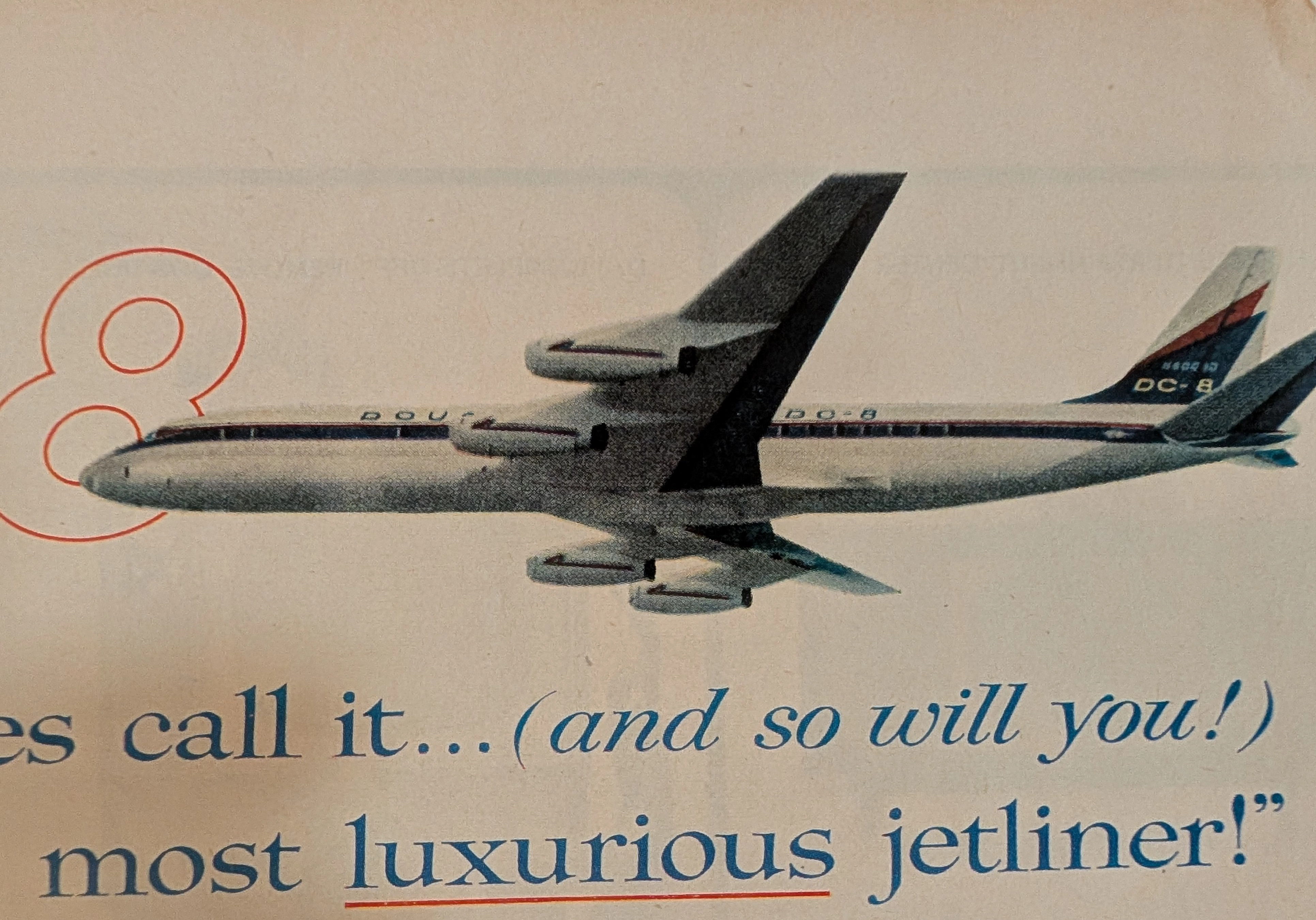
In the late 1950s and early 1960s, the world was irrevocably transformed by the advent of the jetliner. Boeing had delivered a massive psychological blow with the 707. The Douglas Aircraft Company—the undisputed king of the propeller era whose legendary DC-3 through DC-7 had built modern airlines—was forced to unleash its ultimate weapon: the Douglas DC-8. But Douglas understood that merely selling the raw speed of 600 miles per hour was insufficient. They had to sell an exclusive, untouchable lifestyle.
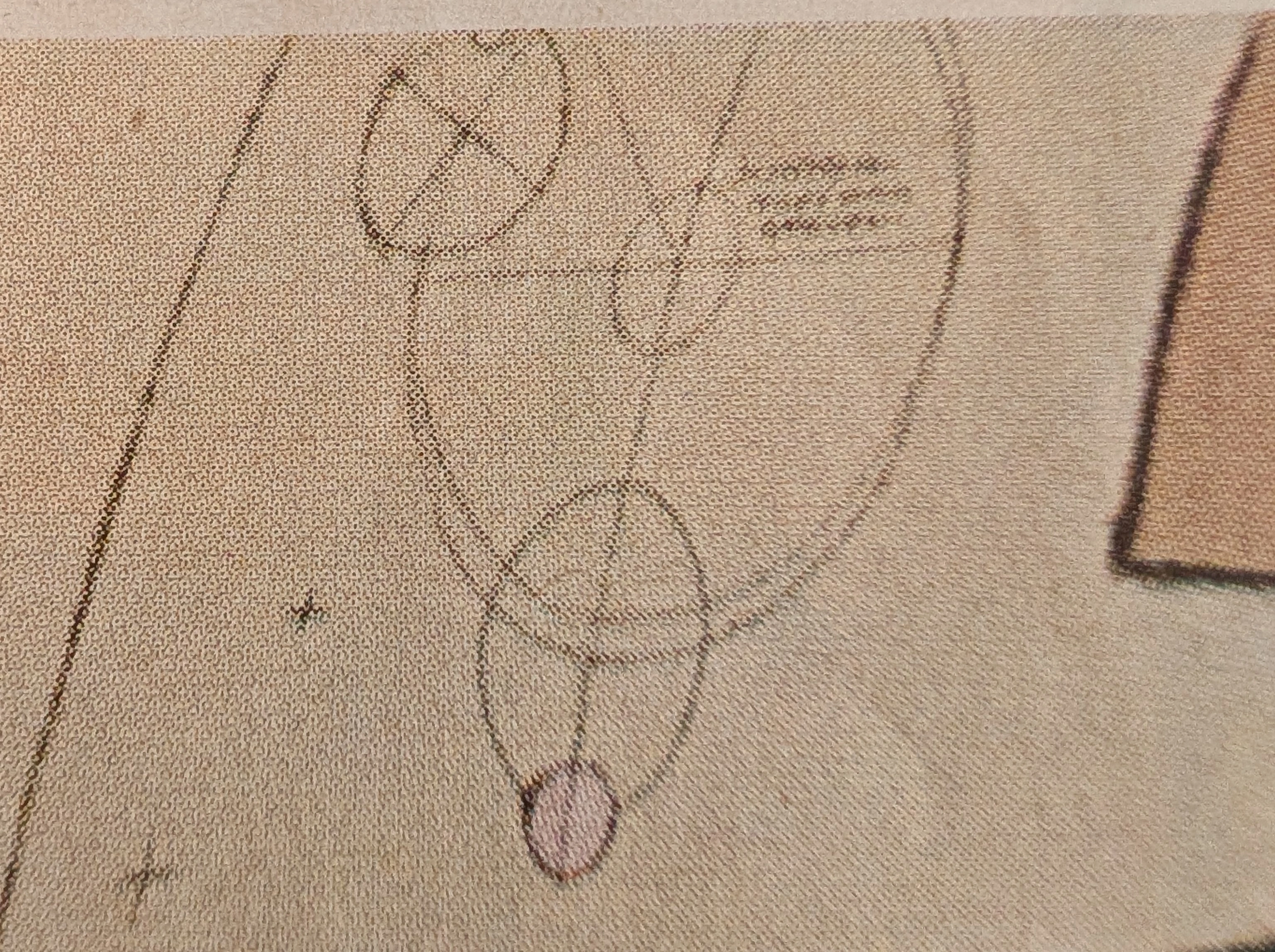
This advertisement is a masterclass in psychological luxury marketing. The evocative, signed illustration completely abandons the reality of cramped seating. Instead, it places the viewer directly inside the "Palomar Lounge"—a sky-bound private club. Analyze the deliberate details: gentlemen in tailored suits smoking cigars and playing cards, a woman draped in pearls, an actual table ("A real table—not a tray"), and a golden champagne bucket being attended to by a pristine stewardess. Furthermore, the rear bulkhead is decorated with a fascinating Space-Age celestial mural depicting orbits and stars, subtly aligning this opulent luxury with the cutting-edge science of the era.
The ultimate psychological weapon of this Primary Art Document is its headline: "Stewardesses call it... (and so will you!) The world's most luxurious jetliner!". In the 1960s, the airline stewardess was the absolute cultural arbiter of glamour, service, and sophistication. By leveraging her authority to validate the aircraft's supremacy, Douglas declared that the DC-8 wasn't just built for pilots to fly; it was engineered for the elite to be pampered.
The staggering roster of global airlines listed in the bottom right corner (from Japan Air Lines to Pan Am) acts as the final declaration of absolute industrial dominance over the global skies.
(THE PAPER: The Aesthetics of Destruction (Wabi-Sabi) — The Scars of the Dawn of Jets)
At The Record, our highest reverence is reserved for the inevitable, tragic beauty of analog destruction. This Primary Art Document is the ultimate physical manifestation of the Japanese philosophy of wabi-sabi—the profound realization of beauty in impermanence and decay. The wood-pulp paper of this magazine was manufactured with high acidity; it was genetically programmed with a chemical death sentence.
Direct your analytical, curatorial gaze to the physical borders of this artifact. The right margin exhibits a violent, jagged tear where it was forcibly and surgically rescued from the magazine's binding. This is the forensic evidence of a preserved relic, a survivor of the incinerator. Over the course of six decades, the inherent lignin within the paper fibers has engaged in a relentless chemical war with ambient oxygen and ultraviolet light. This oxidation process has birthed a deep, warm ivory "patina" that permeates the entire sheet. The authentic analog halftone dots of the celestial mural and the lounge scene have settled permanently into the brittle, degrading fibers. This paper is quietly, literally burning itself alive at a molecular level. Its slow, majestic death is precisely what transfigures it from a corporate advertisement into immortal Primary Art.
( THE RARITY: Class A — A Survivor of the Aviation Archives )
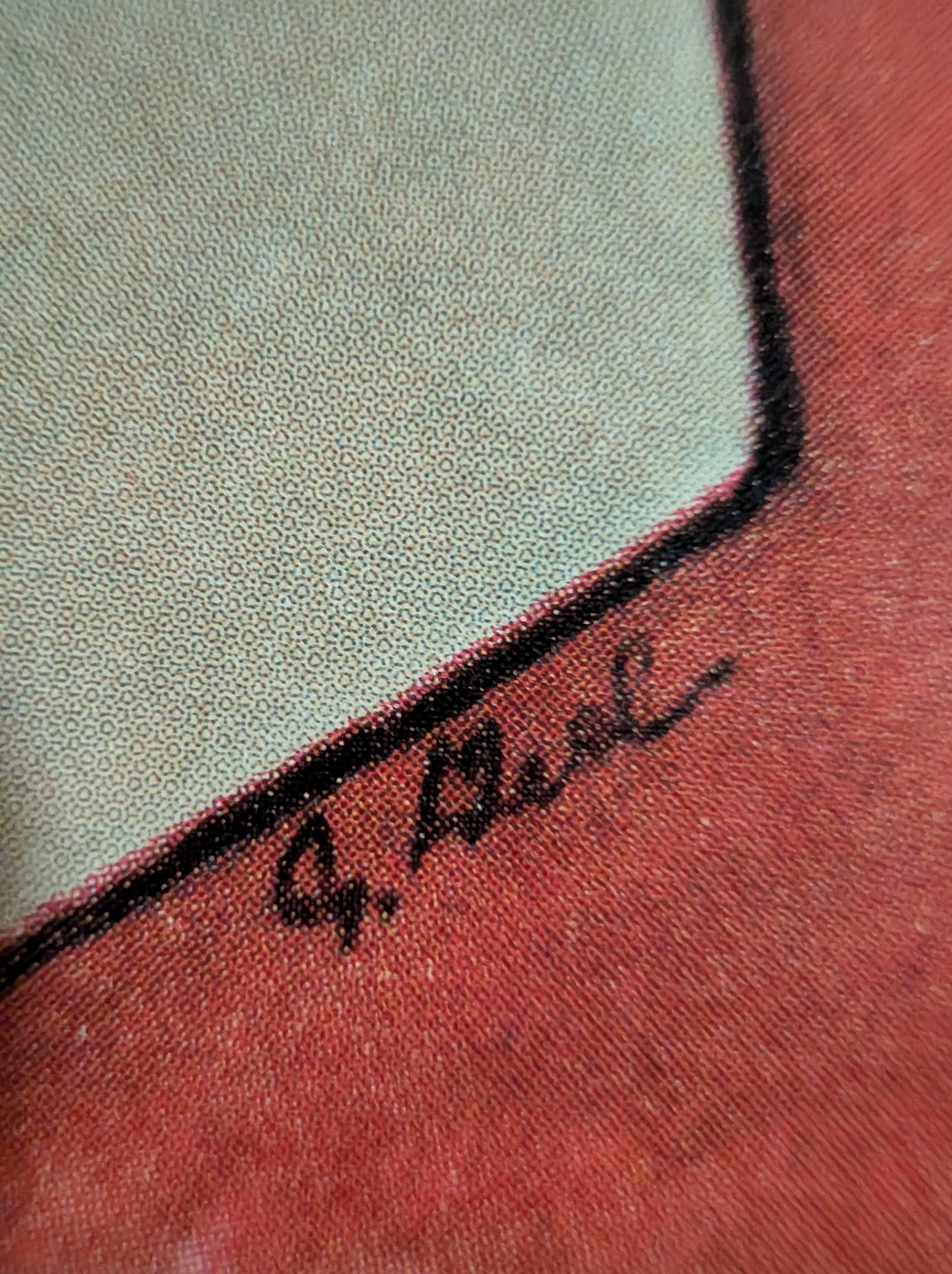
Finding authentic Jet-Age ephemera that retains such crisp illustrative fidelity, complete with a visible artist's signature and a deeply saturated historical narrative, is exceedingly difficult. Mass-market magazines of this era were overwhelmingly consumed, discarded, or destroyed by environmental neglect.
Synthesizing its paramount importance to the history of the Boeing vs. Douglas Jet Age war, its brilliant sociological depiction of exclusive 1960s luxury, and the breathtaking physical trauma of its analog decay, this artifact unequivocally commands a Rarity Class A designation. It has evolved far beyond a disposable commercial message. It is a highly coveted Historical Relic, demanding to be framed and possessed by a discerning curator who truly understands the heavy, beautiful weight of aviation history.
Exhibition Halls
The Archive Continues
Continue the Exploration
Timberland · Fashion
The Time Traveller's Dossier: Terrestrial Navigation – The Timberland Boat Shoe and the Evolution of Amphibious Footwear
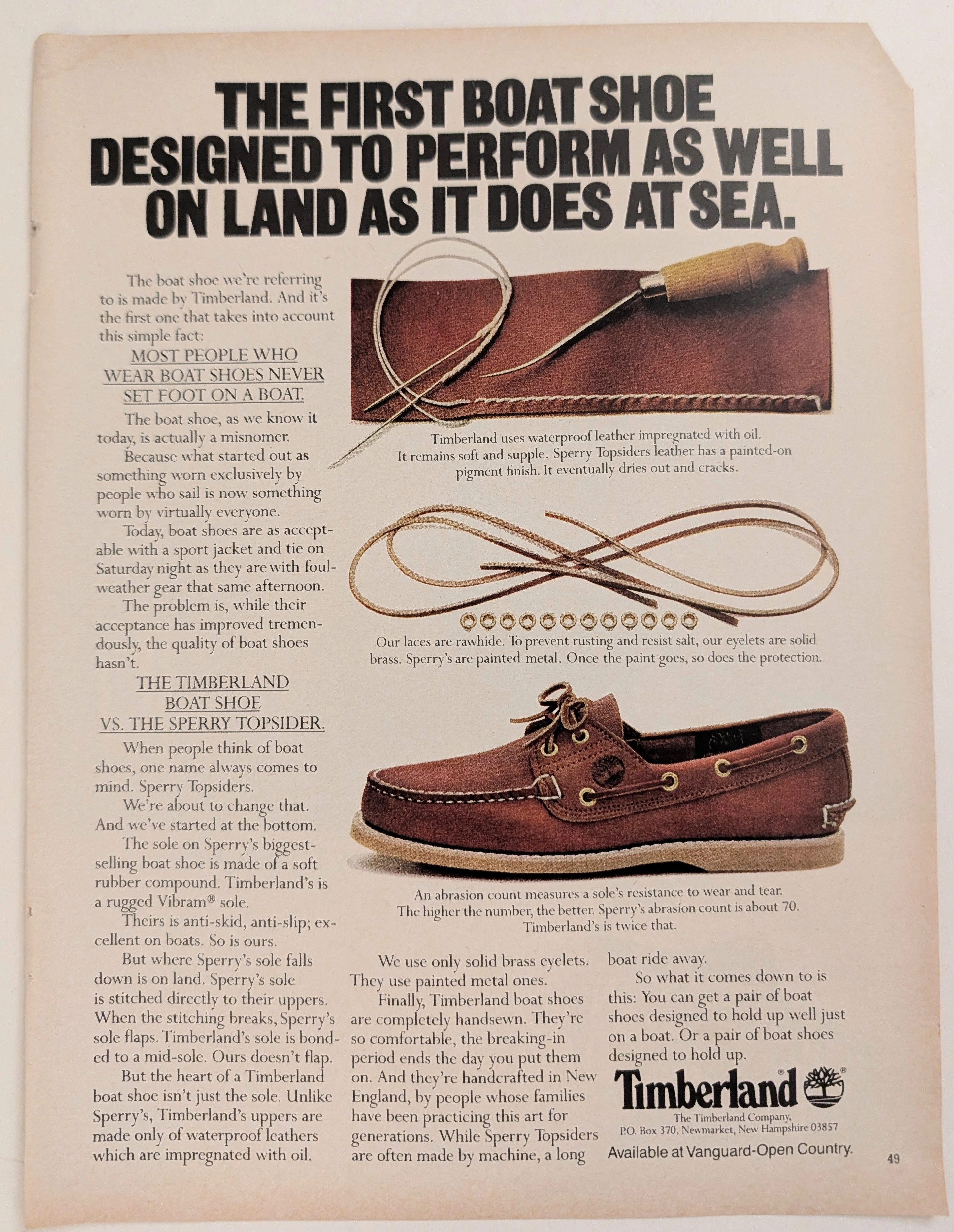
The evolution of twentieth-century American apparel is deeply intertwined with the adaptation of specialized, utilitarian gear for mainstream, terrestrial use. The historical artifact elegantly positioned upon the analytical table of The Record Institute today is a visually detailed and highly informative full-page print advertisement for The Timberland Boat Shoe. This document gracefully transcends the standard boundaries of footwear marketing. It operates as a highly sophisticated, multi-layered cultural mirror, reflecting a precise era in consumer sociology where the American public began integrating specialized sporting garments into their daily wardrobes. By utilizing a methodical, point-by-point comparative analysis against the established market leader, Sperry Topsider, The Timberland Company presented a scholarly and persuasive argument for superior material construction. This comprehensive dossier conducts a meticulous, nuanced, and exceptionally detailed examination of the artifact, operating under the most rigorous parameters of historical, sociological, and material science evaluation. Dedicating the overwhelming majority of our analytical focus (80%) to its immense historical gravity, we will decode the thoughtful marketing psychology embedded within the "land and sea" narrative, analyze the profound engineering differences highlighted in the construction of the shoe, and explore the sociological shift of maritime fashion into the suburban environment. Furthermore, as we venture deeply into the chemical and physical foundations of this analog printed ephemera (10%), we will reveal the precise mechanical fingerprints of the CMYK halftone rosettes captured in the macro imagery of the embossed leather. Finally, we will assess its archival rarity (10%), exploring how the graceful, natural oxidation of the paper substrate cultivates a serene wabi-sabi aesthetic—a natural, irreversible phenomenon that serves as the primary engine increasing its market value exponentially within the elite global spheres of Vintage Commercial Ephemera and Fashion Archives.
Chrysler · Automotive
THE TIME TRAVELER'S DOSSIER: THE KOREAN WAR ANCHOR AND THE SCARCITY OF LUXURY
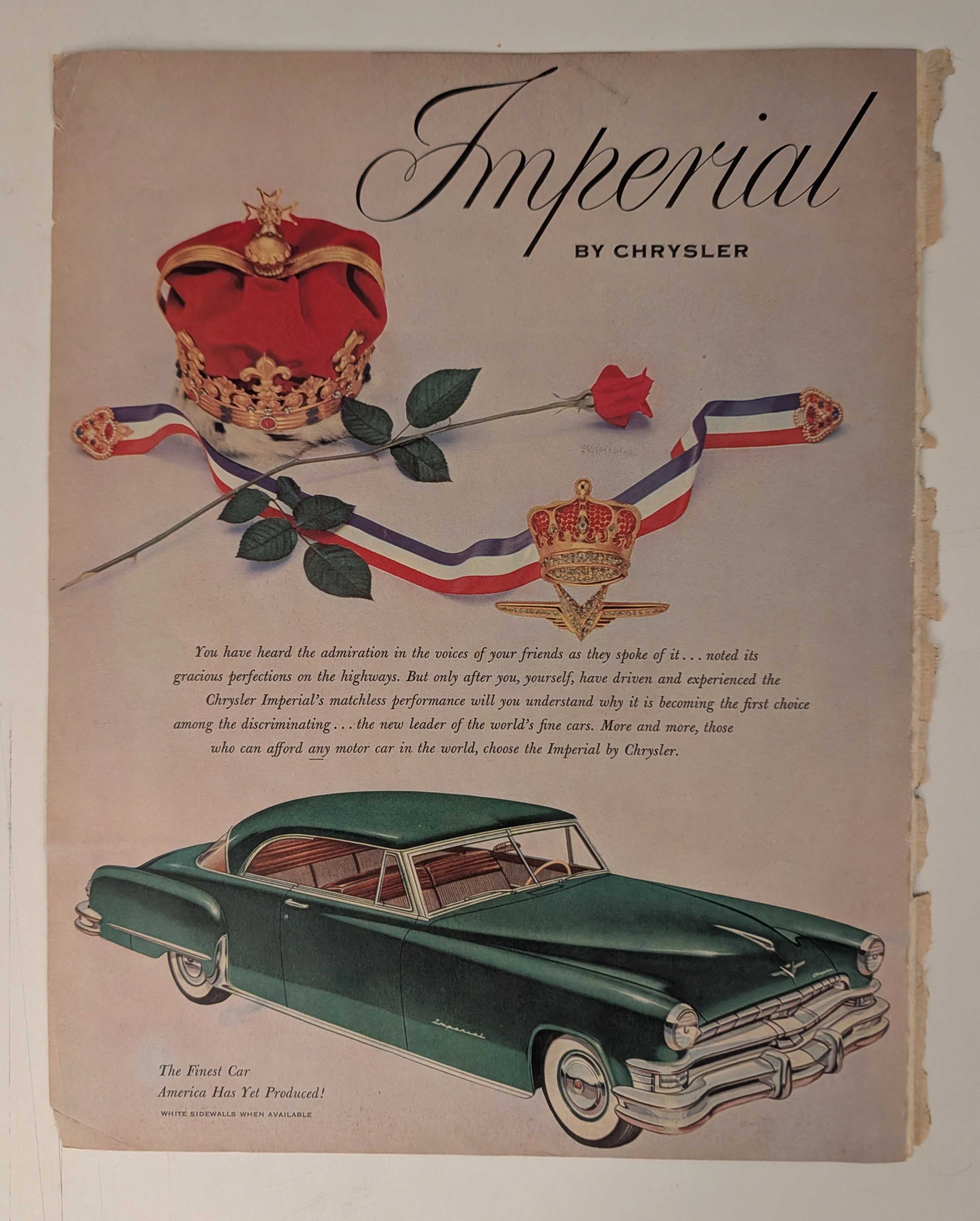
The artifact under our uncompromising, unprecedented museum-grade analysis is a profoundly preserved Historical Relic excavated from the golden age of post-WWII American opulence. This Primary Art Document is a monumental magazine advertisement for the Imperial by Chrysler, dating to the pivotal 1951-1952 era. This document is a "Forensic Blueprint of American Aristocracy and Geopolitical Crisis." It masterfully weaponizes regal European iconography to elevate Chrysler's flagship model above mere transportation, explicitly targeting "those who can afford any motor car in the world". Yet, its most significant historical anchor is hidden in the microscopic fine print: "WHITE SIDEWALLS WHEN AVAILABLE". This single sentence instantly transforms the advertisement into a wartime relic, reflecting the severe rubber shortages imposed during the Korean War. Grounded by the iconic jeweled emblem and its breathtaking wabi-sabi chemical degradation—highlighted by its violently torn binding edge—this artifact commands an irreplaceable status, cementing its Rarity Class A designation.
Polaroid · Technology
The Time Traveller's Dossier: The Instant Gratification Protocol – The Polaroid Color Pack Camera Exhibitio
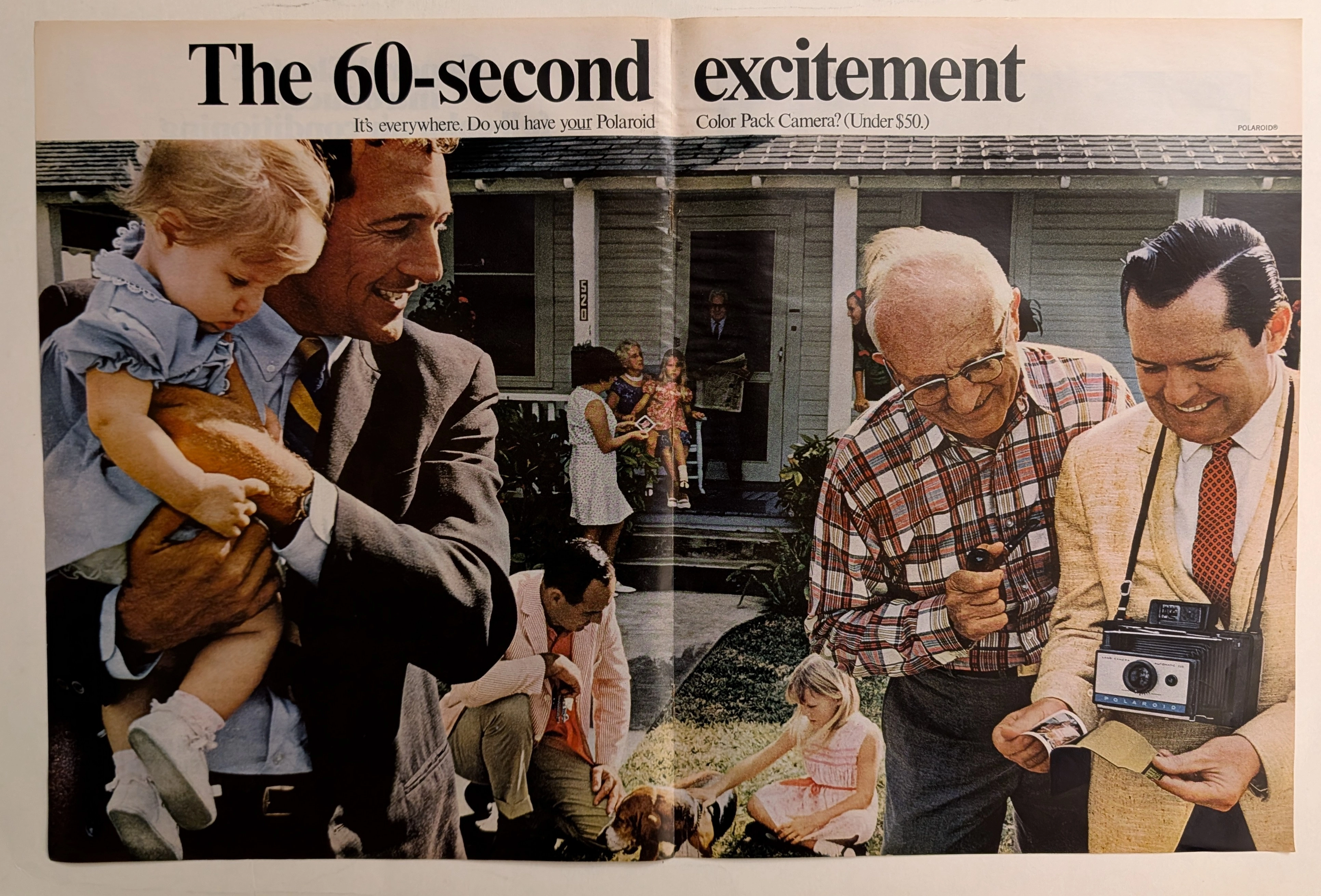
The evolution of photography from a delayed, solitary, and highly technical chemical process into an instantaneous, shared, and interactive social event stands as one of the most profound technological and sociological shifts of the twentieth century. The historical artifact securely and elegantly positioned upon the analytical table of The Record Institute today is a majestic, large-format, two-page print advertisement for the Polaroid Color Pack Camera (Automatic 210), originating from the cultural zenith of the late 1960s. This document completely transcends the traditional boundaries of camera marketing and consumer electronics promotion. It operates as a sophisticated, multi-layered declaration of how optical innovation fundamentally altered human interaction, transforming the act of taking a photograph from a mere recording of memory into an active, thrilling focal point of social gatherings and familial bonding. This world-class, comprehensive dossier conducts a meticulous, unyielding, and exceptionally deep examination of the artifact, operating under the absolute most rigorous parameters of historical, sociopolitical, and material science evaluation. We will decode the vibrant, multi-generational suburban scene that perfectly encapsulates the "60-second excitement" phenomenon, analyzing the complex historical lineage of the Polaroid Corporation and the specific cultural impact of the Automatic 210 model. Furthermore, as we venture deeply into the chemical and physical foundations of this analog printed ephemera, we will reveal the precise mechanical fingerprints of the CMYK halftone rosettes and the graceful, natural oxidation of the paper substrate. This precise intersection of visual nostalgia, mid-century commercial artistry, and the immutable chemistry of time cultivates a serene wabi-sabi aesthetic—a natural, irreversible phenomenon that serves as the primary engine driving up its market value exponentially within the elite global spheres of Vintage Photography Ephemera and Americana collecting.