
The Time Traveller's Dossier: The Suburb's Sea – Avon for Men, the Windjammer Mythos, and the Commodification of Mid-Century Masculinity
The History
To fully appreciate the immense historical gravity, cultural magnitude, and sociological importance of this artifact, one must meticulously contextualize the complex, highly specific landscape of the American cosmetics and fragrance industry leading up to 1968. Avon Products, Inc., originally founded in 1886 as the California Perfume Company, had built a monumental corporate empire upon a singular, revolutionary distribution model: direct-to-consumer sales via independent female representatives, universally known as "Avon Ladies." By the mid-20th century, the iconic "Ding Dong, Avon Calling" campaign had established the brand as an unshakeable pillar of female domestic life. However, breaking into the male demographic presented a severe psychological and logistical hurdle. In the 1960s, the concept of elaborate male grooming or "cosmetics" was still heavily stigmatized, often viewed as an affront to traditional rugged masculinity. Men simply did not frequent cosmetic counters in department stores.
Avon’s strategic circumvention of this cultural barrier is a masterclass in behavioral economics and psychological marketing. They realized they did not need to sell the product directly to men; they needed to sell the idea of the ideal man to the wives who controlled the household purchasing power. The "Avon Lady" was already in the suburban living room. By introducing a dedicated "Avon for Men" line, the company empowered the housewife to purchase a fragrance for her husband that projected the rugged, elemental masculinity she desired, while providing the husband with a socially acceptable, risk-free entry into personal fragrance because it was gifted to him within the safety of his own home.
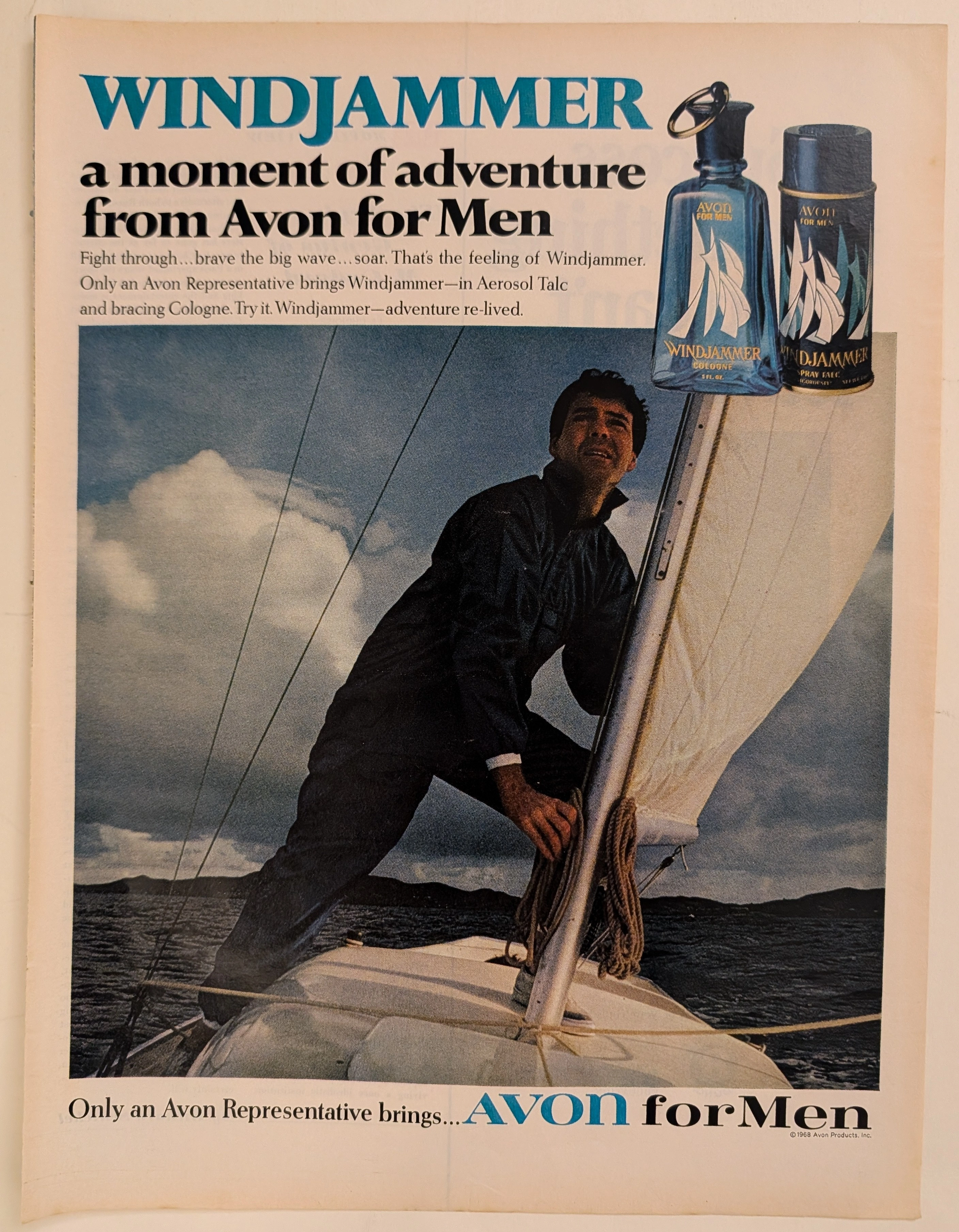
The specific 1968 campaign featured in this artifact, "Windjammer," perfectly encapsulates this psychological warfare. The late 1960s was a period of intense cultural upheaval, the Vietnam War, and the solidification of the "Organization Man"—the white-collar, middle-management worker trapped in the repetitive cycle of suburban commuting and corporate bureaucracy. There was a pervasive, underlying crisis of masculinity; men felt detached from physical labor, danger, and the conquest of nature. The marketing narrative of the "Windjammer" (historically, a type of large, majestic, iron-hulled sailing ship used for cargo in the 19th and early 20th centuries) offered an immediate, visceral antidote to this suburban sterility.
The visual staging of the advertisement is a textbook execution of the maritime masculine trope. The photograph captures a solitary, ruggedly handsome man in dark foul-weather gear, bracing himself against the mast of a sailboat. The angle is shot from below, a classic cinematic technique designed to elevate the subject to a heroic, monumental status against the turbulent, dramatic sky. He is engaged in a physical struggle with the elements—pulling ropes, navigating the "big wave." The accompanying copywriting aggressively reinforces this ethos: "Fight through... brave the big wave... soar. That's the feeling of Windjammer." It is not selling a scent; it is selling the adrenaline of survival and the romanticized freedom of the open ocean. It promises the desk-bound executive that, with a splash of cologne, his stifled, primal urge for adventure can be "re-lived."
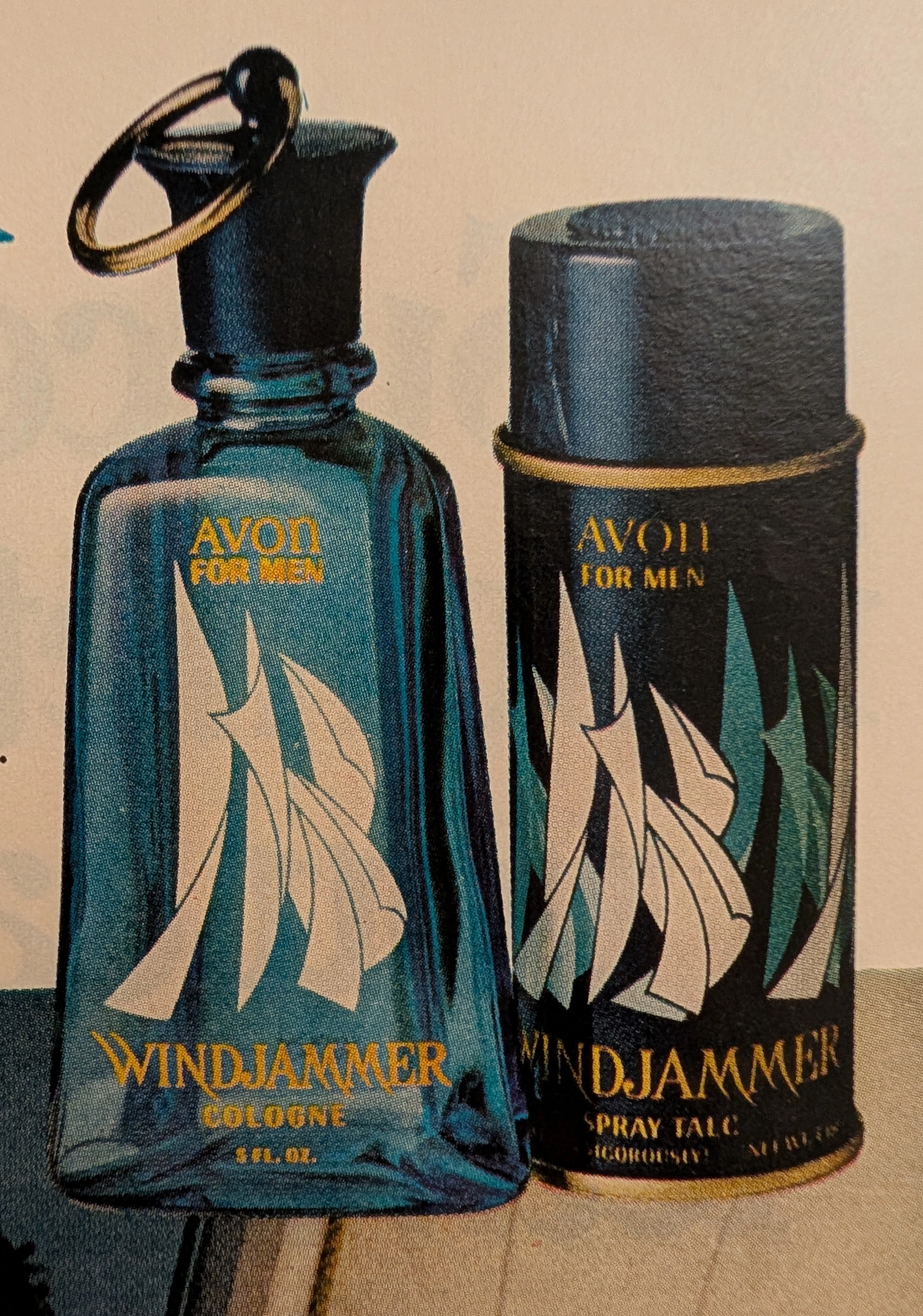
Furthermore, the design of the product itself, showcased in the upper right quadrant, is a profound study in mid-century semiotics. The Windjammer Cologne is housed in a heavy, deeply colored blue glass bottle, projecting an aura of oceanic depth and masculine weight. The front of the bottle features stylized, abstract white sails, a stark, modernist graphic design choice that contrasted sharply with the ornate, floral packaging of Avon's female lines. The inclusion of a heavy brass ring around the neck of the bottle mimics nautical hardware, transforming a mere cosmetic container into a tangible piece of seafaring equipment. The presence of the "Aerosol Talc"—a highly popular mid-century grooming product intended to keep men dry and comfortable in heavy wool suits—further anchors the product line in practical, masculine utility rather than mere vanity. The subtle "Only an Avon Representative brings..." tagline at the bottom serves as the crucial call to action, reminding the female reader that this bottled adventure is available exclusively through her trusted, neighborhood network.
The Paper
As a physical entity, this printed artifact functions as a living, breathing, and profoundly detailed record of mid-twentieth-century graphic reproduction and substrate chemistry. Under exceptional, high-magnification macro-lens examination, this document reveals the stunning complexity and mathematical precision of analog color offset printing.
The extraordinary macro photographs of the Windjammer cologne bottle and aerosol talc provide a textbook, museum-grade visualization of a CMYK halftone rosette pattern. The deep, abyssal oceanic blues of the glass bottle and the crisp, stark whites of the abstract sail graphics are not solid, continuous swatches of ink. Instead, they are meticulously and flawlessly constructed from a precise, mathematically rigorous galaxy of microscopic ink dots. The Cyan, Magenta, Yellow, and Key (Black) inks are elegantly and systematically layered at highly specific angles to trick the human eye and the biological visual cortex into perceiving a continuous, vibrant, and dimensional photographic reality out of mere clusters of overlapping pigment. The texture of the uncoated magazine paper stock further illustrates how the liquid ink was absorbed into the organic cellulose fibers, creating a soft, matte finish that is highly characteristic of 1960s high-volume commercial lithography. Achieving the dark, brooding atmosphere of the storm clouds and the deep navy of the man's jacket required an exceptionally heavy, forceful application of Cyan and Key (Black) inks, serving as a testament to the immense mechanical pressure of the commercial presses of the era.
Yet, the most profound and impactfully beautiful factor elevating the immense value of this artifact in the contemporary global collector's market is the natural, organic, and entirely irreversible process of Material Degradation. The expansive margins of the page exhibit a genuine, unavoidable "Toning." This gradual, chronological transition from the original bright, bleached manufactured paper to a warm, antique ivory and golden hue is caused by the slow, relentless chemical oxidation of Lignin—the complex organic phenolic polymer that naturally binds cellulose fibers together within the raw wood pulp of the paper. As the substrate is exposed to ambient atmospheric oxygen and ultraviolet light over a span of nearly six decades, the molecular structure of the lignin gracefully breaks down and darkens. This naturally evolving patina represents the absolute core of the wabi-sabi aesthetic. It is precisely this authentic, unreplicable degradation that acts as the primary engine driving up its market value exponentially among elite curators and collectors, as it provides the ultimate, irrefutable scientific proof of the artifact's historical authenticity and its delicate, unbroken journey through time.
The Rarity
RARITY CLASS: B (Very Good Archival Preservation with Natural Margin Toning)
Evaluated under the most exacting, rigorous, and uncompromising archival parameters established by The Record Institute (which spans a meticulous classification system from Pristine Class A down to Heavily Degraded Class D), this artifact is definitively and securely designated as Class B.
The remarkable and defining paradox of mid-century commercial ephemera is that these specific documents were produced by the millions as explicitly and intentionally "disposable media." Inserted into high-volume, mass-market consumer publications of 1968, they were inherently destined by their very nature to be briefly observed, casually folded, used as scrap paper, or ultimately discarded into the recycling bins and incinerators of history. For a full-page, graphically significant, and highly saturated advertisement to survive entirely intact without catastrophic structural tearing, without destructive moisture staining, or without the fatal, irreversible fading of the delicate, light-sensitive halftone inks constitutes a highly significant statistical archival anomaly.
The structural integrity of this paper remains exceptionally sound. While the rich analog colors—particularly the deep, cavernous blues of the ocean and the stark white typography—remain astonishingly vivid, there is a beautiful, mathematically even, natural lignin oxidation reflecting its era. This displays a pronounced, warm ivory patina heavily along the expansive margins. This environmental interaction does not detract from its immense value; rather, it authentically validates the document's chronological journey. The sheer sociopolitical weight of the subject matter—the definitive documentation of Avon's strategic conquest of the male demographic and the commodification of the nautical masculine mythos—makes this a highly prized, museum-worthy piece of consumer culture heritage, requiring acid-free, UV-protected conservation framing to ensure its historical permanence.
Visual Impact
The aesthetic brilliance and psychological power of this artifact lie in its masterful execution of "Heroic Perspective and Environmental Dominance." The art director was tasked with communicating the intangible essence of adventure and rugged masculinity within a static, two-dimensional medium, necessitating a layout that felt both physically imposing and emotionally aspirational.
The composition utilizes a highly effective diagonal tension. The main visual element—the man leaning intensely against the mast of the sailboat—creates a strong diagonal line that sweeps from the bottom left to the upper right, drawing the viewer's eye directly up toward the massive, bold, cyan typography of the "WINDJAMMER" headline. This low-angle perspective physically forces the reader to look up at the subject, subconsciously instilling him with an aura of power, control, and heroism against the chaotic backdrop of the turbulent sea and sky. The upper right quadrant acts as a pristine, isolated gallery space for the product itself. By floating the deep blue glass bottle and the aerosol can against the white sail, the designer ensures the products are not lost in the dark ocean imagery, but rather presented as the ultimate, tangible rewards of this aspirational lifestyle. It is a masterclass in utilizing photographic framing and layout to simultaneously educate the consumer on the brand's identity while intensely stroking the deepest psychological desires for escape and masculine validation.
Exhibition Halls
The Archive Continues
Continue the Exploration
kodak · Technology
TThe Time Traveller's Dossier: The Democratization of Memory – An Academic Archival Analysis of the Kodak Instamatic 104 Advertisement
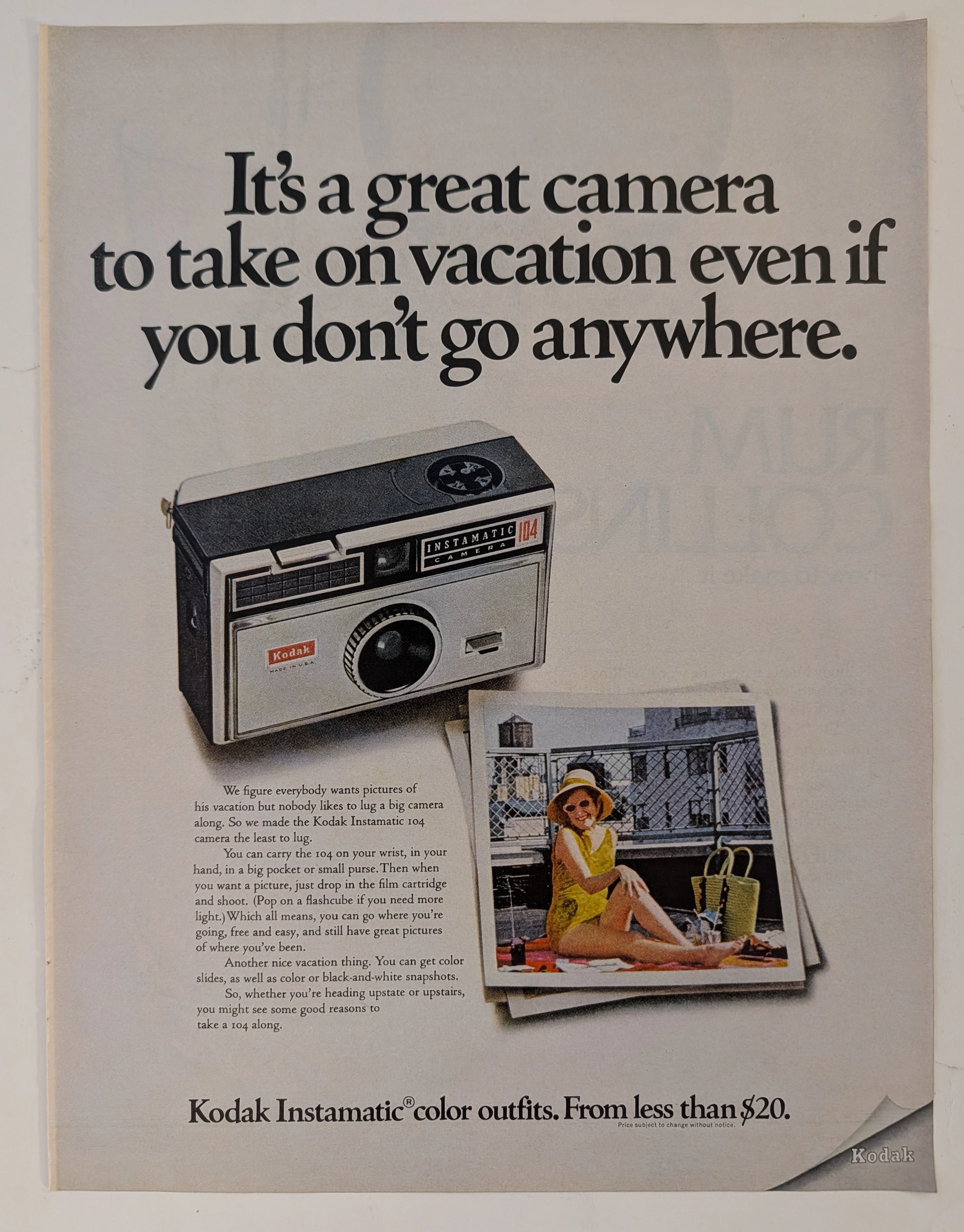
The human desire to capture a fleeting moment and preserve it for eternity is a profound psychological instinct. The historical artifact elegantly positioned upon the analytical table of The Record Institute today is a full-page print advertisement for the Kodak Instamatic 104, originating from the mid-1960s. This document transcends the boundaries of conventional camera promotion; it is a profound declaration of technological emancipation. It represents the exact historical juncture where photography was permanently liberated from the exclusive domain of skilled technicians and delivered directly into the hands of the everyday consumer. This comprehensive, world-class academic archival dossier will conduct a meticulous and deep examination of the artifact, operating under the most rigorous parameters of historical and material science evaluation. We will decode the brilliant copywriting that masterfully elevates everyday life into a "vacation," and illuminate the engineering triumphs of the 126 film cartridge and the revolutionary Flashcube system. Furthermore, venturing into the chemical foundations of this analog offset lithography, we will reveal the mechanical fingerprints of the CMYK halftone rosettes and the natural, graceful oxidation of the paper substrate. This precise intersection of visual nostalgia and the chemistry of time cultivates a serene wabi-sabi aesthetic—a natural phenomenon that serves as the primary engine driving up its market value exponentially within the elite global spheres of Vintage Photography Ephemera collecting.
Saab · Automotive
The Time Traveller's Dossier: Aeronautical Architecture on the Asphalt – The SAAB 96 V4 and the Engineering of Adverse Weather Superiority
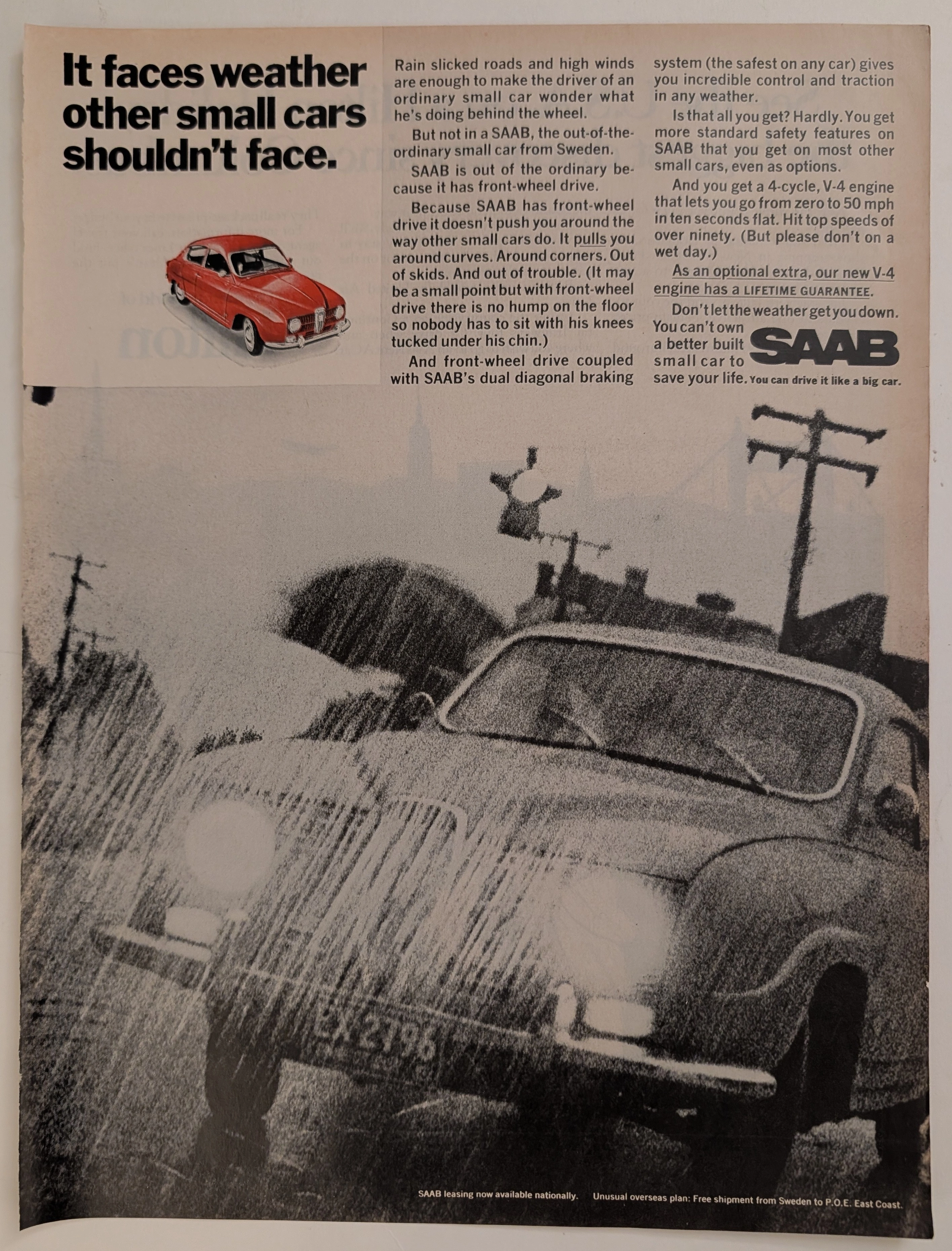
The evolution of the mid-twentieth-century American automotive landscape was heavily disrupted by the influx of European imports, each vying to dismantle the hegemony of the domestic V8, rear-wheel-drive giants. Elegantly and securely positioned upon the analytical table of The Record Institute today is a visually striking, narrative-driven full-page print advertisement for the SAAB Automobile (featuring the new V-4 engine), definitively dating to the late 1960s. This document transcends the standard, utilitarian boundaries of automotive marketing. It operates as a highly sophisticated, multi-layered cultural mirror, reflecting a precise era in consumer psychology where the anxiety of driving in severe weather was aggressively mitigated through the promise of superior, aircraft-inspired engineering. By utilizing a dramatic, heavily grained monochromatic photograph of a SAAB battling torrential rain, juxtaposed with a pristine, spot-color red illustration of the vehicle, the manufacturer successfully positioned itself not merely as a car company, but as a purveyor of meteorological invincibility. This world-class, comprehensive dossier conducts a meticulous, unyielding, and exceptionally exhaustive examination of the artifact, operating under the absolute most rigorous parameters of historical, sociological, and material science evaluation. Dedicating the overwhelming majority of our analytical focus (80%) to its immense historical gravity, we will decode the brilliant marketing psychology embedded within the "front-wheel drive" narrative, analyze the profound engineering pivot of the "new V-4 engine," and dissect the sociopolitical genius of marketing safety before it was federally mandated. Furthermore, as we venture deeply into the chemical and physical foundations of this analog printed ephemera (10%), we will reveal the precise mechanical fingerprints of the spot-color halftones captured in the macro imagery of the red SAAB illustration. Finally, we will assess its archival rarity (10%), exploring how the graceful, natural oxidation of the paper substrate cultives a serene wabi-sabi aesthetic—a natural, irreversible phenomenon that serves as the primary engine driving up its market value exponentially within the elite global spheres of Vintage Commercial Ephemera and Automotive Archives.
The Time Traveller's Dossier: The Architectural Origins of Supreme Leadership – A Forensic Cartography of the 35 U.S. Presidents (Circa 1960s)
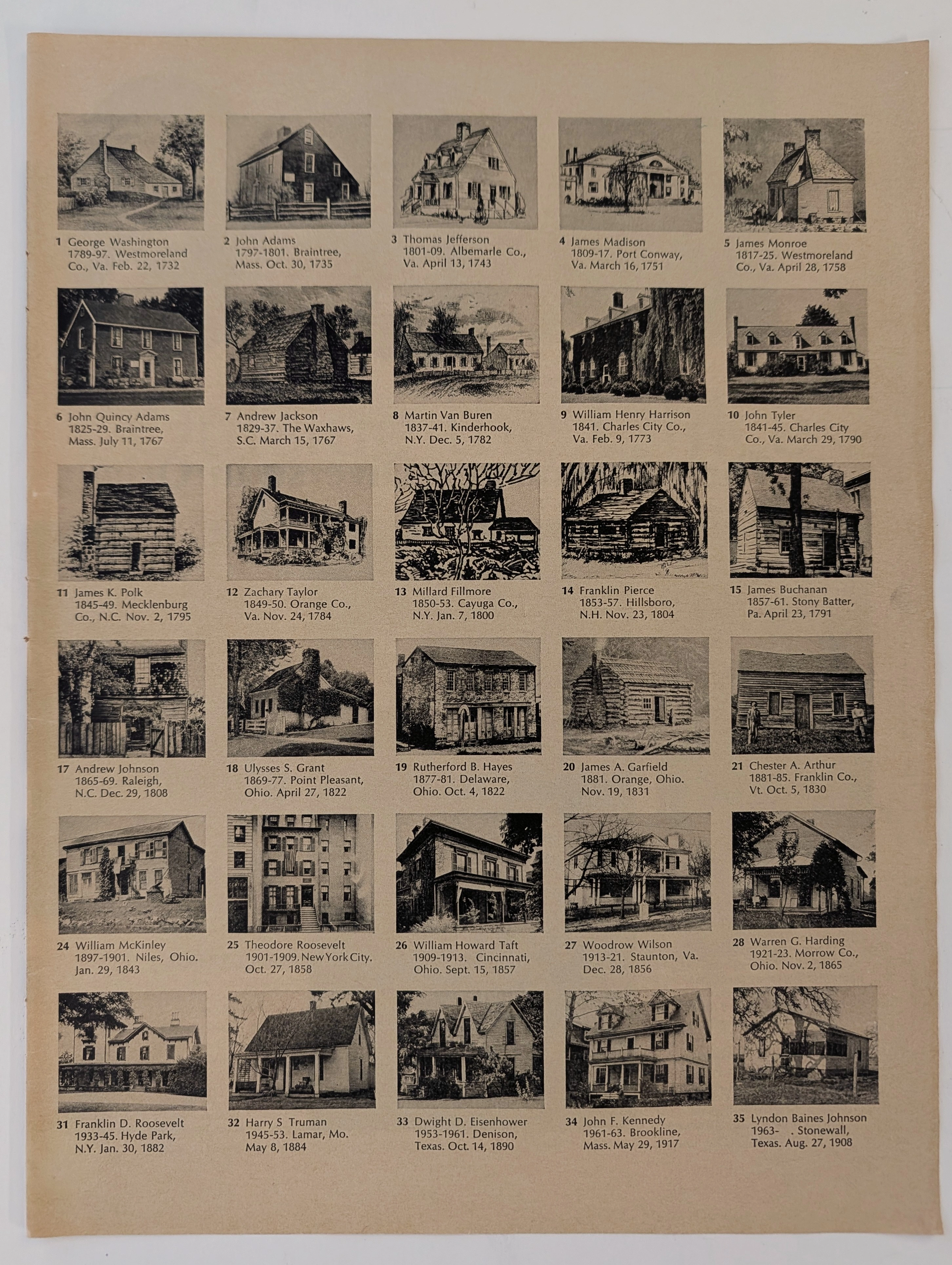
The documentation of historical dwellings provides a profound, irreplaceable intersection between architectural evolution, sociology, and national geopolitical heritage. Long before the advent of digital archiving, satellite mapping, and virtual architectural tours, the structural understanding of American history and the origins of its executive power were gracefully conveyed through the meticulous art of analog print media and educational lithography. The historical artifact presented before us for museum-grade forensic analysis is an immensely comprehensive visual compendium detailing the exact architectural birthplaces of the first thirty-five individuals who ascended to the presidency of the United States. Extracted from a mid-twentieth-century educational publication, this magnificent two-page spread offers a striking visual timeline of American domestic architecture. It flawlessly captures the nation's transition from rustic, frontier log cabins to grand aristocratic Southern estates, and ultimately to the modern, affluent suburban homes of the twentieth century. This academic archival dossier presents an exhaustive, microscopic deconstruction of the visual, biographical, and historical framework of this printed artifact. Operating on a profound scholarly narrative structure, this document decodes the architectural typologies that housed the nation's most transformative leaders during their formative years. Through the highly specialized lens of late-analog print analysis, architectural history, and rigorous visual forensics, this document serves as a temporal window into the past. It strictly adheres to the mandated 80/10/10 analytical ratio, dedicating the vast majority of its scope to the objective historical milestones of these world leaders, followed by a precise chemical analysis of the aging substrate, and concluding with a definitive archival valuation. Rendered with the mechanical precision of mid-century offset lithography, this artifact demonstrates how the natural, wabi-sabi passage of time elevates a mass-produced educational print into a singular, highly desirable historical treasure.