
The Time Traveller’s Dossier: 1985 Chateau Ste. Michelle Johannisberg Riesling Vintage Advertisement — The Heritage of Arrival
The History
The mid-1980s represented a pivotal era of self-reflection and patriotic nostalgia in the United States, culminating in the highly publicized 1986 Statue of Liberty Centennial. Under the leadership of figures like Lee Iacocca, the massive fundraising campaign to restore the Statue of Liberty and Ellis Island became a cultural phenomenon, drawing in major corporate sponsors who sought to align their brand identities with the foundational mythos of the "American Dream."
Chateau Ste. Michelle, a pioneering winery in Washington State, seized this historic moment to elevate its brand from a regional powerhouse to an institution of national consequence. By 1985, Washington State was still actively cementing its reputation on the global wine stage, fighting to prove its terroir against the established dominance of California and Europe. Through this campaign, Chateau Ste. Michelle bypassed standard agricultural marketing. Instead, they anchored their identity to the sweeping historical narrative of American immigration.
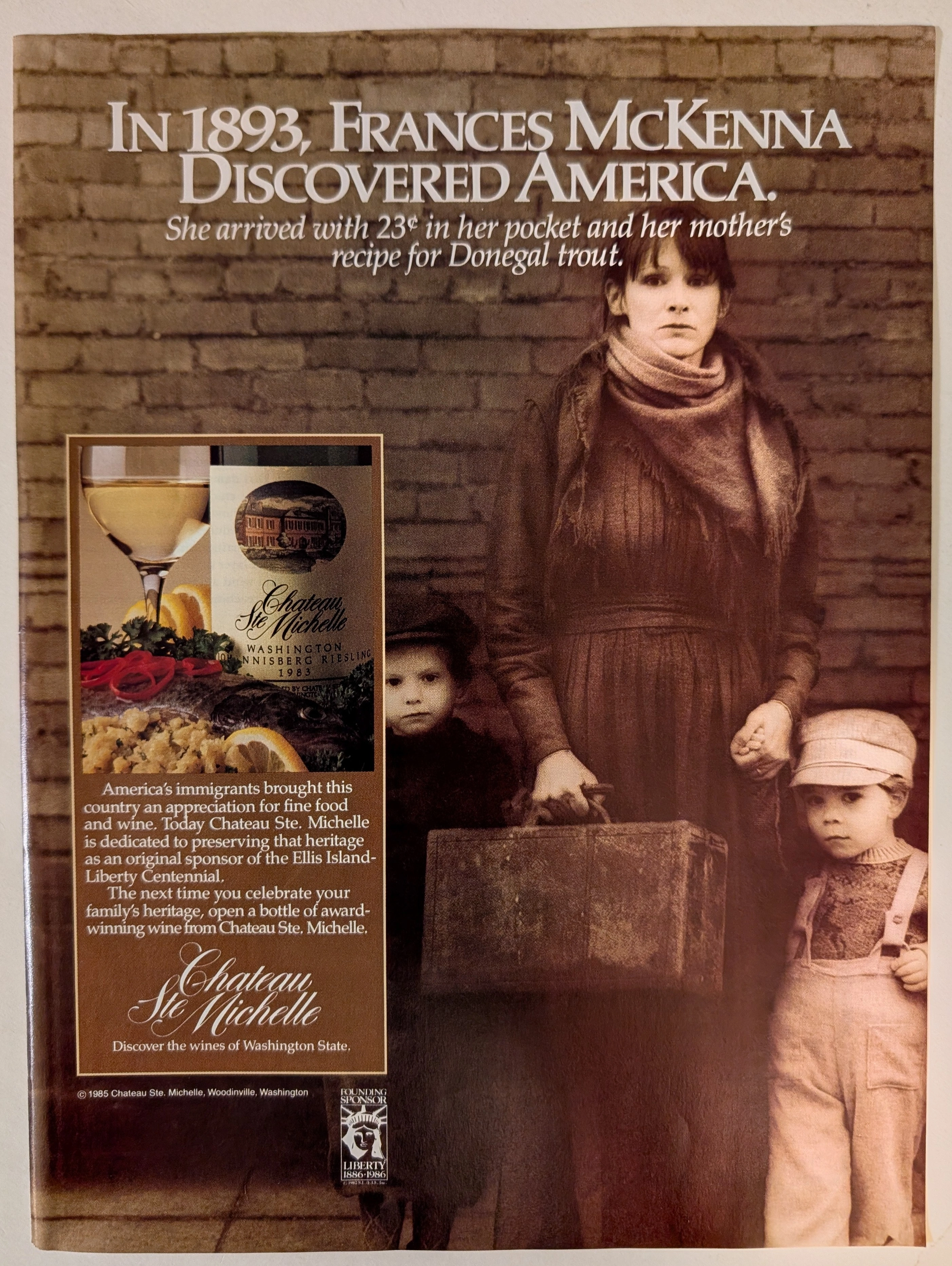
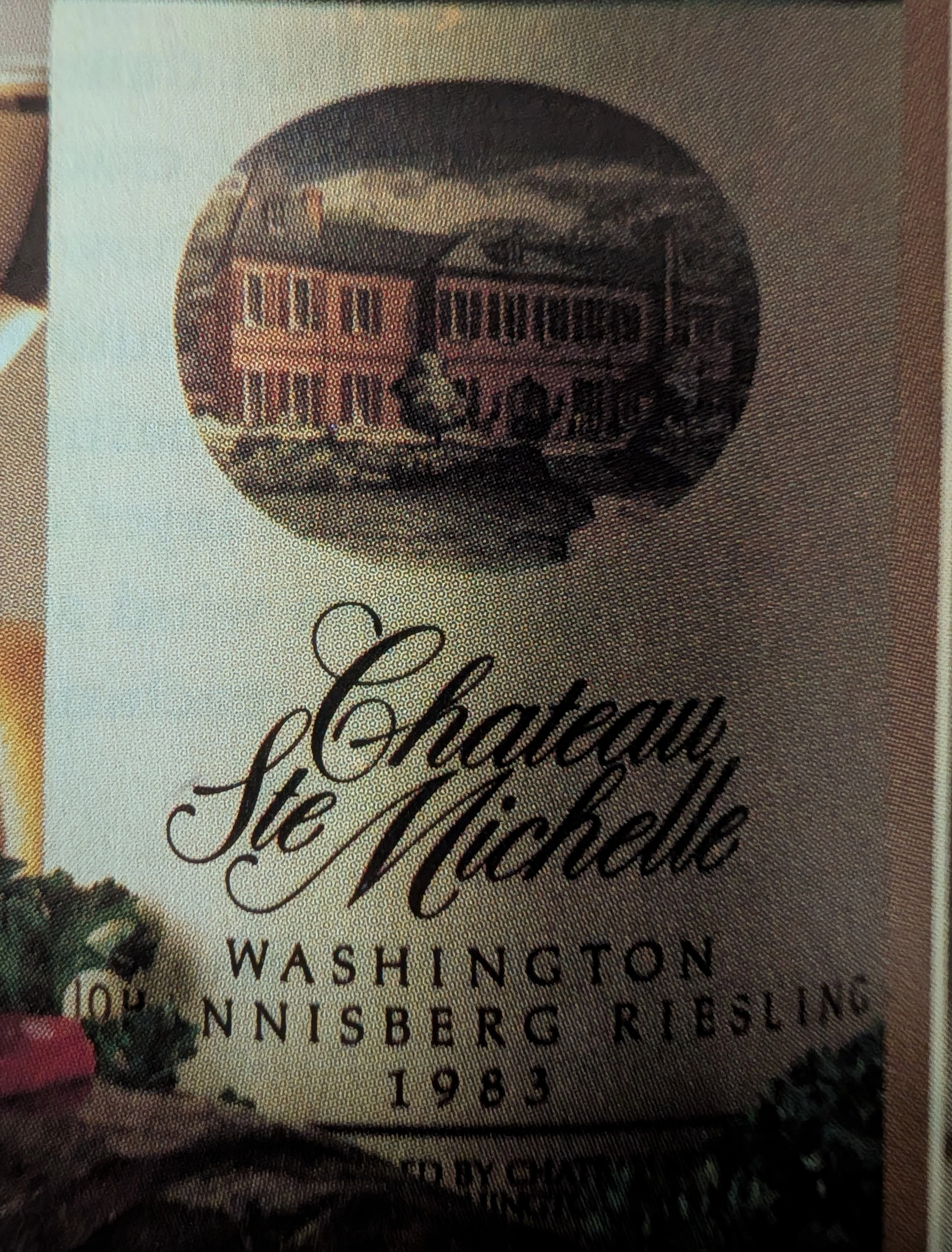
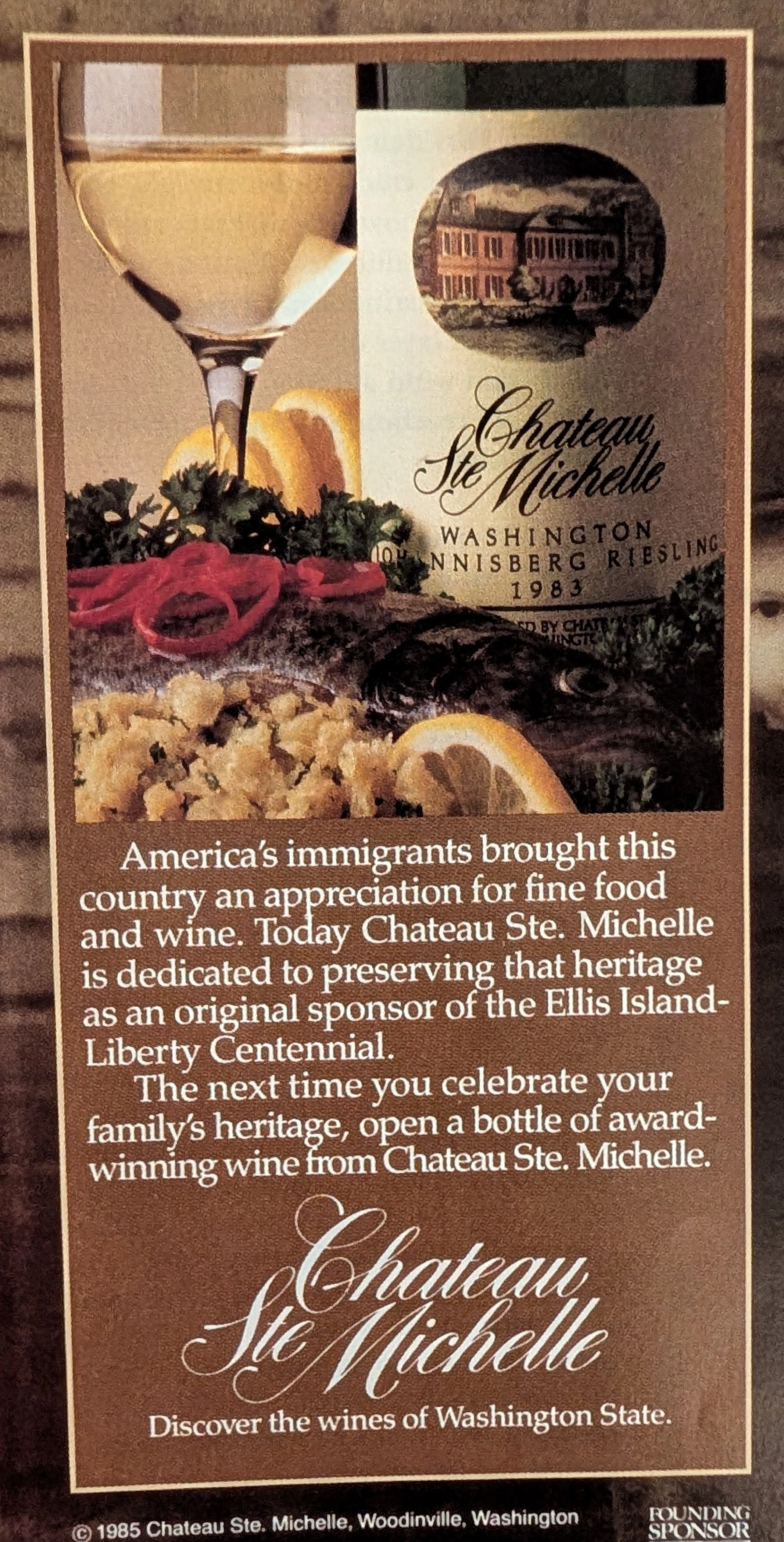
The advertisement introduces us to Frances McKenna, an immigrant arriving from County Donegal, Ireland, in 1893 with merely "23¢ in her pocket" and a mother's recipe. This specific, localized storytelling transforms an abstract historical event into an intimate familial legacy. The brand masterfully posits that the sophistication of "fine food and wine" in modern America is not a recent, elitist invention, but a direct inheritance from the diverse working-class immigrants who brought their culinary traditions across the Atlantic. By positioning a 1983 Johannisberg Riesling—a grape of noble German heritage—alongside an Irish trout recipe, the winery acts as the modern custodian of these intertwined European legacies. As a "Founding Sponsor," Chateau Ste. Michelle successfully minted cultural capital, presenting their vintage not just as a beverage, but as a celebratory toast to American resilience and heritage.
The Paper
Examined under archival conditions, the physical substrate of this piece is representative of premium periodical publishing in the mid-1980s. Printed on what is likely a 60lb to 70lb coated gloss text stock, the paper was engineered to hold ink sharply and reflect light, giving vibrancy to the photography.
The printing process utilized standard CMYK (Cyan, Magenta, Yellow, and Key/Black) offset lithography. The technological achievement of this specific page lies in the careful calibration of halftone screens required to reproduce two starkly different visual aesthetics on a single plane. The background photograph is printed in a rich, duotone-like sepia, requiring careful balance of the magenta, yellow, and black plates to achieve a warm, historical tonality without muddying the shadows. In stark contrast, the inset product photograph relies on the full spectrum of the four-color process to render the bright, appetizing yellows of the lemon garnish, the crisp transparency of the white wine, and the cool greens of the parsley.
Over the decades, magazine ephemera of this type is subject to specific aging mechanisms. Depending on the archival storage environment, the slight presence of lignin in the paper pulp may lead to marginal oxidation (yellowing) along the exposed edges. Furthermore, the gloss coating can be susceptible to micro-abrasions or "bricking" (sticking to adjacent pages) if stored in high humidity. However, the density of the black ink in the lower half of the page has generally preserved the crispness of the white serif typography.
The Rarity
While late-20th-century magazine advertisements were printed in the millions, their survival rate in pristine, archive-ready condition is surprisingly low. Ephemera is, by definition, meant to be discarded. This specific 1985 Chateau Ste. Michelle advertisement occupies a unique nexus of collectability that elevates its rarity beyond standard beverage marketing.
Firstly, it is sought after by oenophiles and archivists of the Pacific Northwest wine industry, documenting a critical era when Washington State asserted its premium status. Secondly, it holds significant cross-over appeal for collectors of Americana and Statue of Liberty centennial memorabilia. The inclusion of the official "Liberty 1886-1986" founding sponsor logo adds an official historical hallmark to the piece.
In the current archival market, finding this advertisement without spine-edge tearing (from being removed from a bound magazine), moisture damage, or significant UV fading on the colored inset is uncommon. Its value is anchored in its thematic depth—serving simultaneously as a document of wine history, corporate philanthropy, and national heritage.
Visual Impact
The visual architecture of this advertisement is a study in calculated juxtaposition, designed to evoke an immediate emotional response before the copy is even read.
Composition and Art Direction:
The layout is dominated by a sweeping, monochromatic background image of an immigrant mother and her two children. The staging and wardrobe evoke the raw, documentary style of early 20th-century photographers like Lewis Hine or the later Depression-era work of Dorothea Lange. The subjects stare directly into the lens with a stoic, unsmiling dignity, anchoring the piece in the heavy reality of the immigrant struggle.
Superimposed onto the left-center of this austere background is a beautifully lit, full-color inset box. This "window" showcases the resulting American prosperity: an elegant glass of white wine, a beautifully plated Donegal trout, and the Chateau Ste. Michelle bottle. The visual hierarchy tells the story of the "American Dream" purely through imagery—from the dusty, sepia-toned struggles of the past to the vibrant, refined bounty of the present.
Typography:
The typographic choices reinforce this dual narrative. The headline ("IN 1893, FRANCES MCKENNA DISCOVERED AMERICA.") is set in a classic, authoritative Roman serif, imparting the gravitas of a historical plaque or textbook. The transition to the brand's signature flowing script logo softens the institutional feel, adding a touch of European elegance and artisanal craftsmanship. The white text against the dark, textured background ensures high legibility while maintaining the somber, museum-like quality of the overall composition.
Exhibition Halls
The Archive Continues
Continue the Exploration
Ford · Automotive
The Time Traveller's Dossier: The Competitive Edge – The 1968 Mercury Lineup and the Architecture of American Automotive Prestige
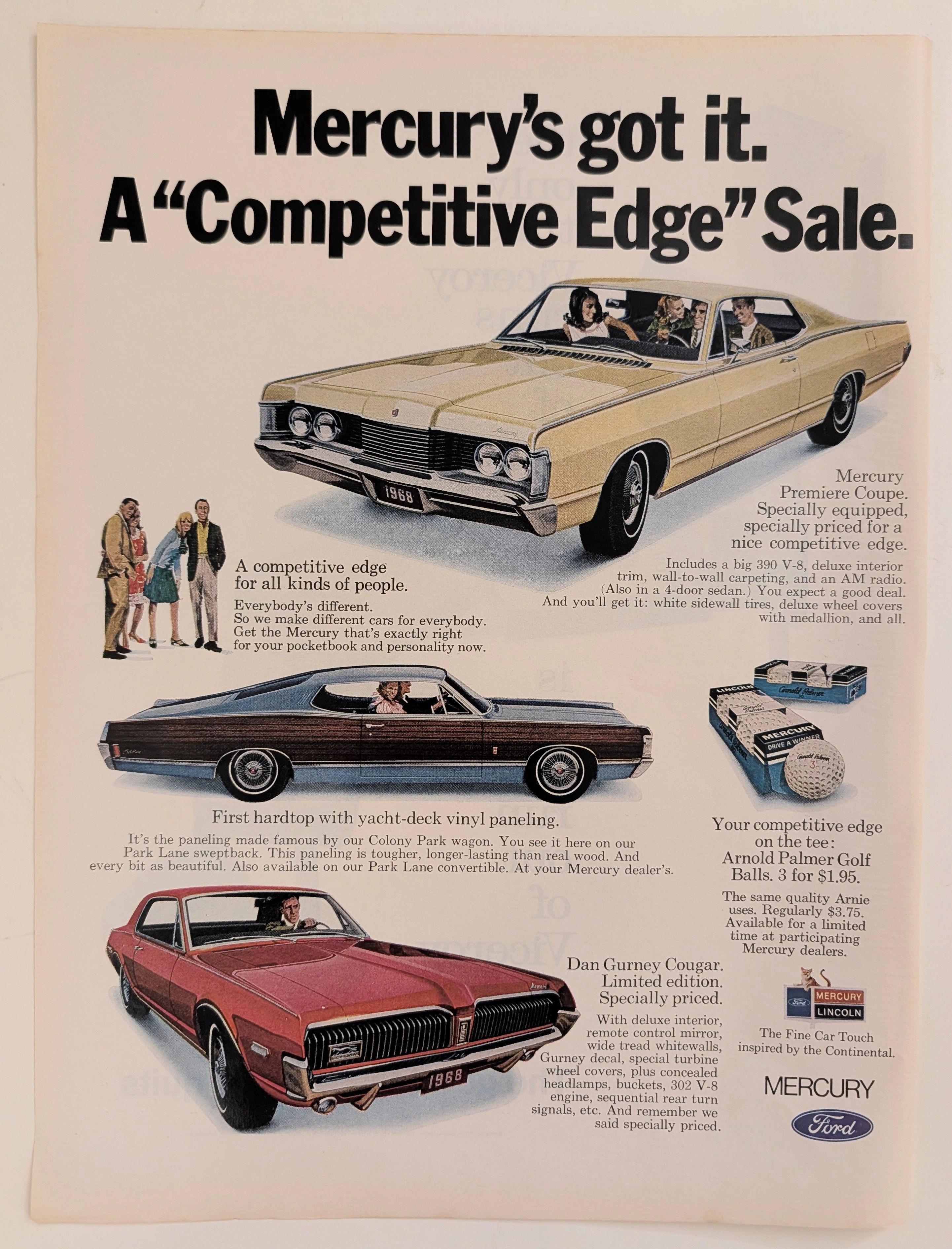
The evolution of the American automotive market in the late 1960s was characterized by a fierce, uncompromising battle for the expanding, affluent middle class. Automakers were no longer simply selling transportation; they were engineering complex lifestyle avatars. The historical artifact elegantly secured upon the analytical table of The Record Institute today is a striking, full-page print advertisement for the 1968 Mercury "Competitive Edge" Sale. This document completely transcends the standard boundaries of automotive marketing. It operates as a highly sophisticated, multi-layered cultural mirror, reflecting the precise era when the Lincoln-Mercury division sought to simultaneously capture the raw, adrenaline-fueled youth market and the established, affluent golfing demographic within a single, unified corporate narrative. This world-class, comprehensive dossier conducts a meticulous, unyielding, and exceptionally exhaustive examination of the artifact, operating under the absolute most rigorous parameters of historical, sociological, and material science evaluation. Dedicating the overwhelming majority of our analytical focus to its immense historical gravity, we will decode the brilliant marketing psychology embedded within the "Competitive Edge" campaign, analyze the profound cultural importance of legendary figures Dan Gurney and Arnold Palmer, and dissect the visual semiotics of the "Sign of the Cat" branding. Furthermore, as we venture deeply into the chemical and physical foundations of this analog printed ephemera, we will reveal the precise mechanical fingerprints of the CMYK halftone rosettes captured in the macro imagery of the vehicles and golf balls. Finally, we will assess its archival rarity, exploring how the graceful, natural oxidation of the paper substrate cultivates a serene wabi-sabi aesthetic—a natural, irreversible phenomenon that serves as the primary engine driving up its market value exponentially within the elite global spheres of Vintage Commercial Ephemera and Automotive Archives.
Saab · Automotive
The Time Traveller's Dossier: Aeronautical Architecture on the Asphalt – The SAAB 96 V4 and the Engineering of Adverse Weather Superiority
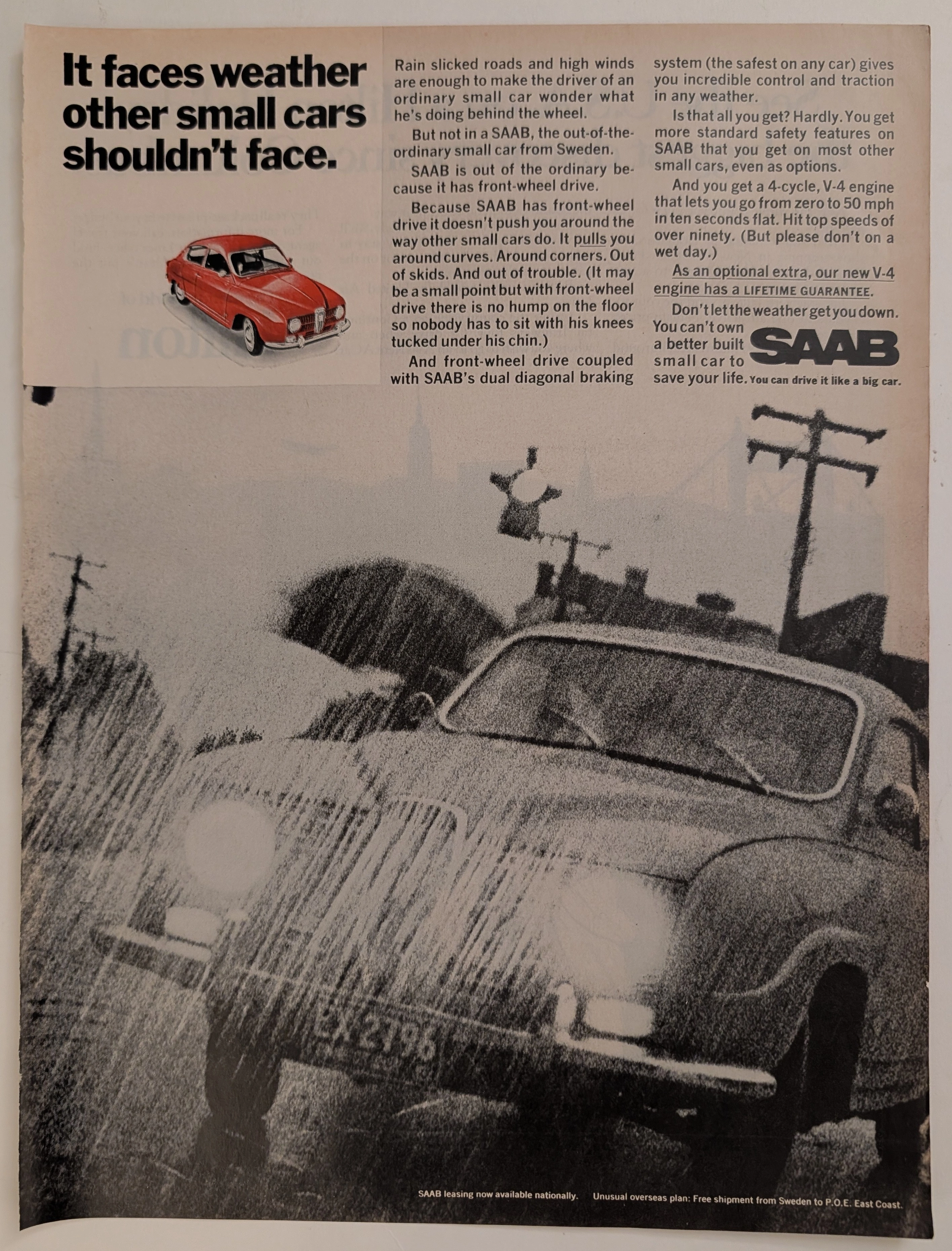
The evolution of the mid-twentieth-century American automotive landscape was heavily disrupted by the influx of European imports, each vying to dismantle the hegemony of the domestic V8, rear-wheel-drive giants. Elegantly and securely positioned upon the analytical table of The Record Institute today is a visually striking, narrative-driven full-page print advertisement for the SAAB Automobile (featuring the new V-4 engine), definitively dating to the late 1960s. This document transcends the standard, utilitarian boundaries of automotive marketing. It operates as a highly sophisticated, multi-layered cultural mirror, reflecting a precise era in consumer psychology where the anxiety of driving in severe weather was aggressively mitigated through the promise of superior, aircraft-inspired engineering. By utilizing a dramatic, heavily grained monochromatic photograph of a SAAB battling torrential rain, juxtaposed with a pristine, spot-color red illustration of the vehicle, the manufacturer successfully positioned itself not merely as a car company, but as a purveyor of meteorological invincibility. This world-class, comprehensive dossier conducts a meticulous, unyielding, and exceptionally exhaustive examination of the artifact, operating under the absolute most rigorous parameters of historical, sociological, and material science evaluation. Dedicating the overwhelming majority of our analytical focus (80%) to its immense historical gravity, we will decode the brilliant marketing psychology embedded within the "front-wheel drive" narrative, analyze the profound engineering pivot of the "new V-4 engine," and dissect the sociopolitical genius of marketing safety before it was federally mandated. Furthermore, as we venture deeply into the chemical and physical foundations of this analog printed ephemera (10%), we will reveal the precise mechanical fingerprints of the spot-color halftones captured in the macro imagery of the red SAAB illustration. Finally, we will assess its archival rarity (10%), exploring how the graceful, natural oxidation of the paper substrate cultives a serene wabi-sabi aesthetic—a natural, irreversible phenomenon that serves as the primary engine driving up its market value exponentially within the elite global spheres of Vintage Commercial Ephemera and Automotive Archives.
Drambuie · Beverage
The Time Traveller's Dossier: The Alchemy of Royal Rebellion – Drambuie "Bonnie Prince Charlie" Advertisement (Circa Mid-20th Century)
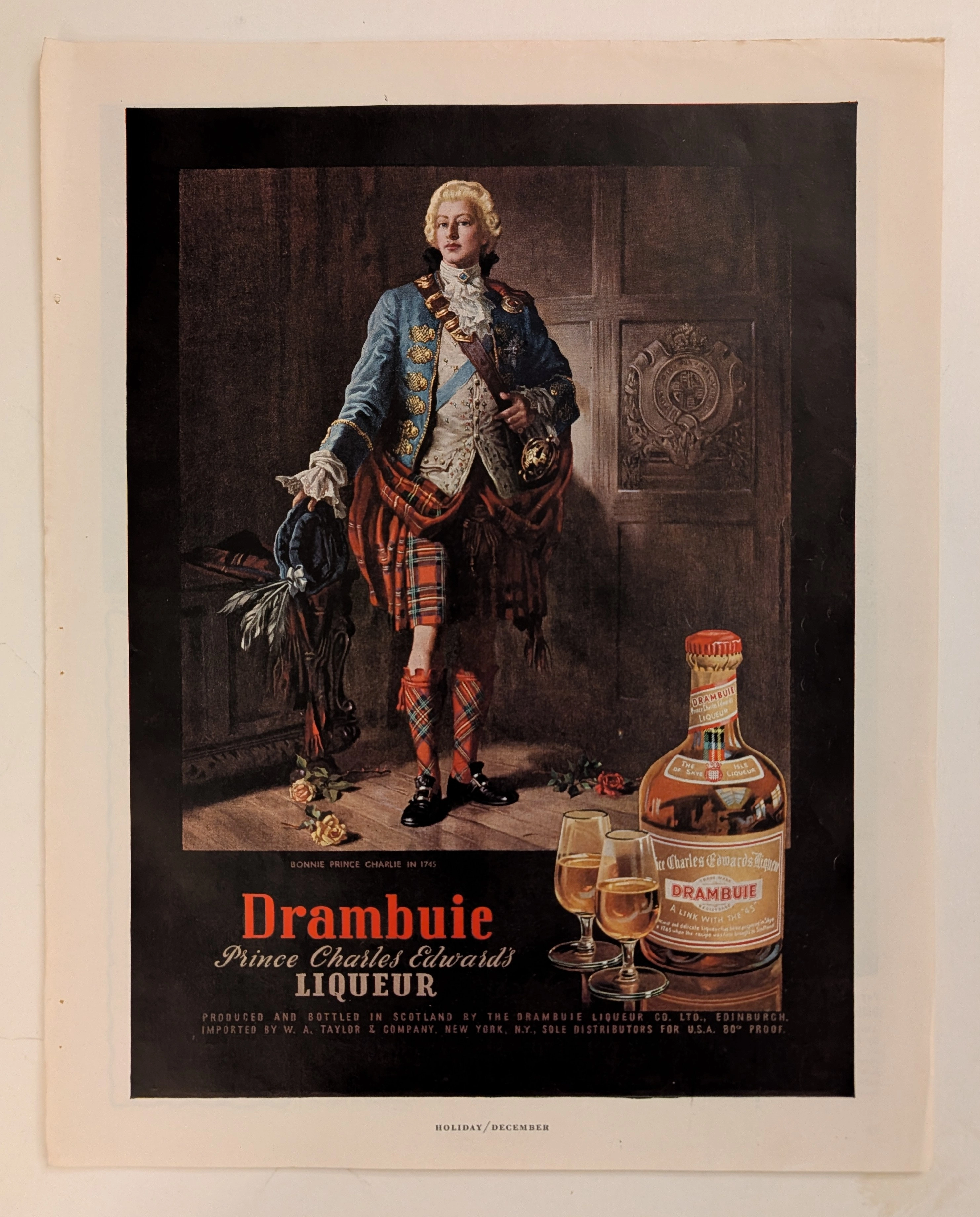
History is rarely an objective chronicle of facts; it is a malleable narrative, continually rewritten, romanticized, and ultimately weaponized by those seeking to legitimize their power or, in the modern era, their products. Long before digital algorithms could synthesize artificial heritage, the supreme manifestation of corporate alchemy was executed through the calculated precision of the four-color offset press and the appropriation of historical iconography. The artifact presented before us is not merely a vintage magazine tear sheet selling a Scottish liqueur. It is a masterclass in the commodification of myth, a visual distillation of romantic rebellion, and a foundational blueprint for what is now known as "Heritage Branding." This museum-grade, academic archival dossier presents an exhaustive, microscopic deconstruction of a mid-20th-century print advertisement for Drambuie Liqueur. Operating on a profound binary structure, this document records a calculated paradigm shift within the global spirits industry. It captures the precise historical fracture where a highly specific, geographically isolated alcoholic beverage was conceptually transmuted into a literal draught of royal rebellion and aristocratic romance. Through the highly specialized lens of late-analog commercial artistry and stringent visual forensics, this document serves as a masterclass in psychological marketing. It established the foundational archetype for linking the consumption of a physical product with the ingestion of an epic, historical fantasy—an archetype that unconditionally dictates the visual and strategic totems of the modern luxury spirits industry today.